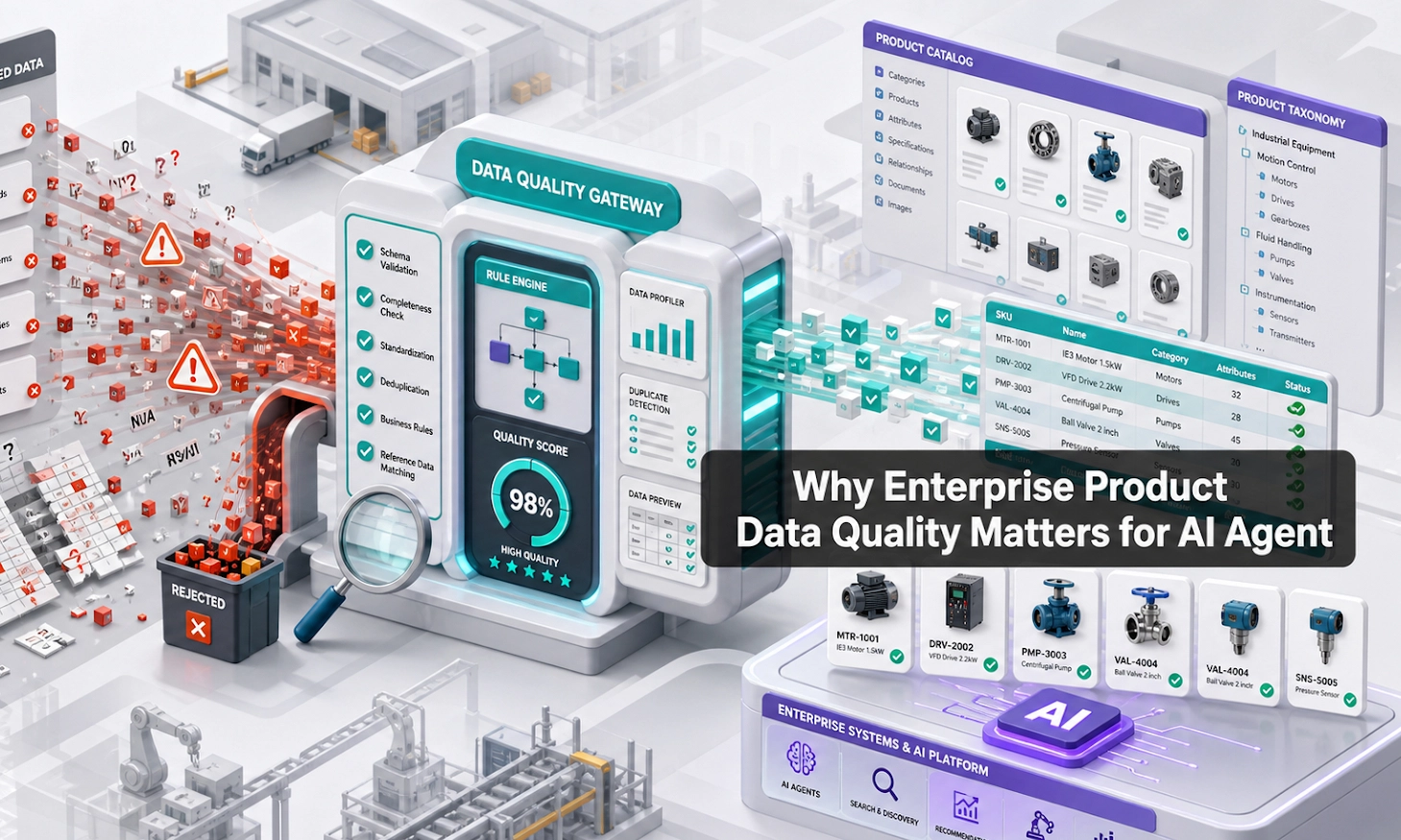
Product data quality is one of the most important foundations of an enterprise-ready AI Agent.
Antbuildz AI Agent uses your product data to answer customer questions, explain specifications, guide product selection, ask follow-up questions, support rental and sales workflows, and prepare enquiries for your sales team. If the product data is incomplete, outdated, inconsistent, or inaccurate, the AI Agent may give weak, generic, or wrong responses.
For industrial B2B businesses, product data quality is not a small admin task. It is an enterprise-level requirement. A serious AI Agent needs accurate product names, correct specifications, clear categories, updated rental and sales status, approved pricing guidance, proper availability notes, compatibility data, product limitations, and enquiry rules.
In simple terms: high-quality data creates a useful AI Agent. Poor-quality data creates poor AI responses.
Introduction
Before launching an AI Agent, many businesses think they can simply upload a catalogue, PDF, spreadsheet, or website link and let the AI handle everything. This may be enough for a very basic starting point, but it is not enough if you want your AI Agent to support real customer enquiries properly.
Antbuildz AI Agent depends heavily on the quality of the product data behind it. Product data helps the AI Agent understand what your business offers, how each product should be explained, what specifications matter, whether the product is available for rental, sales, or both, and what information should be collected before quotation or handover.
This is especially important for industrial B2B businesses. Customers often do not ask perfect questions. They may not know the exact product name, model, capacity, size, specification, or category. They may only describe the job they need to solve.
For example, a customer may say, “I need something to lift materials in a narrow indoor area.” To answer well, the AI Agent needs more than product names. It needs product categories, specifications, use cases, suitability notes, limitations, rental or sales rules, location coverage, and follow-up questions.
Good product data helps the AI Agent guide the customer. Poor product data forces the AI Agent to guess, answer generally, or hand over too early.
Enterprise-Level AI Requires Enterprise-Level Data Quality
An AI Agent is not just reading your product catalogue. It is using your product data to represent your business in front of customers. That makes data accuracy and data quality extremely important.
If a product specification is wrong, the AI Agent may explain the product wrongly. If rental or sales status is unclear, it may ask the wrong questions. If availability data is outdated, it may create wrong customer expectations. If compatibility information is missing, it may need to avoid answering or hand over more often. If product categories are messy, the AI Agent may struggle to understand customer intent.
This is why product data quality must be treated as an enterprise-level discipline. Enterprise-level does not mean only large corporations need it. It means the data must be accurate, structured, consistent, updated, and controlled enough for customer-facing AI use.
The goal is not to upload as much data as possible. The goal is to provide reliable data that the AI Agent can safely use to answer, guide, qualify, and hand over enquiries properly.
For industrial B2B businesses, product data is no longer just catalogue content. It is AI sales infrastructure.
Why Poor Product Data Weakens Your AI Agent
Poor product data does not only affect your product pages. It directly affects how useful your AI Agent becomes.
If your product names are inconsistent, the AI Agent may not know whether two names refer to the same product. If your specifications are missing, the AI Agent cannot explain product suitability properly. If your rental and sales status is unclear, the AI Agent may ask the wrong workflow questions. If your pricing notes are outdated, the AI Agent may create wrong customer expectations. If your product limitations are not documented, the AI Agent may guide customers toward unsuitable options.
This creates a poor customer experience. Customers may receive answers that sound polite but do not help them move forward. Your sales team may receive enquiries that are incomplete. Your marketing campaigns may bring traffic, but visitors may still fail to understand which product fits their need.
Good AI does not fix bad product data automatically. The AI Agent can only work well when the business gives it reliable, structured, and updated product information.
Minimum Product Data Standard Before Launching Your AI Agent
Before launching your AI Agent, every key product should meet a minimum product data standard. This is especially important for your high-demand, high-value, or frequently enquired products.
At minimum, prepare the following:
Product name
Product category
Brand and model, if available
Product photo
Short product description
Key specifications
Rental or sales status
Common use cases
Important limitations
Location or availability note
Pricing guidance, if approved
Required enquiry questions
This minimum standard helps the AI Agent understand what the product is, when it is suitable, what customers should confirm, and how the enquiry should move forward.
For example, if the product is a forklift, the AI Agent should not only know “forklift.” It should know the capacity, power type, lifting height, indoor or outdoor suitability, rental or sales availability, location coverage, and what questions should be asked before quotation.
Without this minimum data standard, the AI Agent may still answer, but it may not answer well enough for real sales use.
Weak Product Data vs Strong Product Data
Many businesses already have product information, but the quality may not be good enough for AI.
A weak product entry may look like this:
“3 Ton Forklift for rental.”
This tells the AI Agent very little. It does not explain the product use case, suitable application, key specification, rental requirement, location factor, or what information should be collected from the customer.
A stronger product entry would be:
“3 Ton Diesel Forklift suitable for outdoor material handling, warehouse loading, construction site movement, and pallet handling. Customers should confirm lifting capacity, lifting height, site condition, rental duration, project location, required start date, and delivery requirement before quotation.”
This version is much more useful because it gives the AI Agent context. It helps the AI Agent explain the product better, ask the right follow-up questions, and prepare a more complete enquiry for the sales team.
This is the standard subscribers should aim for.
1. Use Accurate Product Names and Clear Categories
The first step is to make product names and categories clear.
Industrial B2B businesses often have the same product written in different ways across catalogues, spreadsheets, websites, and internal files. One document may say “Electric Forklift 3 Ton,” another may say “3T Battery Forklift,” and another may say “Lithium Forklift 3000kg.” Your sales team may understand these differences, but customers and AI may not.
Product names should be consistent and easy to understand. Categories should also be structured properly. Forklifts, scissor lifts, boom lifts, generators, compressors, batteries, tyres, spare parts, tools, and accessories should not be mixed randomly.
Clear categories help the AI Agent understand what type of enquiry it is handling. A forklift enquiry needs different follow-up questions from a generator enquiry. A spare parts enquiry needs different information from a rental enquiry. Good category structure helps the AI Agent choose the right conversation path.
2. Standardise Key Specifications
Specifications are one of the most important parts of industrial product data. Customers may ask about capacity, working height, lifting height, dimensions, fuel type, power type, voltage, load limit, tyre type, platform size, or indoor and outdoor suitability.
The problem is that specifications are often inconsistent. One scissor lift may show “working height,” another may show “platform height,” and another may only show “height.” One generator may show kVA, another may show kW, and another may have missing power information.
To improve AI Agent performance, similar products should use similar specification fields and units.
For forklifts, useful fields may include rated capacity, lifting height, load centre, power type, tyre type, mast type, turning radius, and indoor or outdoor suitability. For scissor lifts, useful fields may include working height, platform height, platform capacity, machine width, power type, ground condition, and indoor or outdoor suitability. For generators, useful fields may include power output, fuel type, voltage, phase, noise level, fuel consumption, and application.
When specifications are standardised, the AI Agent can explain products more clearly and ask better follow-up questions.
3. Write Product Descriptions That Help Sales
A product description should not only describe the product. It should help the customer understand whether the product may be suitable.
A weak description only states what the product is. A strong description explains what the product is commonly used for, what conditions it is suitable for, and what information the customer should confirm before enquiry.
For example, instead of writing “Scissor lift available for rental,” write something more useful:
“Electric scissor lift suitable for indoor maintenance, ceiling work, facility management, and warehouse access. Customers should confirm required working height, floor condition, indoor or outdoor usage, rental duration, project location, and delivery requirement before quotation.”
This kind of description helps the AI Agent respond more like a sales assistant, not just a product database.
4. Add Use Cases and Suitability Notes
Customers often describe their problem instead of naming a product. They may say they need to work at height, move pallets, lift heavy materials, clean a factory floor, prepare backup power, or replace a machine part.
If your product data only contains technical specifications, the AI Agent may struggle to connect customer needs to suitable products. That is why use cases and suitability notes are important.
For each major product category, prepare common applications, suitable industries, indoor or outdoor usage, site condition requirements, short-term or long-term suitability, common customer problems, product limitations, and possible alternatives.
For example, a generator product may include use cases such as construction site power, event backup power, temporary factory power, emergency backup, or remote site usage. A forklift product may include warehouse loading, pallet movement, container stuffing, factory logistics, or construction site material handling.
This helps the AI Agent move from simple keyword matching to better requirement-based guidance.
5. Separate Rental and Sales Status Clearly
Rental and sales should not be mixed together without clear rules.
Many industrial B2B businesses support both rental and sales, but not every product is available for both. Some products may be rental-only, some may be sales-only, some may be new units, some may be used units, and some may require quotation confirmation.
The AI Agent needs to know this clearly because rental and sales require different workflows.
For rental enquiries, the AI Agent should usually ask about rental duration, start date, project location, delivery requirement, site condition, usage purpose, and required capacity. For sales enquiries, it should usually ask about product model, quantity, budget range, buying timeline, delivery location, new or used preference, and technical requirement.
If rental and sales status is unclear, the AI Agent may ask the wrong questions and create weak enquiries. Clear rental and sales data helps the AI Agent guide customers properly based on their actual intent.
6. Provide Pricing Guidance Carefully
Pricing is one of the most sensitive areas in product data.
Some products may have fixed rental rates or listed sales prices. Others may depend on duration, location, delivery, quantity, availability, customer type, project size, or sales approval. Before allowing the AI Agent to discuss pricing, subscribers should define what pricing information is approved and what must be handled by the sales team.
The AI Agent may be allowed to explain pricing factors, show approved listed prices, or collect details required for quotation. It should not invent prices, offer unapproved discounts, change payment terms, or confirm final quotation without approval.
A useful pricing rule may say:
“Rental pricing depends on product type, rental duration, project location, delivery requirement, required date, and availability. The AI Agent should collect these details and prepare the enquiry for quotation follow-up.”
This keeps the conversation useful without creating pricing risk.
7. Keep Availability, Location, and Inventory Notes Updated
Availability and location are important for industrial B2B sales, especially rental.
A product may be available in one location but not another. Delivery may depend on distance, site access, product size, transport schedule, and rental duration. Some products may require manual confirmation before the business can commit.
If your business has reliable inventory or availability data, keep it updated. If final availability still requires human confirmation, make that clear in the product data and business rules.
The AI Agent should not say “available” if the data is not reliable. A better response is to collect the customer’s location, required date, rental duration, quantity, and product requirement, then prepare the enquiry for confirmation.
Good availability data helps the AI Agent be helpful without overpromising.
8. Include Compatibility, Alternatives, and Limitations
Good product data should explain not only what a product can do, but also when it may not be suitable.
This is especially important for spare parts, accessories, batteries, tyres, attachments, and technical products. Compatibility may depend on brand, model, serial number, part number, size, year, or photos.
If compatibility data is not clear, the AI Agent should not guess. It should collect the required details and hand over for review.
Subscribers should also include alternatives where possible. If one product is unsuitable, the AI Agent can guide the customer toward another category or ask follow-up questions before suggesting options.
Limitations are equally important. If a product is not suitable for indoor use, uneven ground, heavy-duty applications, certain load conditions, or specific environments, this should be documented. Clear limitations help reduce wrong recommendations and protect customer trust.
9. Add Photos, Product URLs, and Supporting Documents
Product data is not only text. Photos, product pages, product URLs, brochures, manuals, specification sheets, and supporting documents all help customers understand products better.
This is where Antbuildz Webstore becomes important. Webstore product pages give each product a structured digital destination. The AI Agent can guide customers to the right product page, explain the information, and help them submit a clearer enquiry.
For industrial B2B customers, visual confirmation matters. Many buyers want to see the equipment, machine, attachment, spare part, or product condition before enquiring.
Good photos and product pages make the AI Agent more useful because the conversation is connected to real product context, not just text.
Product Data Quality Checklist
Use this checklist to prepare AI-ready product data. Start with your most important products first.
| Data Area | What to Prepare |
|---|---|
| Product Identity | Product name, category, brand, model, product type |
| Product Description | What it is, common use, suitable applications, key notes |
| Specifications | Capacity, height, dimensions, power, fuel, voltage, load, size |
| Photos and Documents | Product photos, brochures, manuals, specification sheets |
| Rental / Sales Status | Rental only, sales only, both, new, used, quotation-based |
| Use Cases | Common applications, industries, site conditions, customer needs |
| Limitations | Unsuitable use cases, safety boundaries, cases needing review |
| Pricing Guidance | Listed prices, pricing factors, quotation rules, discount boundaries |
| Availability / Location | Branch, service area, stock notes, delivery coverage, confirmation rules |
| Compatibility | Related parts, accessories, attachments, compatible models |
| Alternatives | Similar products, higher or lower capacity options, substitute categories |
| Enquiry Questions | What the AI Agent should ask before quotation or handover |
How Antbuildz AI Webstore Helps Product Data Quality
Antbuildz AI Webstore helps turn product information into structured product data. Instead of keeping product details only in PDFs, spreadsheets, or scattered website pages, the Webstore organises products into categories, product pages, descriptions, specifications, photos, rental or sales options, product URLs, FAQs, and enquiry actions.
This structure helps both customers and the AI Agent. Customers can browse and understand products more clearly. The AI Agent can use better product context during conversations. The sales team can receive more complete enquiries because the AI Agent knows what product the customer is asking about and what details should be collected.
A strong AI Webstore is not just a product display. It is the product data foundation for AI-powered sales.
How AI Console Helps Maintain Product Data Quality
Product data quality is not a one-time setup. Products change. New models are added. Old products are removed. Specifications are updated. Pricing rules change. Rental terms change. Service areas change. Customer questions change.
Antbuildz AI Console helps subscribers improve the knowledge behind the AI Agent over time. Subscribers can update knowledge base content, FAQs, agent behaviour, enquiry workflows, lead capture rules, deal intent capture, and handover instructions.
When the AI Agent gives a weak answer, the problem may not be the AI model. It may be missing product data, unclear specifications, outdated FAQs, weak workflow rules, or conflicting information. AI Console gives subscribers a way to fix the source of the problem.
Common Product Data Mistakes to Avoid
One common mistake is uploading old catalogues without checking whether the products, prices, specifications, or availability are still valid. Old information can create wrong customer expectations and weak AI Agent answers.
Another mistake is using inconsistent names and categories. If the same product appears under different names, customers and AI may become confused.
A third mistake is only preparing specifications without use cases. Customers often do not know how to interpret technical numbers, so the AI Agent needs application notes and suitability guidance.
Another common mistake is mixing rental and sales information without clear rules. If the AI Agent does not know whether a product is for rental, sales, or both, it may ask the wrong questions.
The biggest mistake is treating product data as low-level admin work. In an AI-powered sales system, product data is part of your sales infrastructure.
What the AI Agent Should Not Do
Even with strong product data, the AI Agent must stay within approved business rules. Antbuildz AI Agent should not invent product specifications, guess spare part compatibility, confirm final stock unless data is reliable, promise delivery dates without confirmation, approve discounts, change pricing rules, make legal commitments, or provide unsafe technical diagnosis for complex cases.
If product data is missing or unclear, the AI Agent should ask follow-up questions or prepare the enquiry for human review. This protects both the customer and the business.
FAQ
1. Why does product data quality matter for Antbuildz AI Agent?
Product data quality matters because the AI Agent uses product information to answer questions, explain specifications, recommend options, ask follow-up questions, and prepare sales enquiries. Poor data leads to weak, generic, or risky responses.
2. Why is this considered enterprise-level?
Because the AI Agent uses product data to represent your business in front of customers. If the data is wrong, the AI response may be wrong. Enterprise-level means the data must be accurate, structured, consistent, updated, and controlled enough for customer-facing AI use.
3. What product data should I prepare first?
Start with your high-demand, high-value, and frequently enquired products. Prepare product names, categories, descriptions, photos, key specifications, use cases, rental or sales status, pricing guidance, availability notes, and required enquiry questions.
4. Is a product catalogue enough?
A catalogue is a good starting point, but it is not enough by itself. The AI Agent also needs structured specifications, use cases, rental and sales rules, pricing guidance, availability notes, compatibility information, FAQs, and enquiry workflows.
5. Should I include pricing?
Yes, if the pricing is approved and clear. If final pricing depends on duration, location, delivery, quantity, availability, or sales approval, the AI Agent should explain the pricing factors and collect details for quotation follow-up.
6. Should I include product limitations?
Yes. Limitations are very important because they help the AI Agent avoid recommending unsuitable products and protect the business from wrong expectations.
7. Should I include product photos?
Yes. Product photos help customers understand and trust the product. They also make Webstore product pages more useful when the AI Agent guides customers during enquiry.
8. How often should product data be updated?
Update product data whenever products, specifications, pricing, rental status, sales status, availability, service areas, or business rules change. Product data should also be reviewed regularly after real customer conversations.
9. Who should own product data quality?
Product data quality should be shared by sales, operations, product, marketing, and management. Sales knows customer questions, operations knows availability and fulfilment, product teams know specifications, marketing manages presentation, and management approves commercial rules.
Conclusion
Product data quality is one of the most important foundations of Antbuildz AI Agent.
The AI Agent can only answer, recommend, qualify, and guide customers based on the quality of the product data behind it. If the data is weak, the AI Agent becomes weak. If the data is accurate, structured, updated, and useful, the AI Agent becomes much more valuable.
For industrial B2B businesses, product data is no longer just catalogue content. It is enterprise-level AI sales infrastructure. The accuracy and quality of your product data directly affect the accuracy and usefulness of your AI Agent.
Good product data helps customers understand products, helps the AI Agent ask better questions, helps sales teams receive stronger enquiries, and helps the business scale with better consistency.
Start with your most important products. Clean the names and categories. Standardise the specifications. Add use cases and limitations. Separate rental and sales rules. Define pricing and availability guidance. Keep everything updated inside Antbuildz Webstore and AI Console.
The better your product data, the better your AI Agent performs.