Many businesses think they need to start from zero before using an AI Agent.
They worry that they need to rewrite every product description, rebuild their catalogue, create a new database, or manually teach the AI every single answer.
The good news is that you usually do not need to start from zero.
Most industrial B2B businesses already have useful knowledge. It may be inside product catalogues, websites, PDFs, Excel sheets, Google Sheets, Word documents, brochures, FAQs, rental terms, pricing files, service policies, agreement documents, or internal SOPs.
Antbuildz AI Agent can use these existing materials as a starting point.
But there is an important difference between “having data” and “having AI-ready knowledge.”
A messy product list may help a little.
A clear Webstore and structured knowledge base help a lot.
This article explains how Antbuildz AI Agent learns from your existing business information, why Webstore data is especially powerful, and what your business should prepare before launching the AI Agent.
The Right Mindset: The AI Agent Needs Business Knowledge, Not Just Files
Uploading files is not the real goal.
The real goal is to give the AI Agent proper business knowledge.
For industrial B2B businesses, customers do not only ask simple questions. They may ask about product suitability, equipment rental, product sales, spare parts, service support, pricing, delivery, availability, technical specifications, agreement terms, or quotation requirements.
To answer properly, the AI Agent needs more than product names.
It needs to understand:
What products you offer
What each product is used for
What specifications matter
Whether the product is for rental, sales, or both
What questions should be asked before quotation
What policies and terms apply
What information should be captured from the customer
When the enquiry should be handed over to your team
That is why business knowledge preparation matters.
Your catalogue, website, PDFs, sheets, and documents are the raw materials.
Antbuildz AI Agent uses those materials to support customer conversations.
A Simple Look at How AI Uses Your Business Knowledge
Modern AI systems can use a method called Retrieval-Augmented Generation, often called RAG. In simple terms, RAG helps a large language model reference information from external knowledge sources before generating an answer. This is why business documents, knowledge bases, and structured product data matter.
The process is easier to understand in four steps.
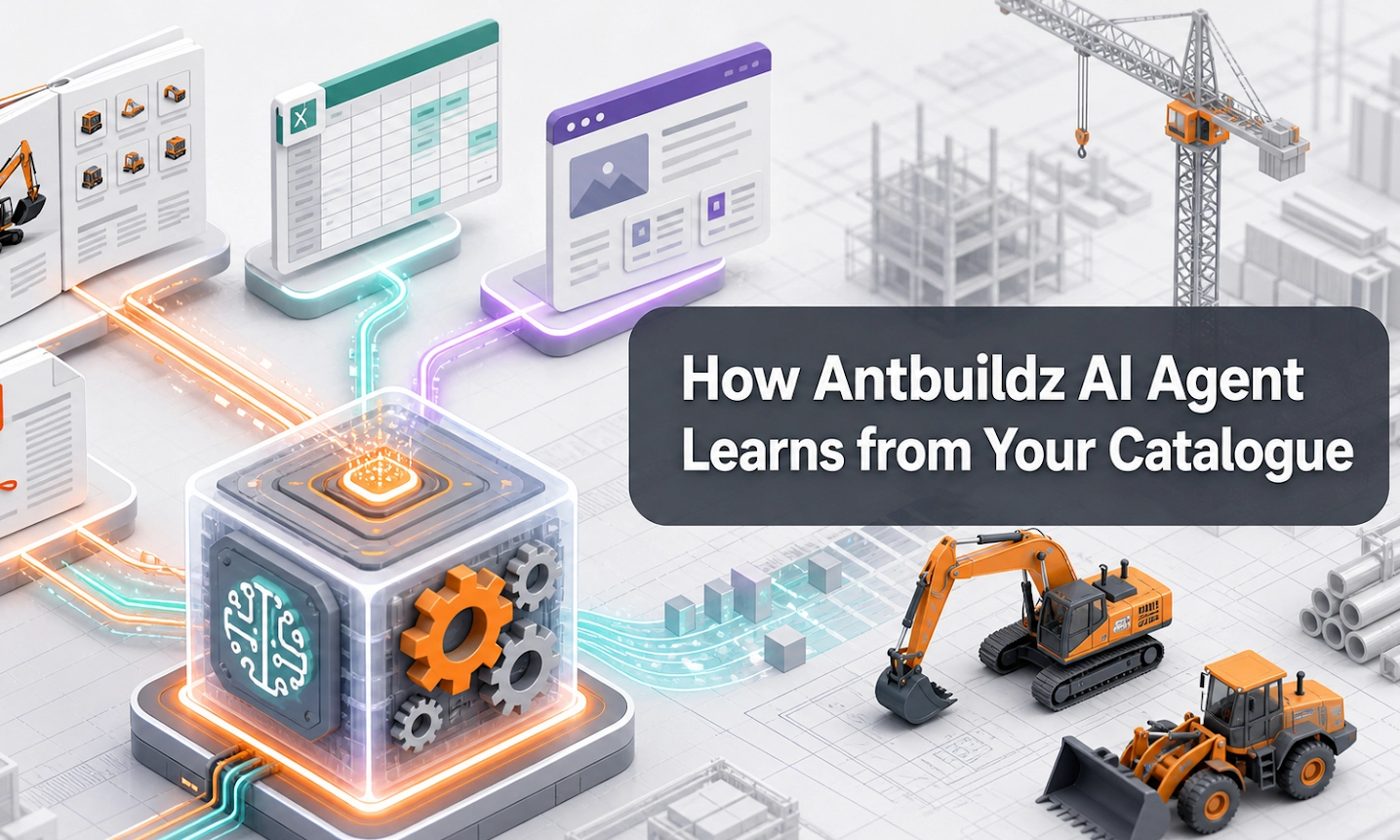
First, your business information is added into the system. This may include Webstore data, catalogue information, website pages, PDFs, spreadsheets, FAQs, agreement terms, and internal documents.
Second, the system organises and indexes the information so relevant content can be searched when a customer asks a question.
Third, when a customer asks something, the AI Agent retrieves relevant information from the available business knowledge.
Fourth, the AI Agent uses the retrieved information, business rules, and enquiry workflow to generate a more useful response.
In simple terms:
The LLM understands the language.
Your business knowledge provides the facts.
The workflow guides what should happen next.
This is what turns a general AI model into a practical business AI Agent.
Source 1: Antbuildz Webstore Data
The most powerful source for Antbuildz AI Agent is structured Webstore data.
A Webstore is not just a product display page. It can become the AI Agent’s product and business data layer.
Antbuildz Webstore can provide structured information such as:
Product categories
Product pages
Product names
Brands and models
Photos
Product descriptions
Specifications
Rental or sales options
Product URLs
Location information
Inventory-related data, depending on setup
Enquiry actions
FAQs
Agreement or policy pages
This is more useful than a simple PDF catalogue because the data is already organised around how customers browse and enquire.
If a visitor is looking at a forklift product page and asks whether it is suitable for indoor warehouse use, the AI Agent can use the Webstore context to ask better follow-up questions about lifting capacity, lifting height, aisle width, power type, rental duration, and location.
This is why Antbuildz AI Agent works especially well with Antbuildz Webstore.
The Webstore gives structure.
The AI Agent uses that structure to guide the conversation.
Source 2: Product Catalogues
Your product catalogue is still important.
It may contain product names, categories, photos, model numbers, specifications, descriptions, and applications.
For many businesses, this is the starting point.
However, product catalogues are often written for people who already understand the product. They may be too technical for first-time buyers, purchasers, or procurement teams. Different brands may also present specifications differently, which makes comparison difficult.
Antbuildz AI Agent can use catalogue information to answer product questions, explain specifications, and guide customers. But the quality depends on how clear and updated the catalogue is.
A good catalogue should include:
Product category
Product name
Model or brand
Photos
Description
Key specifications
Common applications
Rental or sales status
Related products or alternatives
Notes on suitability or limitations
The AI Agent can then use this information to support better product understanding and product recommendation.
Source 3: Website Pages
Your website may contain important business knowledge beyond product listings.
This may include:
About Us information
Service pages
Rental pages
Sales pages
FAQ pages
Blog articles
Case studies
Delivery coverage
Contact details
Company capabilities
Industry experience
Terms and policies
This information helps the AI Agent understand your business more broadly.
For example, if a customer asks whether your business supports a certain region, the AI Agent may refer to your service area information. If a customer asks what your company does, the AI Agent may use your About Us or service pages.
But website pages should be reviewed carefully.
Outdated pages, conflicting descriptions, old pricing, or old service information can confuse the AI Agent. If your website has old information that no longer matches your business, it should be cleaned before it becomes part of the AI knowledge base.
Source 4: PDFs and Brochures
Many industrial B2B businesses still rely heavily on PDFs.
PDFs may contain product catalogues, technical brochures, specification sheets, warranty documents, rental terms, agreement documents, safety guides, or service information.
These documents can be useful for the AI Agent, especially when they contain detailed product or policy information.
But PDFs also have limitations.
Some PDFs are image-based and hard to read. Some are outdated. Some combine too many products in one document. Some use tables or formatting that may not be easy for AI to interpret perfectly. Some contain technical language that customers may not understand.
This does not mean PDFs are useless.
It means PDFs should be treated as a starting point, not the final structure.
Where possible, important product information from PDFs should also be structured into Webstore product pages, FAQs, knowledge base entries, or clear policy documents.
The easier the information is to read and interpret, the better the AI Agent can use it.
Source 5: Spreadsheets and Sheets
Spreadsheets are common in industrial B2B businesses.
They may contain product lists, price lists, rental rates, availability notes, stock information, customer segments, delivery charges, or internal sales rules.
Spreadsheets can be useful because they are structured in rows and columns.
However, they still need clarity.
Useful spreadsheet columns may include:
Product name
Category
Brand
Model
Specification
Rental or sales status
Daily, weekly, or monthly rental rate
Sales price guidance
Availability status
Location
Remarks
Internal notes
Updated date
The problem is that many spreadsheets are messy.
They may use inconsistent column names, missing values, outdated notes, unclear abbreviations, or mixed information in one cell.
Before using spreadsheets for AI Agent knowledge, it is better to clean them.
Clean spreadsheets help the AI Agent understand the information more clearly and reduce the chance of weak answers.
Source 6: Internal Documents and SOPs
Internal documents are often where the most valuable business knowledge lives.
This may include:
Sales SOPs
Enquiry handling process
Rental terms
Sales terms
Agreement rules
Service policies
Warranty rules
Delivery rules
Pricing rules
Handover instructions
Common objections
Customer qualification criteria
These documents help the AI Agent understand how your business operates.
For example, product data tells the AI what you offer. SOPs tell the AI how the enquiry should be handled.
That difference matters.
A customer asking about forklift rental does not only need product information. The AI Agent should also know what details to collect, what terms apply, when sales follow-up is needed, and what it should not promise.
This is why SOPs and internal documents are important for getting the AI Agent ready.
Source 7: FAQs and Common Customer Questions
FAQs are one of the fastest ways to improve AI Agent performance.
Your sales team already knows the questions customers ask repeatedly.
These may include:
Do you sell or rent this product?
What is the minimum rental period?
Do you deliver to my area?
What information do you need for quotation?
Can I extend the rental?
Do you provide warranty?
Do you have spare parts?
Can you recommend an alternative?
Is this suitable for indoor use?
What is the payment process?
These questions should be documented clearly.
FAQs help the AI Agent answer common questions consistently and reduce repetitive sales work.
They also help customers get faster answers without waiting for human follow-up.
What the AI Agent Can Learn From Each Source
| Data Source | What It Helps the AI Agent Understand |
|---|---|
| Webstore data | Product pages, categories, specifications, product URLs, rental or sales options, enquiry actions |
| Product catalogue | Product range, models, descriptions, photos, technical information |
| Website pages | Company profile, services, service areas, FAQs, business credibility |
| PDFs and brochures | Detailed specifications, product details, policies, manuals, agreement terms |
| Spreadsheets | Product lists, pricing guidance, rental rates, availability notes, location data |
| Internal documents | SOPs, business rules, enquiry process, handover instructions |
| FAQs | Common customer questions and approved answers |
The strongest AI Agent usually does not depend on one source only.
It works better when product data, business rules, FAQs, and enquiry workflows are connected properly.
The Difference Between Reading Data and Being Ready
This is important.
Just because the AI Agent can read your documents does not mean it is fully ready for customers.
Reading data is only the first step.
To be customer-ready, the AI Agent also needs:
Clean and updated product information
Clear rental and sales rules
Proper FAQs
Defined enquiry workflows
Clear agent behaviour instructions
Lead capture rules
Deal intent capture logic
Handover instructions
Testing with real customer questions
If these are missing, the AI Agent may still answer, but the answer may be too general or incomplete.
This is why Section 4 is important.
Getting ready is not only about uploading files.
It is about preparing the business knowledge that the AI Agent will use to serve customers properly.
How Antbuildz AI Console Helps
Antbuildz AI Console helps subscribers prepare and improve the AI Agent.
Through AI Console, businesses can manage:
Knowledge base content
FAQs
Agent behaviour
Enquiry workflows
Required questions
Lead capture rules
Deal intent capture
Conversation review
Handover instructions
Weak answers and missing knowledge
This gives businesses more control.
If the AI Agent gives a weak answer, the team can improve the knowledge base.
If customers keep asking a new question, the team can add a new FAQ.
If leads are missing important details, the enquiry workflow can be improved.
This turns AI Agent setup into a continuous improvement process.
What You Should Prepare Before Launching the AI Agent
To get your AI Agent ready, start with the most important information first.
You do not need to prepare everything perfectly on day one.
Start with:
Product catalogue
Top product categories
Main product descriptions
Key specifications
Product photos
Rental or sales status
FAQs
Rental and sales terms
Service areas
Delivery rules
Agreement terms
Required enquiry questions
Lead capture fields
Common customer questions
Handover instructions
After launch, improve deeper areas such as pricing rules, compatibility data, availability logic, spare parts information, service workflows, and detailed comparison notes.
The goal is not perfection before launch.
The goal is to start with useful business knowledge and improve from real customer conversations.
Common Data Problems to Fix First
Before connecting documents to the AI Agent, check for common problems.
1. Outdated Information
Remove old products, old pricing, old agreement terms, outdated service areas, and old policies.
Outdated information can lead to wrong customer expectations.
2. Conflicting Answers
If one document says one thing and another document says something different, the AI Agent may struggle to know which source to follow.
Clean up conflicts before launch.
3. Missing Product Context
Product names and specifications are not enough.
Add use cases, suitable applications, limitations, rental or sales status, and related products where possible.
4. Unclear Abbreviations
Internal abbreviations may make sense to your team but not to customers or AI.
Spell out important terms clearly.
5. No Workflow Instructions
If the AI Agent does not know what information to collect, it may answer the question but fail to qualify the enquiry.
Add clear workflows for rental, sales, spare parts, service, quotation, and technical enquiries.
What the AI Agent Should Not Do
A good AI Agent should stay within approved business knowledge.
Antbuildz AI Agent should not invent product specifications, guess spare part compatibility when data is unclear, confirm final stock unless inventory data is reliable, promise delivery dates without business confirmation, decide special pricing without approved rules, make legal or contractual commitments outside approved terms, or provide unsafe technical diagnosis for complex service cases.
If information is missing or unclear, the AI Agent should ask follow-up questions or prepare the enquiry for human review.
This protects customer trust while still helping the business respond faster and qualify enquiries better.
Example: From Product Catalogue to Customer-Ready AI Agent
Imagine a customer asks:
“I need a forklift for indoor warehouse use. What should I choose?”
If the AI Agent only has a product list, it may give a general answer.
If the AI Agent has structured Webstore data, product specifications, FAQs, and rental or sales workflow, it can ask better questions:
Are you looking to rent or buy?
What lifting capacity do you need?
What lifting height is required?
What is the aisle width?
Is the floor condition suitable?
What is your location?
When do you need it?
How long is the rental duration?
Do you prefer diesel, electric, or lithium?
After collecting the information, the AI Agent can guide the customer toward a more suitable rental or sales enquiry and prepare better context for the sales team.
That is what “getting ready” means.
It is not only about the AI reading files.
It is about the AI having enough business knowledge to ask, guide, qualify, and hand over properly.
FAQ
1. Does Antbuildz AI Agent really learn from my existing documents?
Yes. Antbuildz AI Agent can use your existing business information such as Webstore data, product catalogues, website pages, PDFs, spreadsheets, FAQs, policies, and internal documents.
However, the quality of the answers depends on how accurate, updated, and structured the information is.
2. Do I need to rebuild all my data before using the AI Agent?
No. You usually do not need to start from zero.
Existing files can be used as a starting point. But cleaning and structuring important information will help the AI Agent perform better.
3. Is uploading a PDF enough?
A PDF can help, but it may not be enough by itself.
For better performance, important information should also be organised into Webstore data, FAQs, knowledge base content, and enquiry workflows.
4. Why is Webstore data better than only uploaded documents?
Webstore data is usually more structured.
It can include product pages, categories, specifications, product URLs, rental or sales options, enquiry actions, and customer browsing context.
This gives the AI Agent stronger product and sales context than text-only documents.
5. Can the AI Agent combine information from different sources?
Yes. The AI Agent can use information from different approved sources, such as product data, FAQs, agreement terms, service areas, and enquiry workflows.
However, the sources should be consistent. Conflicting information should be cleaned before launch.
6. Will the AI Agent always give accurate answers if I upload documents?
No. Uploading documents helps, but it does not guarantee perfect answers.
Accuracy depends on data quality, clarity, source consistency, business rules, workflow setup, and ongoing review.
7. How often should I update the knowledge base?
Update it whenever your business information changes.
This includes new products, removed products, pricing changes, rental terms, service areas, policies, FAQs, and customer enquiry patterns.
8. How does AI Console help?
AI Console helps subscribers update knowledge base content, improve FAQs, adjust agent behaviour, configure enquiry workflows, review conversations, and improve lead capture rules.
This helps the AI Agent become more useful over time.
Conclusion
Your existing business information is the starting point for Antbuildz AI Agent.
Your catalogue, website, PDFs, spreadsheets, FAQs, policies, and internal documents can all help the AI Agent understand your business better.
But the goal is not only to upload files.
The goal is to prepare AI-ready business knowledge.
For industrial B2B businesses, that means clear product data, rental and sales rules, service areas, agreement terms, FAQs, enquiry workflows, lead capture rules, and customer-ready answers.
Antbuildz AI Agent becomes more useful when it can use your business knowledge to answer, ask, guide, qualify, and hand over enquiries properly.
The better your knowledge base and Webstore data, the better your AI Agent can support customers.
Ready to get your AI Agent ready? Start by preparing your product catalogue, Webstore data, FAQs, and enquiry workflows inside Antbuildz AI Console.