Most industrial B2B businesses use separate tools for different parts of their digital sales process.
They may have a company website for branding, a PDF catalogue for products, spreadsheets for inventory, WhatsApp for customer enquiries, a marketplace listing for exposure, and maybe a chatbot for basic questions.
Each tool may help a little.
But when these tools are disconnected, gaps appear.
Product information becomes inconsistent.
Customers see one thing on the website and another thing in the catalogue.
Sales teams receive vague enquiries without enough context.
Marketing traffic lands on pages that do not convert.
Chatbots cannot answer properly because they are not connected to real product data.
AI tools become generic because they do not understand the business workflow.
Antbuildz takes a different approach.
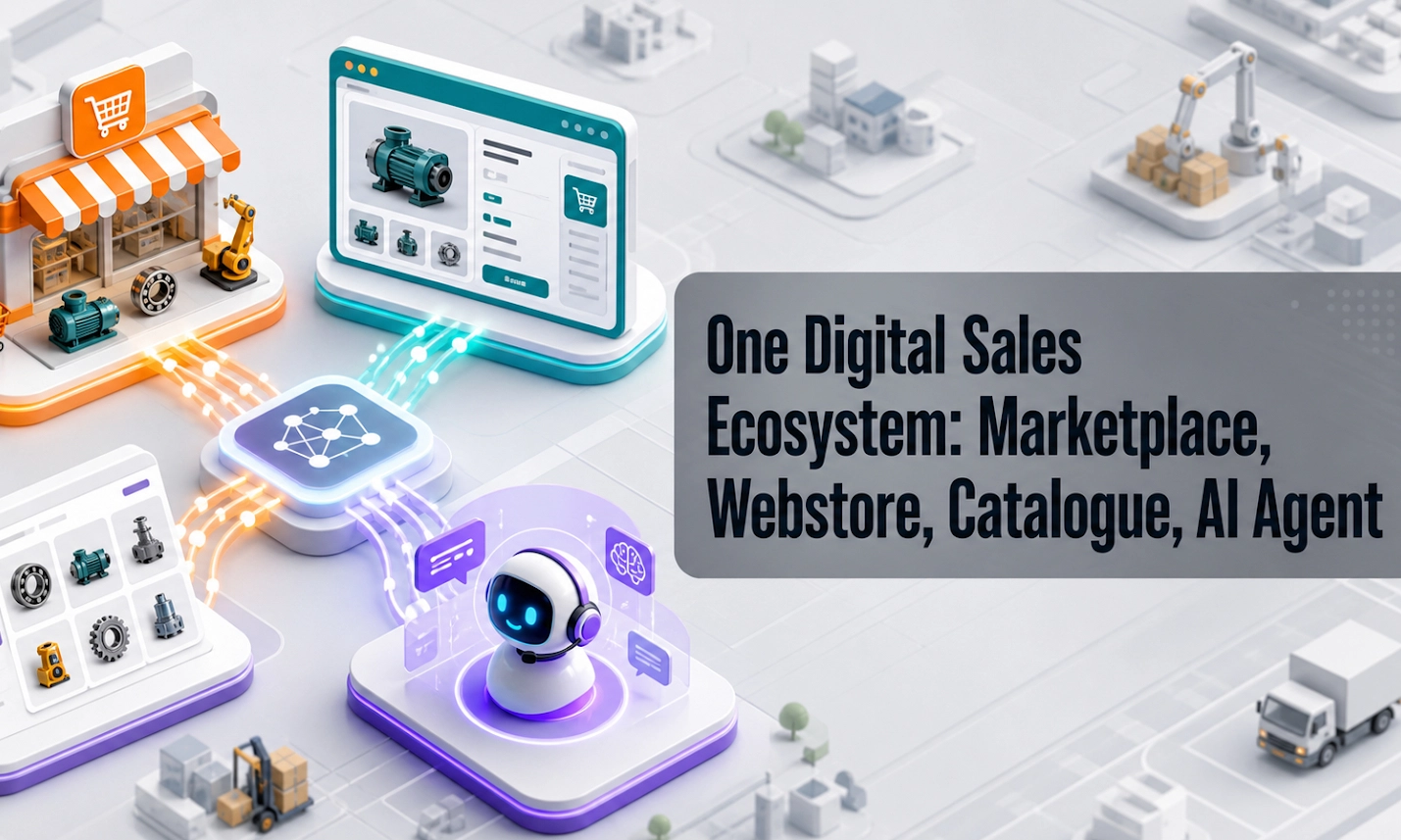
Instead of treating Marketplace, Webstore, Catalogue, and AI Agent as separate tools, Antbuildz connects them into one digital sales ecosystem.
This matters because industrial B2B sales is not a simple online checkout process. Customers may need to discover products, compare options, understand specifications, decide whether to rent or buy, ask about spare parts, check delivery areas, request quotations, or clarify technical requirements.
A disconnected system cannot support that journey properly.
A connected ecosystem can.
The Big Idea: One Ecosystem, Not Four Separate Tools
The strength of Antbuildz is not just that it has a Marketplace, Webstore, Catalogue, and AI Agent.
The strength is that these components are designed to work together.
A normal marketplace may give exposure but not help you own the customer relationship.
A normal website may present your brand but may not structure product data properly.
A normal catalogue may list products but may not guide customers.
A normal AI chatbot may answer questions but may not understand your product structure or sales workflow.
Antbuildz connects these pieces.
The Marketplace creates discovery.
The Webstore creates your branded sales destination.
The Catalogue creates structured product data.
The AI Agent creates guided customer conversations and qualified enquiries.
Together, they help industrial B2B businesses move from scattered digital tools to a more complete sales infrastructure.
Why Industrial B2B Businesses Need This
Industrial B2B sales is more complex than normal e-commerce.
Customers may not know the exact product name. They may not understand the specifications. They may not know whether to rent or buy. They may not know what details are needed before quotation. They may also need help with location, delivery, availability, spare parts, service support, or technical confirmation.
For example, a customer may ask:
“I need a forklift for warehouse use.”
That enquiry is not complete.
The business still needs to know the lifting capacity, lifting height, indoor or outdoor usage, aisle width, rental duration, project location, delivery requirement, and whether the customer wants to rent or buy.
This is why a simple website or product list is not enough.
The customer journey needs product discovery, structured information, guided questions, and proper enquiry capture.
That is exactly why Antbuildz combines Marketplace, Webstore, Catalogue, and AI Agent.
Component 1: Marketplace for Discovery and Reach
The Antbuildz Marketplace helps industrial B2B suppliers become discoverable by customers who are actively searching for products, rental options, tools, equipment, spare parts, and industrial solutions.
Marketplace is important because many buyers do not start by searching for a specific supplier. They search for the product or category they need.
They may search for forklift rental, generator sales, scissor lift, compressor, spare parts, or other industrial products. If your business is only relying on your own website, you may miss customers who do not already know your brand.
The Marketplace helps solve this by giving suppliers an additional discovery channel.
It is useful for:
Reaching customers who are actively searching
Increasing product exposure
Appearing alongside relevant product categories
Supporting rental and sales discovery
Helping smaller suppliers compete digitally
Giving customers a place to browse and compare options
The Marketplace is the discovery layer.
It helps bring buyers into the Antbuildz ecosystem.
Component 2: Webstore for Brand Ownership and Direct Sales
The Marketplace helps customers discover you.
The Webstore helps you own the customer journey.
Antbuildz Webstore gives each business its own branded digital sales channel. Instead of only appearing inside a shared marketplace environment, suppliers can present their own company, product range, categories, rental or sales options, and customer enquiry paths.
This is important because serious buyers often want to understand the supplier, not only the product.
They want to see your product range, your brand, your service coverage, your rental or sales offering, and your business credibility.
The Webstore can support:
Branded product pages
Category pages
Product photos
Specifications
Rental or sales options
Product URLs
Enquiry actions
FAQs
Agreement or policy pages
Marketing campaign landing paths
AI Agent conversations
A normal company website may only show a few product sections.
Antbuildz Webstore creates structured product pages that can be used for search, marketing, customer sharing, QR codes, email campaigns, proposals, and AI Agent guidance.
This makes the Webstore more than an online brochure.
It becomes a digital sales channel.
Component 3: Catalogue for Structured Product Knowledge
The Catalogue is the product data foundation.
Many industrial B2B businesses already have product information, but it is often scattered across PDFs, Excel files, brochures, websites, ERP systems, WhatsApp chats, and salespeople’s memory.
That is not enough for AI-powered selling.
The Catalogue helps organise product knowledge into a more structured format.
This may include:
Product categories
Product names
Brands and models
Photos
Specifications
Product descriptions
Use cases
Rental or sales status
Pricing guidance, where applicable
Availability or inventory-related data, depending on setup
Location information
Compatibility notes
FAQs
Agreement or policy information
Enquiry workflow data
This structure matters because AI cannot perform well if product knowledge is messy.
If the Catalogue is weak, the AI Agent may give generic answers or ask the wrong questions. If the Catalogue is structured, the AI Agent can use it to explain products, compare options, ask follow-up questions, and guide customers toward better enquiries.
The Catalogue is not just a product list.
It is the business knowledge layer that supports the Webstore, Marketplace, and AI Agent.
Component 4: AI Agent for Engagement and Conversion
The AI Agent is the engagement layer.
The Marketplace may bring traffic.
The Webstore may show products.
The Catalogue may structure data.
But the AI Agent helps turn customer interest into conversation and enquiry.
Antbuildz AI Agent is designed to help customers ask questions, understand products, clarify requirements, and submit better enquiries.
It can support conversations around:
Product suitability
Rental enquiries
Sales enquiries
Spare parts
Service support
Pricing questions
Delivery and location
Technical specifications
Product comparison
Quotation preparation
Lead capture
Deal intent capture
For example, if a customer asks:
“Which forklift is suitable for indoor warehouse use?”
The AI Agent can ask about lifting capacity, lifting height, aisle width, indoor or outdoor usage, rental duration, location, and whether the customer wants to rent or buy.
This is more useful than a static product page or a generic chatbot.
The AI Agent does not only answer.
It helps guide the customer into the right enquiry workflow.
How the Four Components Work Together
The real power comes when all four components work together.
A buyer may first discover your product through the Antbuildz Marketplace. From there, they may click into your Webstore to see your full product range. The Webstore shows structured product pages built from your Catalogue data. When the buyer has questions, the AI Agent uses that same product and business data to guide the conversation.
The journey may look like this:
Marketplace Discovery → Webstore Product Page → Catalogue Data → AI Agent Conversation → Qualified Sales Enquiry
This connected journey is important because it reduces friction.
The customer does not need to jump between random PDFs, generic websites, WhatsApp messages, and unclear forms. They can discover, browse, ask, qualify, and enquire through one connected ecosystem.
The sales team also benefits because they receive better enquiry context.
Instead of receiving:
“Customer asked about forklift.”
They can receive:
“Customer is looking for forklift rental for indoor warehouse use, one-month duration, Johor location, estimated 3-ton capacity, prefers electric or lithium, and wants quotation follow-up.”
That is a much stronger sales starting point.
Why Integration Matters More Than Individual Tools
Many businesses already have individual tools.
They may have a website.
They may have a product catalogue.
They may use marketplace listings.
They may use WhatsApp for enquiries.
They may try an AI chatbot.
But disconnected tools create disconnected customer experiences.
A product may appear in one place but not another. Pricing may be updated in a spreadsheet but not on the website. A chatbot may not know the latest product data. A marketplace listing may not match the supplier’s catalogue. A salesperson may receive an enquiry without knowing what the customer has already seen or asked.
These gaps create friction and reduce trust.
Antbuildz reduces these gaps by connecting the core parts of the digital sales journey.
The Catalogue structures the product data.
The Webstore presents the data to customers.
The Marketplace increases discovery.
The AI Agent uses the data to support conversations.
This is why integration matters.
The goal is not to have more tools.
The goal is to have a connected system that helps customers move forward and helps sales teams follow up better.
Marketplace vs Webstore vs Catalogue vs AI Agent
| Component | Main Role | Business Value |
|---|---|---|
| Marketplace | Helps customers discover products and suppliers | Increases exposure and buyer reach |
| Webstore | Creates branded product pages and enquiry paths | Turns product information into a digital sales channel |
| Catalogue | Structures product and business knowledge | Keeps product data organised and useful for AI, Webstore, and sales |
| AI Agent | Engages visitors and guides conversations | Captures leads, qualifies intent, and prepares sales follow-up |
Each component has value on its own.
But the advantage becomes stronger when they work together.
A Practical Example: Forklift Rental Journey
Imagine a customer is looking for forklift rental.
Without an integrated system, the customer may find a product online, open a PDF catalogue, send a vague WhatsApp message, and wait for the sales team to reply.
The sales team may then need to ask basic questions:
What capacity do you need?
Where is the project location?
How long is the rental?
Indoor or outdoor use?
Do you need delivery?
When do you need it?
This creates slow back-and-forth.
With Antbuildz, the journey can be more structured.
The customer discovers forklift rental through the Marketplace. They click into the supplier’s Webstore and browse forklift product pages. The Catalogue provides structured product specifications and category data. The AI Agent asks the right follow-up questions and captures rental duration, location, usage requirement, delivery need, and contact details.
By the time the sales team receives the enquiry, the customer is already better qualified.
This is how the four components work together.
How This Helps Rental and Sales Businesses
Rental and sales workflows are different.
A rental enquiry usually needs duration, start date, location, delivery, usage purpose, site condition, and required capacity.
A sales enquiry usually needs quantity, model, specification, budget range, buying timeline, delivery location, and new or used preference.
Antbuildz can support both.
The Webstore can structure rental and sales product pages. The Catalogue can organise rental and sales product data. The AI Agent can ask different questions depending on whether the customer wants to rent, buy, compare, or request quotation follow-up.
This matters because many industrial B2B businesses handle both rental and sales.
A customer may start by asking about rental but later consider buying. Another customer may ask about buying but later decide rental is better.
A connected ecosystem makes it easier to support that journey.
How This Helps Marketing Campaigns
Marketing campaigns need more than traffic.
They need a destination and conversion path.
Antbuildz Webstore gives campaigns specific product pages, category pages, rental pages, sales pages, and enquiry paths. The AI Agent gives the campaign an interactive conversation layer.
This means businesses can use the Webstore and AI Agent across:
Google Ads
Social media campaigns
Email marketing
WhatsApp broadcasts
QR codes
Brochures
Catalogues
Exhibitions
Sales proposals
Overseas campaigns
Instead of sending traffic to a generic homepage, businesses can send customers to a relevant product or category page where the AI Agent can answer questions, capture lead details, and qualify buyer intent.
This turns marketing from passive traffic generation into active sales enquiry conversion.
Why This Is Different From a Website With a Chatbot
A website with a chatbot is usually two separate tools.
The website shows information. The chatbot answers questions. But unless they are deeply connected, the chatbot may not understand the product data, customer journey, rental or sales workflow, or lead qualification rules.
Antbuildz is different because the AI Agent is designed to work with the Webstore and Catalogue.
This means the AI Agent can use structured product data, product URLs, specifications, category context, rental or sales options, and enquiry workflows during the conversation.
The difference is not just “AI on a website.”
The difference is connected product data, business logic, and sales workflow.
Why This Is Different From a Standalone AI Agent
A standalone AI Agent may be able to answer questions, read uploaded documents, and connect with some tools.
That can be useful.
But industrial B2B selling needs more than AI conversation.
It needs product structure, Webstore pages, rental and sales workflows, lead capture, deal intent capture, marketing destinations, and sales handover.
Antbuildz AI Agent is not floating outside the business process.
It is part of the same ecosystem as the Webstore, Catalogue, and Marketplace.
That gives it more practical context.
It can help customers discover, understand, ask, qualify, and enquire inside one connected journey.
The Single Source of Truth Advantage
One of the biggest problems in industrial B2B sales is inconsistent information.
Product names may differ across brochures. Specifications may be updated in one file but not another. Sales teams may use different price sheets. Website content may be outdated. Marketplace listings may not match the latest catalogue.
This creates customer confusion and internal inefficiency.
Antbuildz reduces this problem by making structured product data the foundation of the ecosystem.
When product data is organised properly in the Catalogue and Webstore, the same data can support product pages, marketplace exposure, AI Agent conversations, and sales enquiries.
This helps the business maintain more consistent information across the digital sales journey.
The cleaner the data, the better the ecosystem performs.
AI Console and Continuous Improvement
A digital sales ecosystem should not be static.
Products change. Pricing rules change. Rental terms change. Service areas change. Customer questions change. Marketing campaigns change.
Antbuildz AI Console helps subscribers manage and improve the AI Agent and knowledge base over time.
Businesses can update FAQs, refine agent behaviour, improve enquiry workflows, review customer conversations, adjust lead capture rules, and improve handover quality.
This gives the business more control.
The system improves as the business learns from real customer enquiries.
What Antbuildz Should Not Overpromise
A strong digital sales ecosystem should still stay within business rules.
The AI Agent should not invent product specifications, guess spare part compatibility when data is unclear, confirm final stock unless inventory data is reliable, promise delivery dates without business confirmation, decide special pricing without approved rules, or make legal commitments outside approved terms.
If information is unclear, the AI Agent should ask follow-up questions or prepare the enquiry for human review.
This balance is important.
The system should help automate and qualify the early-stage sales process, while keeping final business judgement under the company’s control.
FAQ
1. What are the four main components of the Antbuildz ecosystem?
The four components are Marketplace, Webstore, Catalogue, and AI Agent.
The Marketplace helps with discovery. The Webstore creates a branded sales channel. The Catalogue structures product data. The AI Agent engages customers, answers questions, and captures qualified enquiries.
2. Do I need all four components to start?
Not necessarily.
A business can start with Webstore and Catalogue, then add AI Agent and Marketplace exposure later. However, the full value becomes stronger when the components work together.
3. How is Webstore different from Marketplace?
The Marketplace is a shared discovery platform where buyers can find different suppliers and products.
The Webstore is your own branded digital sales channel, showing only your products, company information, product pages, and enquiry paths.
4. Why is the Catalogue important?
The Catalogue structures product data such as categories, specifications, descriptions, rental or sales options, pricing guidance, availability-related data, and product relationships.
This makes the data more useful for Webstore, Marketplace, AI Agent, and sales follow-up.
5. How does the AI Agent use the Catalogue and Webstore?
The AI Agent can use structured product data, product pages, specifications, FAQs, business rules, and enquiry workflows to answer questions, ask follow-up questions, guide customers, and capture better enquiries.
6. Can this support both rental and sales?
Yes. Antbuildz can support rental, sales, or both depending on the business model.
Rental and sales require different enquiry workflows, and the ecosystem helps structure those flows.
7. Is this only for equipment businesses?
No. Antbuildz can support industrial B2B businesses dealing with equipment, machinery, tools, spare parts, accessories, industrial supplies, materials, safety products, rental, sales, service, or support workflows.
8. How is this different from a normal website with a chatbot?
A normal website with a chatbot is often two separate tools.
Antbuildz connects Webstore product data, Catalogue structure, AI Agent conversations, and enquiry workflows inside the same ecosystem.
9. How does this help the sales team?
The sales team receives better-qualified enquiries with more context.
Instead of starting from zero, the team can follow up with customer requirements, product interest, location, timeline, rental or buying intent, and conversation history.
10. Can this help with marketing campaigns?
Yes. Webstore product pages and AI Agent conversations can be used as campaign destinations for ads, social media, QR codes, email marketing, catalogues, exhibitions, and proposals.
This helps turn campaign traffic into qualified enquiries.
Conclusion
Antbuildz is not just a marketplace, not just a Webstore, not just a catalogue tool, and not just an AI Agent.
It is a connected digital sales ecosystem for industrial B2B businesses.
The Marketplace helps customers discover you.
The Webstore gives your business a branded product destination.
The Catalogue structures your product knowledge.
The AI Agent turns product interest into guided sales conversations and qualified enquiries.
Together, these components help businesses move beyond disconnected tools and build a more scalable digital sales process.
For industrial B2B businesses, this means better product visibility, cleaner product data, stronger customer guidance, more complete enquiries, better sales handover, and a more connected path from discovery to sales follow-up.
Ready to build a connected digital sales ecosystem? Start with Antbuildz Webstore, structure your Catalogue, and connect your AI Agent to help customers browse, ask, qualify, and enquire faster.