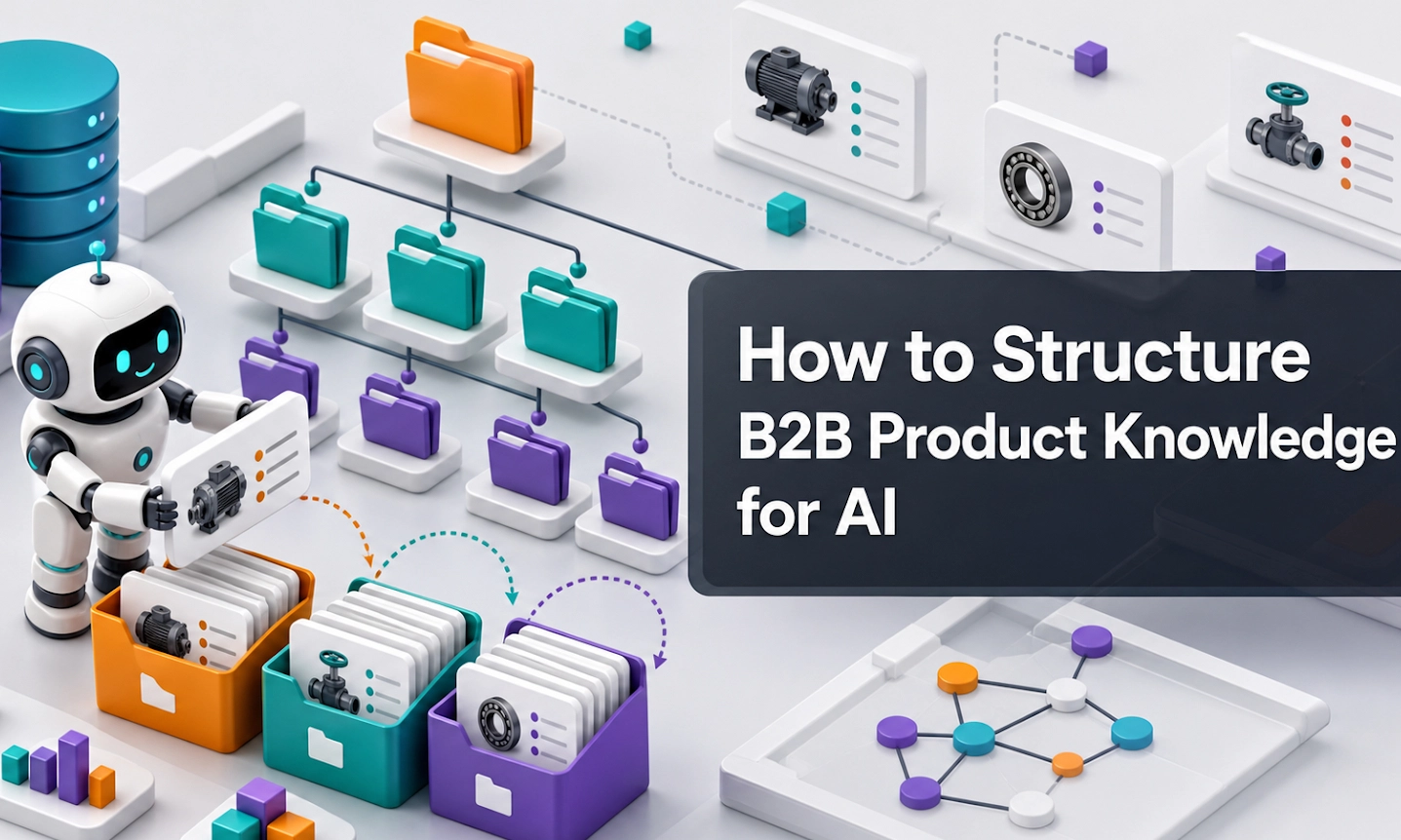
Most industrial B2B businesses already have product information somewhere.
It may be inside PDF catalogues, Excel files, brochures, supplier datasheets, website pages, ERP systems, WhatsApp messages, or the memory of experienced salespeople.
The problem is not that the business has no knowledge.
The problem is that the knowledge is often scattered, inconsistent, too technical, or not structured in a way that customers and AI can use properly.
For a normal product catalogue, this may be acceptable. Customers can browse, read, and contact sales if they need help.
But for an AI Webstore and AI Agent, structure matters much more.
The AI Agent cannot perform well if product knowledge is just a messy list of product names, random descriptions, inconsistent specifications, and outdated pricing notes.
It needs proper product knowledge structure.
This is what allows Antbuildz AI Agent to understand customer intent, explain product information, reason through requirements, ask the right follow-up questions, and guide the customer toward the right rental, sales, spare parts, service, or technical enquiry workflow.
In simple terms:
A catalogue stores product information.
A knowledge structure makes that information usable for AI, customers, and sales teams.
Why Product Knowledge Structure Matters
Industrial B2B products are not simple.
Customers may need help choosing equipment, machinery, tools, spare parts, accessories, materials, safety products, or technical industrial supplies. They may not know the exact product name. They may not understand the specifications. They may not know whether to rent or buy. They may not know which model, capacity, size, or configuration is suitable for their job.
This is why product knowledge must be structured around how customers actually ask questions.
A customer may not ask:
“Do you have a 10m electric scissor lift with indoor application and platform capacity details?”
They may simply ask:
“I need something for indoor ceiling maintenance.”
To support this kind of enquiry, the AI Agent needs structured product knowledge. It needs to know the product category, use case, specification fields, rental or sales rules, location coverage, and what follow-up questions should be asked.
Without structure, the AI Agent may still answer, but the answer may be too general.
With structure, the AI Agent can guide.
The Problem With Flat Product Lists
Many businesses think product knowledge means a product list.
For example:
Product name
Product photo
Short description
Price
Contact button
That is a start, but it is not enough for industrial B2B sales.
A flat product list does not explain which specifications matter. It does not show which products are comparable. It does not tell the AI when a product is suitable or unsuitable. It does not separate rental logic from sales logic. It does not capture compatibility, spare parts, service rules, delivery coverage, or enquiry requirements.
This creates a weak AI experience.
The AI may know that a product exists, but it may not know how to recommend it, compare it, explain it, or qualify an enquiry properly.
Antbuildz AI Webstore is designed to solve this by turning product information into structured product knowledge that can support both customers and AI Agent conversations.
Layer 1: Product Categories and Hierarchy
The first layer is product category structure.
Products should not be listed randomly. They should be grouped in a way that reflects how customers search, compare, and enquire.
For example, a business may organise products like this:
Material Handling → Forklifts → Electric Forklifts
Material Handling → Forklifts → Diesel Forklifts
Access Equipment → Scissor Lifts → Electric Scissor Lifts
Power & Energy → Generators → Diesel Generators
Parts & Accessories → Forklift Parts → Batteries / Tyres / Forks
This category structure is important because different product types require different specifications and enquiry flows.
A forklift enquiry is different from a generator enquiry. A scissor lift enquiry is different from a spare parts enquiry. A rental product enquiry is different from a sales product enquiry.
When the category structure is clear, the AI Agent can better understand what type of product the customer is asking about and what questions should come next.
For example, if a customer asks about a forklift for warehouse use, the AI Agent should know to ask about lifting capacity, lifting height, aisle width, indoor or outdoor use, rental duration, and location.
That is only possible when product categories are structured properly.
Layer 2: Standardised Specifications
The second layer is specification structure.
Industrial B2B products depend heavily on specifications, but specifications are only useful when they are clear and consistent.
For forklifts, useful specification fields may include rated capacity, lifting height, load centre, mast type, power source, turning radius, tyre type, operating weight, and suitable application.
For scissor lifts, useful specification fields may include working height, platform height, platform capacity, machine width, power type, indoor or outdoor suitability, ground condition, and platform size.
For generators, useful specification fields may include power output, fuel type, voltage, phase, usage type, fuel consumption, noise level, and application.
The problem is that different brands often present specifications differently.
One brand may highlight working height. Another may highlight platform height. One supplier may describe engine type differently. Another may use different measurement units.
This creates confusion for buyers and AI.
Standardised specifications help solve this.
When similar products use the same specification fields and formats, the AI Agent can compare them more effectively, explain differences more clearly, and ask better follow-up questions.
This also helps customers who are not technical experts.
They do not only see numbers. They get clearer guidance on what the numbers mean.
Layer 3: Use Case and Application Knowledge
Specifications tell you what a product can do.
Use case knowledge tells you when and why the product should be used.
This is one of the most important layers for AI product recommendation.
Customers often describe their job instead of naming the product. They may say:
“I need something to lift materials in a narrow indoor area.”
Or:
“I need backup power for my factory.”
Or:
“I need equipment for outdoor uneven ground.”
A product list cannot handle this properly.
The AI Agent needs use case knowledge.
For each product or product category, the business should define:
Common applications
Suitable industries
Suitable site conditions
Indoor or outdoor usage
Short-term or long-term suitability
Rental or purchase suitability
Common customer problems it solves
Situations where the product is not suitable
Alternative products to consider
This helps the AI Agent reason through the customer’s requirement.
Instead of only matching keywords, it can ask better questions and guide the customer toward more suitable options.
This is where Antbuildz AI Agent becomes more than a search box. It helps customers move from unclear requirement to structured enquiry.
Layer 4: Rental and Sales Rules
For Antbuildz, this layer is critical.
Many industrial B2B businesses support both rental and sales. The same product can have two very different customer journeys depending on whether the customer wants to rent or buy.
A rental enquiry usually requires:
Rental duration
Start date
Project location
Delivery requirement
Site condition
Usage purpose
Required capacity or specification
Return or extension terms
A sales enquiry usually requires:
Product model
Quantity
Budget range
Buying timeline
Delivery location
New or used preference
Technical requirement
Quotation requirement
If the AI Agent does not understand the difference, it may ask the wrong questions.
For example, if the customer wants rental but the AI only asks sales questions, the enquiry becomes weak. If the customer wants to buy but the AI only asks about rental duration, the conversation becomes confusing.
This is why rental and sales rules must be part of the product knowledge structure.
Antbuildz AI Webstore can help structure product pages around rental, sales, or both. Antbuildz AI Agent can then guide the customer based on the correct intent.
Layer 5: Compatibility and Relationship Data
Many industrial products do not stand alone.
They may connect to spare parts, accessories, attachments, consumables, batteries, tyres, chargers, tools, or service components.
This is where compatibility data matters.
For example:
Which battery fits which machine?
Which tyre size is suitable for which model?
Which attachment is compatible with which equipment?
Which spare part belongs to which brand or serial number?
Which accessory is required for a specific application?
Which product can be used as an alternative?
Without compatibility data, the AI Agent may need to avoid answering or ask for human review.
That is safer than guessing.
But when compatibility information is properly structured, the AI Agent can collect the right details and guide the customer more accurately.
For spare parts enquiries, this is especially important. Customers may not know the exact part number. They may only know the brand, model, serial number, machine type, photo, or problem.
A good product knowledge structure should help the AI Agent collect this information properly before the sales or service team follows up.
Layer 6: Pricing and Commercial Rules
Pricing is another important layer, but it must be handled carefully.
Industrial B2B pricing is rarely simple.
A product may have rental rates, sales prices, long-term rates, bulk pricing, special project pricing, delivery fees, deposits, payment terms, or quotation-based pricing.
The AI Agent should not freely decide pricing by itself.
Instead, the business should structure pricing and commercial rules clearly.
This may include:
Daily, weekly, or monthly rental rates
Long-term rental logic
Sales price guidance
New or used pricing
Delivery fee rules
Deposit rules
Minimum rental period
Discount approval rules
Quotation requirements
Cases that need human approval
When these rules are clear, the AI Agent can support pricing conversations better.
It can explain pricing structure, collect required details, and prepare the enquiry for quotation follow-up.
For special pricing, custom discounts, or high-value negotiations, the AI Agent should follow the company’s configured business rules and guide the customer to sales review.
That protects margin and avoids wrong promises.
Layer 7: Availability, Location, and Logistics Data
Industrial B2B sales is often location-dependent.
A product may be available in one location but not another. Rental availability may depend on date, duration, and logistics. Delivery may depend on distance, site access, unloading requirements, and service coverage.
This layer may include:
Branch or warehouse location
Service areas
Delivery coverage
Delivery lead time
Rental availability
Inventory-related data
Backorder or pre-order status
Site access requirements
Delivery restrictions
Areas that require manual confirmation
If the business has reliable inventory or availability data, the AI Agent can use it depending on setup.
If final availability is not confirmed, the AI Agent should not invent stock status. Instead, it should collect the customer’s requirement, location, rental duration, quantity, and timeline so the sales team can confirm accurately.
This is the right balance.
The AI Agent should use structured data to improve enquiry quality, while the business stays in control of final commitments.
Layer 8: FAQs, Policies, and Agreement Terms
Product knowledge is not only product data.
Customers also ask about business rules.
Common questions include:
What is the minimum rental period?
Do you deliver to my area?
What are the payment terms?
Is deposit required?
What happens if I extend the rental?
What is covered under warranty?
What is the agreement process?
What information is needed before quotation?
Who is responsible for damages?
What is the return or cancellation policy?
If these answers are not structured, the AI Agent may give incomplete or inconsistent replies.
A strong knowledge structure should include FAQs, policies, agreement terms, rental terms, sales terms, warranty rules, service rules, and customer responsibilities.
This helps the AI Agent answer common questions more consistently and reduces repetitive work for the sales team.
It also protects the business because the AI Agent uses approved information instead of guessing.
Layer 9: Enquiry Workflow and Lead Qualification Rules
This is the layer many businesses miss.
Even if the product data is good, the AI Agent still needs to know how to move the conversation forward.
For example:
What questions should be asked for rental?
What questions should be asked for sales?
What details are needed before quotation?
When should the AI Agent ask for contact details?
What makes a lead qualified?
What indicates strong deal intent?
What should be handed over to the sales team?
Which enquiries need technical review?
Which enquiries need service follow-up?
This turns the AI Agent from a question-answering tool into a sales assistant.
Lead qualification rules help the AI Agent capture useful information such as customer name, company, contact number, product interest, quantity, location, rental or buying intent, timeline, budget range, urgency, and follow-up preference.
Deal intent rules help identify whether the customer is casually browsing, comparing suppliers, checking pricing, planning a future project, or ready for quotation follow-up.
This is where structured product knowledge becomes structured sales opportunity.
How Product Knowledge Structure Improves AI Agent Performance
When product knowledge is structured properly, the AI Agent becomes more useful in several ways.
It can understand product categories better. It can ask better follow-up questions. It can explain specifications more clearly. It can guide customers toward suitable rental or sales options. It can collect better lead details. It can avoid unsupported claims. It can prepare stronger handover notes for the sales team.
The result is not only better AI answers.
The result is a better sales process.
Customers get clearer guidance. Sales teams receive better enquiries. Product pages become more useful. Marketing campaigns become easier to convert. The business becomes easier to scale.
This is why Antbuildz AI Webstore and Antbuildz AI Agent work better when product knowledge is structured properly.
Product Catalogue vs Product Knowledge Structure
| Area | Product Catalogue | Product Knowledge Structure |
|---|---|---|
| Main purpose | Show product information | Help AI and customers understand, compare, and enquire |
| Product grouping | Often simple list | Structured categories and hierarchy |
| Specifications | May be inconsistent | Standardised fields and units |
| Use cases | Often missing | Mapped to applications and site conditions |
| Rental and sales logic | Usually separate or manual | Structured for different workflows |
| Compatibility | Often handled by experts | Documented where possible |
| Pricing | Often static or unclear | Structured with commercial rules |
| Availability | Often manual | Can include location and availability logic |
| FAQs and policies | Often separate | Connected to product and enquiry flow |
| Lead capture | Not included | Supports qualification and deal intent |
| AI usefulness | Limited | Stronger grounding for AI Agent |
A catalogue is still useful.
But a knowledge structure makes the catalogue usable for AI-powered sales.
How Antbuildz AI Webstore Helps
Antbuildz AI Webstore helps businesses turn product information into a structured digital sales layer.
The Webstore supports product pages, product categories, product descriptions, specifications, product URLs, rental or sales options, enquiry actions, and customer browsing journeys.
This structure helps customers browse and understand products more clearly.
It also helps Antbuildz AI Agent use product context during conversations.
For example, if a customer is browsing forklift rental and asks whether it is suitable for warehouse use, the AI Agent can use the product category, specifications, rental context, and enquiry workflow to ask better questions.
This is more useful than a standalone AI tool that only reads uploaded documents.
How AI Console Helps Maintain Product Knowledge
Product knowledge is not fixed forever.
Products change. Pricing rules change. Rental terms change. Service areas change. Customer questions change. New products are added. Old products are removed. New marketing campaigns create new questions.
This is why AI Console matters.
Through Antbuildz AI Console, subscribers can improve their AI Agent by managing knowledge base content, FAQs, agent behaviour, enquiry workflows, required questions, lead capture rules, deal intent capture, handover instructions, conversation review, weak answers, and customer question gaps.
This gives businesses control.
A good AI Agent should not be a one-time setup. It should improve as the business improves its product knowledge.
What Businesses Should Prepare First
Businesses do not need to complete everything on day one.
The best starting point is to prepare the most useful knowledge first.
Start with:
Main product categories
Top-selling or high-value products
Product descriptions
Key specifications
Product photos
Common use cases
Rental or sales status
Common customer questions
Service areas
Basic rental or sales terms
Required enquiry questions
Lead capture fields
After that, improve the deeper layers such as compatibility, pricing rules, availability, detailed comparison notes, agreement terms, and workflow rules.
The goal is not perfection on day one.
The goal is to start with a useful structure and improve over time.
What Antbuildz AI Agent Should Not Do
A strong AI Agent should still stay within business rules.
Antbuildz AI Agent should not invent product specifications, guess spare part compatibility when data is unclear, confirm final stock unless inventory data is reliable, promise delivery dates without business confirmation, decide special pricing without approved rules, make legal or contractual commitments outside approved terms, or provide unsafe technical diagnosis for complex cases.
If information is unclear, the AI Agent should ask follow-up questions or prepare the enquiry for human review.
This protects customer trust while still helping the business respond faster and qualify enquiries better.
FAQ
1. What is B2B product knowledge structure?
B2B product knowledge structure is the organised way of preparing product information so customers, sales teams, Webstore pages, and AI Agent can use it properly.
It includes categories, specifications, use cases, rental and sales rules, compatibility, pricing, availability, FAQs, policies, and enquiry workflows.
2. Why is product knowledge structure important for AI Agent?
AI Agent needs structured business data to answer accurately, ask the right questions, recommend suitable options, and capture better enquiries.
If the data is unstructured, the AI Agent may give general answers or miss important follow-up questions.
3. Is a product catalogue enough?
No. A product catalogue is a good starting point, but it is not enough.
The AI Agent also needs use cases, business rules, rental and sales workflows, compatibility information, FAQs, pricing logic, location data, and lead qualification rules.
4. Do rental and sales products need different structures?
Yes. Rental and sales enquiries require different information.
Rental usually needs duration, start date, location, delivery, and usage. Sales usually needs model, quantity, budget, delivery location, and buying timeline.
The product knowledge structure should support both workflows if the business offers both rental and sales.
5. What should I prepare first?
Start with your main product categories, high-value products, product descriptions, key specifications, photos, common FAQs, service areas, rental or sales terms, and required enquiry questions.
You can improve compatibility, pricing, availability, and workflow rules over time.
6. Can existing data be used?
Yes. Existing PDFs, Excel files, websites, ERP data, brochures, and internal notes can be used as a starting point.
However, the information should be cleaned, updated, and structured so the AI Agent can use it more effectively.
7. Who maintains the product knowledge structure?
The business should maintain the product knowledge because product information, pricing rules, availability, policies, and customer questions change over time.
Antbuildz AI Console helps subscribers manage and improve the knowledge base, FAQs, agent behaviour, and enquiry workflows.
8. Does structured product knowledge help the sales team too?
Yes. Structured product knowledge helps the sales team answer more consistently, train faster, reduce repeated internal questions, and receive better-qualified enquiries from the AI Agent.
It improves both AI performance and human sales performance.
Conclusion
B2B product knowledge is not just a product list.
For industrial B2B businesses, product knowledge needs structure: categories, specifications, use cases, rental and sales rules, compatibility, pricing, availability, FAQs, policies, and enquiry workflows.
This structure is what allows Antbuildz AI Webstore and Antbuildz AI Agent to work better.
The Webstore organises the product information.
The AI Agent uses that information to guide customer conversations.
The AI Console helps the business improve the knowledge over time.
The stronger your product knowledge structure, the better your AI Agent can explain, recommend, qualify, and prepare enquiries for sales follow-up.
Ready to turn your product catalogue into a proper AI-ready knowledge structure? Build your Antbuildz AI Webstore and connect it with Antbuildz AI Agent to help customers browse, understand, ask, and enquire faster.