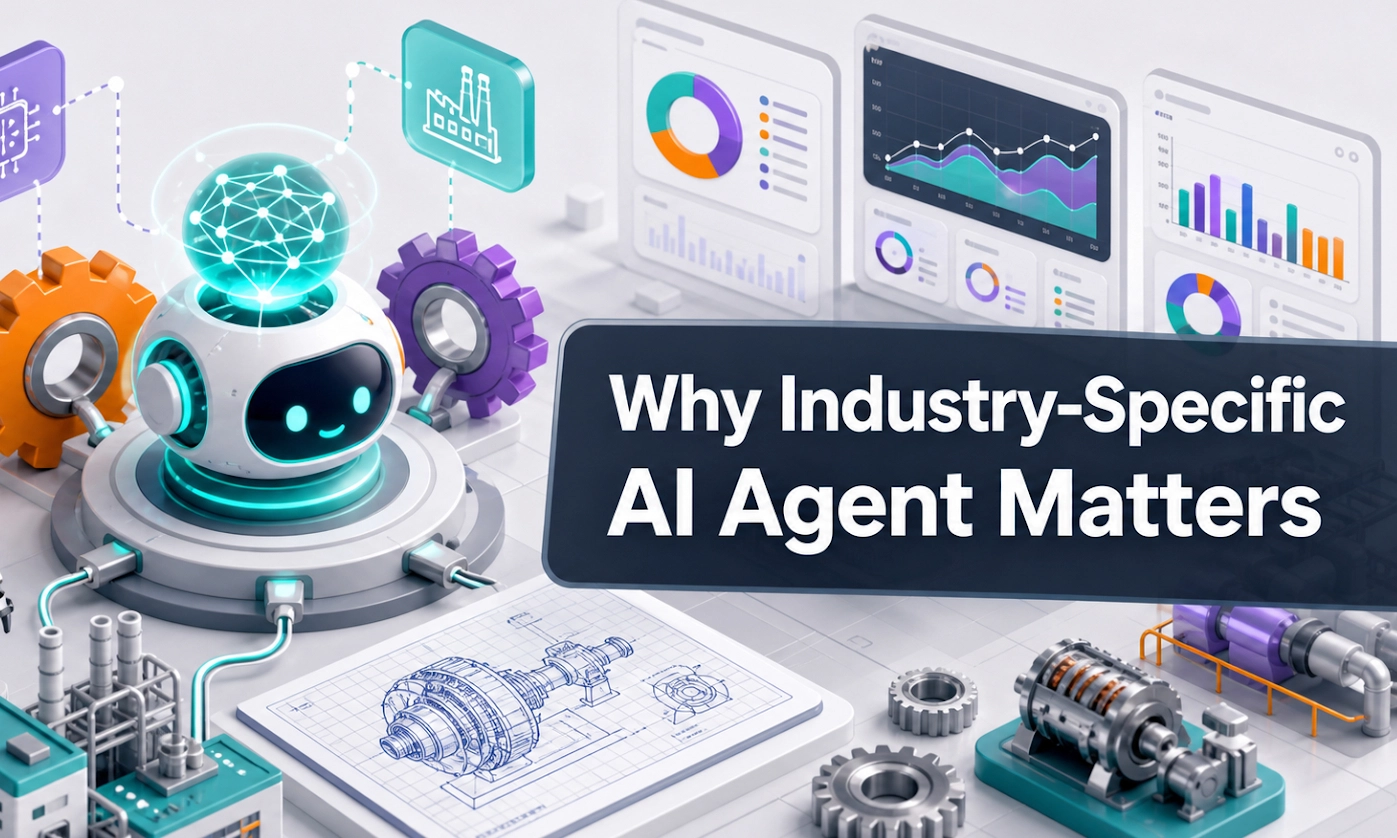
Generic AI is powerful.
It can write, summarise, translate, explain, and answer many types of questions. For general productivity, tools like ChatGPT, Gemini, Claude, and other AI models are useful.
But industrial B2B sales is not general productivity.
A customer may not ask a clean, simple question. They may not know the exact product name, model, capacity, specification, or category. They may describe a job, a site condition, a problem, or a requirement.
For example:
“I need something to move heavy materials in a narrow indoor space.”
A generic AI may understand the sentence. But to handle the enquiry properly, the AI needs to know what questions to ask next. It needs to understand load, height, working area, indoor or outdoor use, floor condition, rental duration, location, and whether the customer wants to rent or buy.
That is why industry-specific AI matters.
The goal is not only to answer. The goal is to understand the customer’s intent, reason through the requirement, follow the right workflow, and guide the customer toward the next best step.
Generic AI Understands Language. Industry-Specific AI Understands the Business Context.
The main difference is not whether the AI can speak well.
Most modern AI can speak well.
The real difference is whether the AI understands the business context.
A generic AI may know what a forklift is. It may explain what a generator does. It may describe common uses for a scissor lift. But industrial B2B customers usually need more than general explanation.
They need help answering questions like:
Is this product suitable for my job?
Should I rent or buy?
What model or capacity do I need?
What details are needed before quotation?
Can this product work in my location or site condition?
Is this spare part compatible with my machine?
What information should I provide before service follow-up?
What is the next step?
Industry-specific AI is valuable because it understands that these questions are not just language questions. They are sales, product, rental, service, workflow, and business logic questions.
Why Industrial B2B Is Different From Normal E-Commerce
Industrial B2B is not like buying a simple consumer product online.
A consumer buying a shirt may care about size, colour, price, and delivery. An industrial buyer may need to evaluate capacity, dimensions, compatibility, application, safety context, location, rental duration, service support, lead time, and quotation process.
Even when the product page has all the technical information, the customer may still not know whether the product is suitable.
This is especially common when the person browsing is a purchaser, procurement executive, project coordinator, admin staff, or first-time buyer. They may be responsible for sourcing, but they may not be the technical expert.
That is why industrial B2B businesses need AI that can guide the conversation, not just display product information.
Rental and Sales Need Different AI Workflows
One major reason industry-specific AI matters is that many industrial B2B businesses support both rental and sales.
The same product can create two very different customer journeys.
A customer asking about a forklift may want to rent it for one week, rent it long-term for warehouse operations, buy a new unit, buy a used unit, compare rental versus purchase, or ask for pricing before deciding.
A generic AI may treat these as similar product questions. But in real business operations, rental and sales require different workflows.
For rental enquiries, the AI Agent should usually ask about rental duration, start date, project location, delivery requirement, site condition, usage purpose, and required specification.
For sales enquiries, the AI Agent should usually ask about product model, quantity, budget range, buying timeline, delivery location, new or used preference, and technical requirement.
This difference matters because the wrong workflow creates weak enquiries.
If the customer wants rental but the AI only asks sales questions, the sales team will still need to restart the conversation. If the customer wants to buy but the AI only asks about rental duration, the enquiry becomes confusing.
Antbuildz AI Agent is designed to support both rental and sales workflows, especially when connected with Antbuildz Webstore. The Webstore can structure rental and sales product pages, while the AI Agent can guide the customer based on whether they want to rent, buy, compare, or request quotation follow-up.
1. Industry-Specific AI Understands Product Use Cases
In industrial B2B, the right product depends heavily on the use case.
The same product category can serve very different situations. A forklift for an outdoor construction site is different from a forklift for an indoor warehouse. A generator for temporary site use is different from a generator for factory backup power. A scissor lift for indoor maintenance is different from a rough-terrain scissor lift for outdoor work.
A generic AI may give a broad suggestion. Industry-specific AI should ask better questions before suggesting anything.
For example, if a customer says:
“I need a forklift for warehouse use.”
The AI should not jump straight into a recommendation. It should ask about lifting capacity, lifting height, aisle width, indoor or outdoor use, floor condition, rental duration, location, and whether the customer is looking to rent or buy.
This is the difference between giving a general answer and supporting a real sales conversation.
2. Specifications Are Not Just Numbers
Industrial product specifications are often connected to each other.
A buyer may see numbers on a product page but still not understand how those numbers affect the job.
For example, a forklift’s load capacity cannot be judged properly without considering load centre, lifting height, aisle width, tyre type, indoor or outdoor use, and working environment. A scissor lift’s working height matters, but so does platform size, machine width, ground condition, and whether the job is indoor or outdoor. A generator’s power output matters, but so does the actual load requirement and usage pattern.
A generic AI may treat specifications as isolated data.
Industry-specific AI should understand that specifications are part of a decision process. It should help the customer understand which information matters, what is missing, and what should be confirmed before moving forward.
Antbuildz AI Agent is designed to support this kind of structured enquiry, especially when connected with Webstore product data and knowledge base content.
3. Industry-Specific AI Understands Different Enquiry Workflows
Industrial B2B enquiries are not all the same.
A customer asking about one product may be looking to rent, buy, repair, compare, find spare parts, check delivery, request pricing, or ask for technical advice.
Each workflow needs different information.
A rental enquiry may need rental duration, start date, location, delivery requirement, and usage purpose.
A sales enquiry may need quantity, model preference, specification, budget range, and buying timeline.
A spare parts enquiry may need brand, model, serial number, part number, photo, and urgency.
A service enquiry may need issue description, machine details, error code, location, and support requirement.
This is where generic AI often falls short. It may answer the message, but it may not route the enquiry into the right workflow.
Antbuildz AI Agent is designed around industrial B2B enquiry workflows. It does not only reply. It helps collect the right information based on the customer’s intent.
4. Industry-Specific AI Needs Structured Product Data
Industry-specific AI is not magic.
It still needs good business data.
This is why Antbuildz Webstore matters. A Webstore does not only display products. It creates structured product data that the AI Agent can use.
This may include:
Product categories
Product pages
Product names
Brands and models
Photos
Specifications
Product descriptions
Rental or sales options
Product URLs
Location data
Inventory-related data, depending on setup
FAQs
Agreement or policy pages
Enquiry actions
This structured data gives the AI Agent more context.
If a customer is browsing a forklift rental product page and asks whether it is suitable for indoor warehouse use, the AI Agent can respond with better context than a generic AI tool that only reads uploaded text.
It can ask relevant follow-up questions and guide the customer toward a clearer rental or sales enquiry.
5. Industry-Specific AI Helps With Product Recommendation
Many customers do not know what product they need.
They may only describe the job.
A customer may say:
“I need something to lift materials in a narrow indoor area.”
A generic AI may suggest several possible options in a broad way. But an industry-specific AI should guide the customer through the requirement step by step.
It should ask about load weight, lifting height, working area, floor condition, project location, rental duration, and whether the customer is looking to rent or buy.
Then, using approved Webstore data and knowledge base content, it can guide the customer toward more suitable product categories or options.
This does not mean the AI should make final technical decisions for every situation. For complex or safety-critical cases, it should collect the right information and guide the enquiry to human review.
That is the right balance: useful guidance without uncontrolled guessing.
6. Industry-Specific AI Helps Customers Understand Technical Products
A product catalogue can be difficult to understand.
Different brands may present specifications differently. One brand may highlight working height, another may highlight platform height. One may focus on capacity, another on dimensions, power, or compatibility.
Even experienced buyers may not know every product category.
This creates friction. The customer may have enough information in front of them, but still not know what it means or whether it is suitable.
Industry-specific AI helps by translating technical product information into customer-friendly guidance.
It can explain what a specification means, why it matters, what other information should be checked, and what questions the customer should answer before enquiring.
This improves customer confidence and enquiry quality.
7. Industry-Specific AI Reduces Wrong or Weak Enquiries
Wrong enquiries waste time.
A customer may enquire about the wrong product because they misunderstood the specification, category, application, or compatibility. A salesperson then needs to spend time correcting the enquiry, asking basic questions, or redirecting the customer.
Weak enquiries also waste time.
For example:
“How much is generator?”
This is not enough for sales follow-up. The sales team still needs to ask what the generator is for, where it is needed, what load it must support, whether the customer wants rental or purchase, when it is required, and who to contact.
Industry-specific AI helps reduce this by asking better questions before the enquiry reaches the sales team.
The result is not only more enquiries. It is better enquiries.
8. Industry-Specific AI Captures Lead Details and Deal Intent
A good AI Sales Agent should not only answer questions.
It should help capture sales-ready information.
Antbuildz AI Agent can collect details such as customer name, company name, contact number, email address, product interest, quantity, location, rental or buying intent, timeline, rental duration, budget range, usage requirement, delivery requirement, urgency, and follow-up preference.
It can also help identify deal intent.
Is the customer casually browsing? Comparing suppliers? Checking price? Waiting for project confirmation? Looking for urgent rental? Ready for quotation follow-up?
This matters because not every lead should be treated the same way.
A serious and urgent enquiry should be prioritised differently from a casual browsing question.
Industry-specific AI helps sales teams understand the quality and urgency of the opportunity.
9. Industry-Specific AI Supports Marketing and Webstore Conversion
A generic AI tool may be able to respond to campaign traffic.
But industry-specific AI connected with a Webstore gives the campaign a stronger sales path.
For example, a forklift rental campaign can send visitors to a forklift rental Webstore page. The AI Agent can then ask about lifting capacity, rental duration, location, delivery, indoor or outdoor use, and contact details.
A spare parts campaign can send visitors to a spare parts page. The AI Agent can ask for brand, model, serial number, part number, photo, and urgency.
This means marketing does not stop at clicks.
The Webstore gives campaign visitors a product destination. The AI Agent gives them a guided conversation. The sales team receives better-qualified enquiries.
That is how industry-specific AI supports real sales conversion.
10. Industry-Specific AI Gives Businesses More Control
A business AI system should not be a black box.
If the AI gives a weak answer, the business should be able to improve it. If customers keep asking the same question, that knowledge should be added. If the workflow is wrong, it should be adjusted. If product information changes, it should be updated.
Antbuildz AI Agent is supported by AI Console.
Through AI Console, subscribers can improve knowledge base content, FAQs, agent behaviour, enquiry workflows, required questions, lead capture rules, deal intent capture, handover instructions, conversation review, weak answers, and customer question gaps.
This gives businesses more control over how the AI Agent performs.
Industry-specific AI should not be a one-time setup. It should become a continuous improvement system.
Industry-Specific AI vs Generic AI
| Area | Generic AI | Industry-Specific AI with Antbuildz |
|---|---|---|
| Main strength | Understands language broadly | Understands industrial B2B enquiry context |
| Product knowledge | General or uploaded text | Webstore product data, specs, pages, URLs, and knowledge base |
| Rental workflow | Usually custom-built from scratch | Supports rental-specific enquiry flow |
| Sales workflow | Usually custom-built from scratch | Supports sales-specific enquiry flow |
| Recommendation | Broad suggestions | Requirement-based product guidance |
| Workflow logic | Usually custom-built from scratch | Built around rental, sales, spare parts, service, pricing, and technical workflows |
| Lead capture | Basic or manually configured | Captures requirements, urgency, and deal intent |
| Webstore connection | Usually separate | Designed to work with Webstore product structure |
| Business control | Depends on setup or vendor | AI Console helps improve knowledge and workflow |
| Best use | General AI tasks | Complex industrial B2B sales enquiries |
Industry-Specific Does Not Mean Less Flexible
Some business owners may think industry-specific AI is less flexible.
That is the wrong way to look at it.
Industry-specific AI does not mean the AI can only answer one type of question. It means the AI starts with better context for the industry.
For industrial B2B businesses, this is valuable because customers may ask many types of questions: rental, sales, spare parts, service, pricing, delivery, availability, product recommendation, or technical support.
Industry-specific AI can still be flexible. The difference is that the flexibility is guided by business logic, product structure, and enquiry workflows.
That makes the AI more useful, not less useful.
Industry-Specific AI Still Needs Your Business Knowledge
This is important.
Industry-specific AI does not mean the AI automatically knows everything about your company.
It still needs your business knowledge.
Your product catalogue, specifications, rental or sales terms, service areas, agreement rules, FAQs, pricing guidance, product pages, location data, and enquiry workflows still matter.
Antbuildz provides the industrial B2B framework, Webstore structure, AI Agent, and AI Console. But the quality of the AI Agent still depends on the quality of the business data provided and maintained.
This is why knowledge base and Webstore setup are important.
The stronger your business knowledge, the stronger your AI Agent becomes.
What Antbuildz AI Agent Should Not Do
A strong AI Agent should also stay within business rules.
Antbuildz AI Agent should not invent product specifications, guess spare part compatibility when data is unclear, confirm final stock unless inventory data is reliable, promise delivery dates without business confirmation, decide special pricing without approved rules, make legal or contractual commitments outside approved terms, or provide unsafe technical diagnosis for complex service cases.
If information is unclear, the AI Agent should ask follow-up questions or prepare the enquiry for human review.
This protects customer trust while still helping the business respond faster and qualify enquiries better.
FAQ
1. What does industry-specific AI mean?
Industry-specific AI means AI that is designed around the real business context of a specific industry.
For Antbuildz, this means industrial B2B product data, rental and sales workflows, spare parts enquiries, service support, technical questions, lead capture, deal intent, Webstore data, and AI Console control.
2. Why is generic AI not enough for industrial B2B?
Generic AI may understand language, but industrial B2B enquiries need product knowledge, specifications, use-case matching, workflow logic, rental or sales rules, and lead qualification.
Without that context, the AI may give answers that are too general.
3. Why do rental and sales need different AI workflows?
Rental and sales require different information.
Rental usually needs rental duration, start date, location, delivery requirement, and usage purpose. Sales usually needs product model, quantity, specification, budget range, buying timeline, and delivery location.
If the AI uses the wrong workflow, the sales team may still need to restart the conversation.
4. Is industry-specific AI only for equipment rental?
No. Antbuildz AI Agent can support a wide range of industrial B2B businesses, including equipment, machinery, tools, spare parts, accessories, industrial supplies, safety products, materials, rental, sales, service, and support workflows.
5. Can industry-specific AI recommend products?
Yes. It can guide customers toward suitable options based on their requirements and approved business data.
For complex or safety-critical cases, the AI Agent should collect the right information and guide the enquiry to human review or technical confirmation.
6. Why does Webstore data matter?
Webstore data gives the AI Agent structured product context.
It can use product pages, specifications, photos, categories, rental or sales options, product URLs, location data, and enquiry paths to guide customer conversations more effectively.
7. Does industry-specific AI replace my sales team?
No. The goal is not to replace the full sales team.
The AI Agent helps handle first response, common questions, requirement clarification, lead capture, and deal intent identification. Human salespeople are still important for technical confirmation, negotiation, key accounts, special pricing, and closing.
8. How does AI Console help?
AI Console helps businesses manage and improve the AI Agent.
Subscribers can update knowledge base content, improve FAQs, adjust agent behaviour, configure workflows, review conversations, and improve lead capture rules.
9. Is industry-specific AI harder to set up?
Not necessarily.
With Antbuildz, the industrial B2B direction, Webstore structure, and AI Agent workflow are already designed for this market. Businesses still need to prepare product data, FAQs, business rules, and enquiry flows, but they are not starting from a blank generic AI tool.
Conclusion
Generic AI is powerful, but industrial B2B sales needs more than general intelligence.
Customers need help understanding products, comparing specifications, clarifying requirements, choosing the right rental or sales workflow, submitting complete enquiries, and moving toward sales follow-up.
That is why industry-specific AI matters.
Antbuildz AI Agent combines Large Language Model capability with industrial B2B logic, Webstore data, product knowledge, rental and sales workflows, lead capture, deal intent capture, and AI Console control.
The result is not just smarter answers.
The result is a more practical AI sales system for industrial B2B businesses.
A generic AI can answer.
An industry-specific AI can guide, qualify, and convert.
Ready to see how industry-specific AI can support your business? Try Antbuildz AI Agent with your own Webstore data, product catalogue, FAQs, workflows, and real customer questions.