How AI Agent Improves Over Time
Meta description: Discover how AI Agents use a continuous learning loop — enquiries, feedback, and analytics — to deliver better responses the longer they serve your business.
When you first deploy an AI Agent, it is already capable. It can answer questions about your products, handle basic enquiries, and engage visitors around the clock. But that is just the starting point. Unlike a static website or a fixed FAQ page, an AI Agent gets better the longer it works for your business. Every enquiry teaches it something. Every piece of feedback refines its understanding. Over weeks and months, the Agent becomes more accurate, more helpful, and more aligned with how your customers actually think and ask questions. This is the learning loop, and it is one of the most valuable aspects of AI-powered customer engagement.
The Learning Loop: How It Works
The learning loop is a continuous cycle that turns every customer interaction into an opportunity for improvement. It works in three stages: enquiry, feedback, and refinement.
In the first stage, a visitor asks the AI Agent a question. The Agent searches its knowledge base, retrieves relevant information, and generates a response. This interaction is recorded — the question asked, the data sources used, and the response delivered.
In the second stage, feedback is collected. This can happen in several ways. The visitor might rate the response as helpful or unhelpful. Your team might review conversation logs and flag responses that were inaccurate or incomplete. The system might detect that the visitor asked a follow-up question, which suggests the first answer did not fully address their needs.
In the third stage, the feedback is used to refine the Agent's knowledge and response patterns. If a particular question consistently receives negative feedback, the system identifies the gap and prompts you to update the relevant data source or add new information. If certain response styles generate better engagement, the Agent adjusts its communication approach accordingly.
This cycle repeats continuously. Each loop makes the Agent slightly better. Over hundreds and thousands of interactions, those small improvements compound into a significant difference in quality and effectiveness.
Analytics on Common Questions
One of the most immediate benefits of the learning loop is visibility into what your customers are actually asking. Most businesses think they know what their customers want, but the reality is often different. Analytics from your AI Agent reveal the real questions, concerns, and interests of your visitors.
The system tracks which questions are asked most frequently, which products generate the most enquiries, which specifications visitors care about most, and which questions the Agent struggles to answer. This data is invaluable for your business — not just for the AI Agent, but for your sales strategy, marketing content, and product positioning.
For example, if analytics show that 30 percent of visitors ask about delivery timelines, you know that delivery information needs to be more prominent on your website and in your product listings. If a particular product category generates a high volume of questions but low conversion, the issue might be pricing, specification clarity, or availability — and the conversation logs help you pinpoint which.
Common question patterns also reveal opportunities. If visitors frequently ask about a product or service you do not currently offer, that is market intelligence. If they ask about compatibility between products, you can create comparison guides or bundled offerings. The AI Agent's analytics turn customer conversations into actionable business insights.
Refining Responses
As the learning loop accumulates data, the AI Agent's responses become more refined. This happens in several ways.
First, the Agent learns which data sources are most useful for different types of questions. If visitors asking about rental terms consistently find the detailed policy document more helpful than the summary page, the Agent prioritises the detailed document for future rental-related questions.
Second, the Agent learns the language your customers use. Equipment buyers do not always use the same terminology as your product listings. A visitor might ask for a "cherry picker" when your catalogue lists "boom lifts." Over time, the Agent builds a mapping between customer language and your product terminology, making its responses more natural and accurate.
Third, the Agent learns from corrections. When your team reviews a conversation and identifies an inaccurate or incomplete response, that correction feeds back into the system. The Agent will not repeat the same mistake. It updates its understanding and handles similar questions better in the future.
Fourth, the Agent learns contextual patterns. It discovers that visitors from certain industries tend to need specific information — cold storage operators care about temperature ratings, construction companies care about transport dimensions, logistics companies care about lift height. The Agent begins to anticipate these needs and proactively include relevant details.
Getting Better With Usage
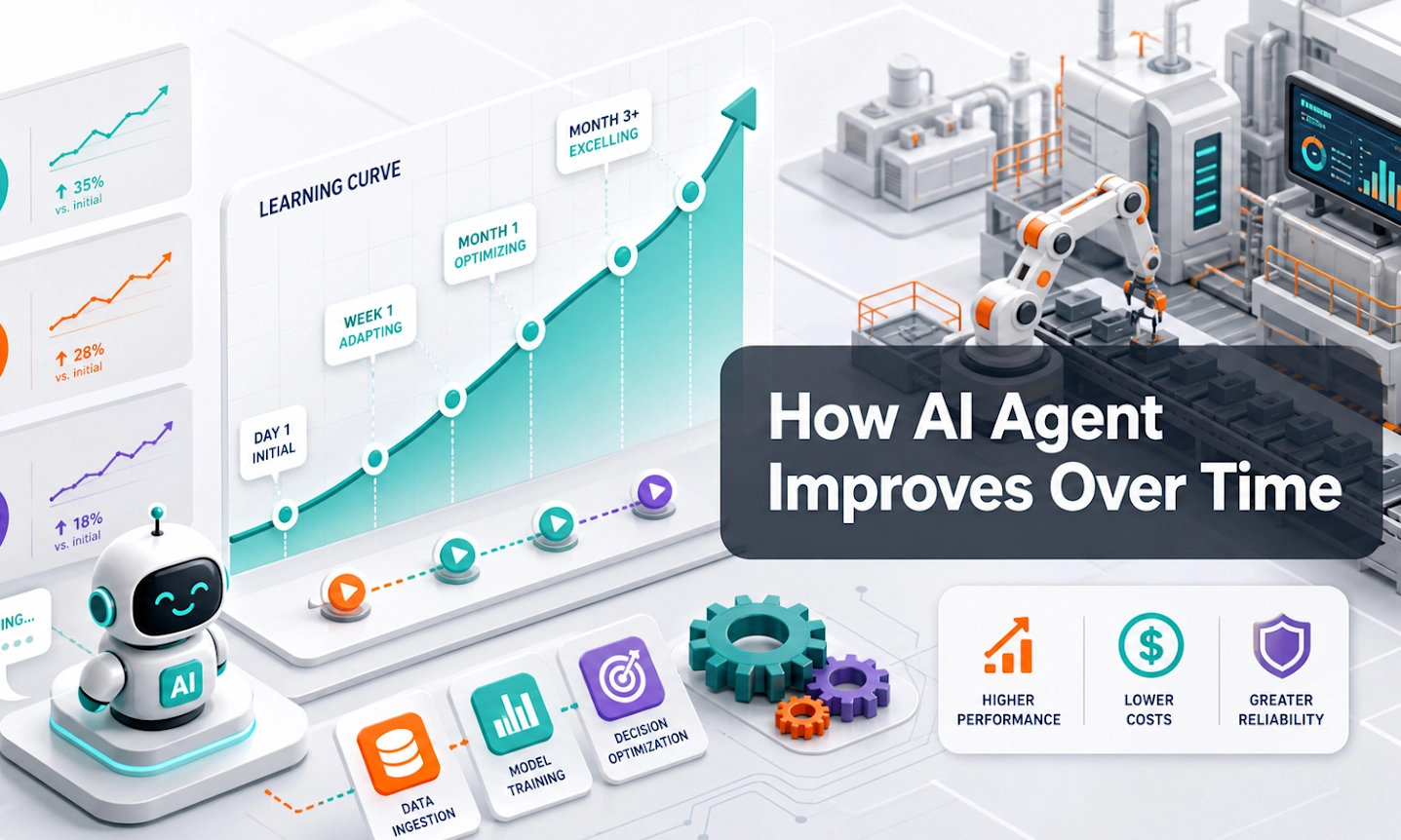
The relationship between usage and improvement is not linear — it is compounding. In the first week, the Agent handles a limited number of interactions and learns basic patterns. By the first month, it has encountered enough variation to handle most common questions confidently. By the third month, it has refined its responses to the point where it can handle complex, multi-part enquiries with accuracy that matches or exceeds a junior sales team member.
This improvement curve is one reason why businesses that commit to their AI Agent see better results over time. The Agent that felt limited in its first week becomes indispensable by its third month. Patience during the early learning period pays dividends as the Agent matures.
Usage volume accelerates improvement. A high-traffic webstore gives the Agent more interactions to learn from, which means faster refinement. But even lower-traffic businesses see steady improvement — it simply takes longer to accumulate the same volume of learning data.
The Role of Your Team
While the AI Agent learns automatically from interactions, your team plays a critical role in accelerating and guiding that learning. Sales team members who review conversation logs can identify patterns the automated system might miss — industry-specific nuances, regional preferences, or emerging customer needs.
Your team can also proactively feed the Agent new information. When you launch a new product, update pricing, or change a policy, uploading that information to the Agent's knowledge base ensures it can answer questions about the change immediately. The combination of automatic learning from interactions and manual updates from your team creates the fastest path to a highly effective AI Agent.
Think of it as onboarding a new team member. The new hire learns on the job from interactions with customers, but they also benefit from training, guidance, and corrections from experienced colleagues. Your AI Agent works the same way.
What the Data Reveals
Beyond improving responses, the learning loop generates a rich dataset about your customers and your business. Over time, you gain visibility into trends and patterns that inform strategic decisions.
Seasonal patterns become clear. If enquiries about generator rentals spike every December, you know to prepare inventory and staffing. If questions about a particular product category are declining, it might signal a shift in market demand.
Geographic patterns emerge. If enquiries from a particular region consistently ask about products you do not currently stock in that area, there is an opportunity to expand your distribution. If a specific product is popular in one market but not another, your marketing strategy can be adjusted accordingly.
Competitive intelligence surfaces. When visitors ask how your products compare to competitors, the AI Agent records those questions. Over time, you build a picture of which competitors your customers are considering and which features they value most in comparisons.
Frequently Asked Questions
1.How quickly does the AI Agent start improving? Improvement begins from the first interaction. Within the first week of deployment, the Agent starts identifying common question patterns. Within the first month, most businesses see noticeable improvements in response accuracy and relevance. Significant refinement typically occurs within the first three months of active use.
2.Do I need to manually train the AI Agent? The AI Agent learns automatically from customer interactions through the learning loop. However, you can accelerate improvement by reviewing conversation logs, providing feedback on responses, and updating your data sources when business information changes. The combination of automatic learning and manual guidance produces the best results.
3.What if the AI Agent gives a wrong answer? When the AI Agent gives an incorrect answer, the error is logged and used to prevent similar mistakes in the future. Your team can review the conversation, flag the issue, and update the relevant data source. The Agent will not repeat the same error once the correction is processed.
4.Can I see what questions customers are asking? Yes. The analytics dashboard shows the most common questions, question categories, response ratings, and conversation trends. This data helps you understand customer needs, identify knowledge gaps, and make informed decisions about your product offerings and marketing strategy.
5.Does the AI Agent get confused by contradictory information? The AI Agent is designed to handle information from multiple sources. When sources contain different versions of the same information — for example, an older PDF and a newer website page — the Agent typically prioritises the most recently updated source. Keeping your data sources current prevents contradictions.
Conclusion
An AI Agent is not a set-and-forget tool. It is a growing asset that becomes more valuable over time. The learning loop — enquiry, feedback, refinement — ensures that every interaction makes the Agent smarter and more effective. Analytics from customer conversations provide insights that benefit your entire business. And the compounding nature of improvement means that the longer you use your AI Agent, the better it performs. The businesses that commit to their AI Agent early are the ones that see the greatest returns.
See how Antbuildz AI Agent improves with every interaction at Antbuildz.com.