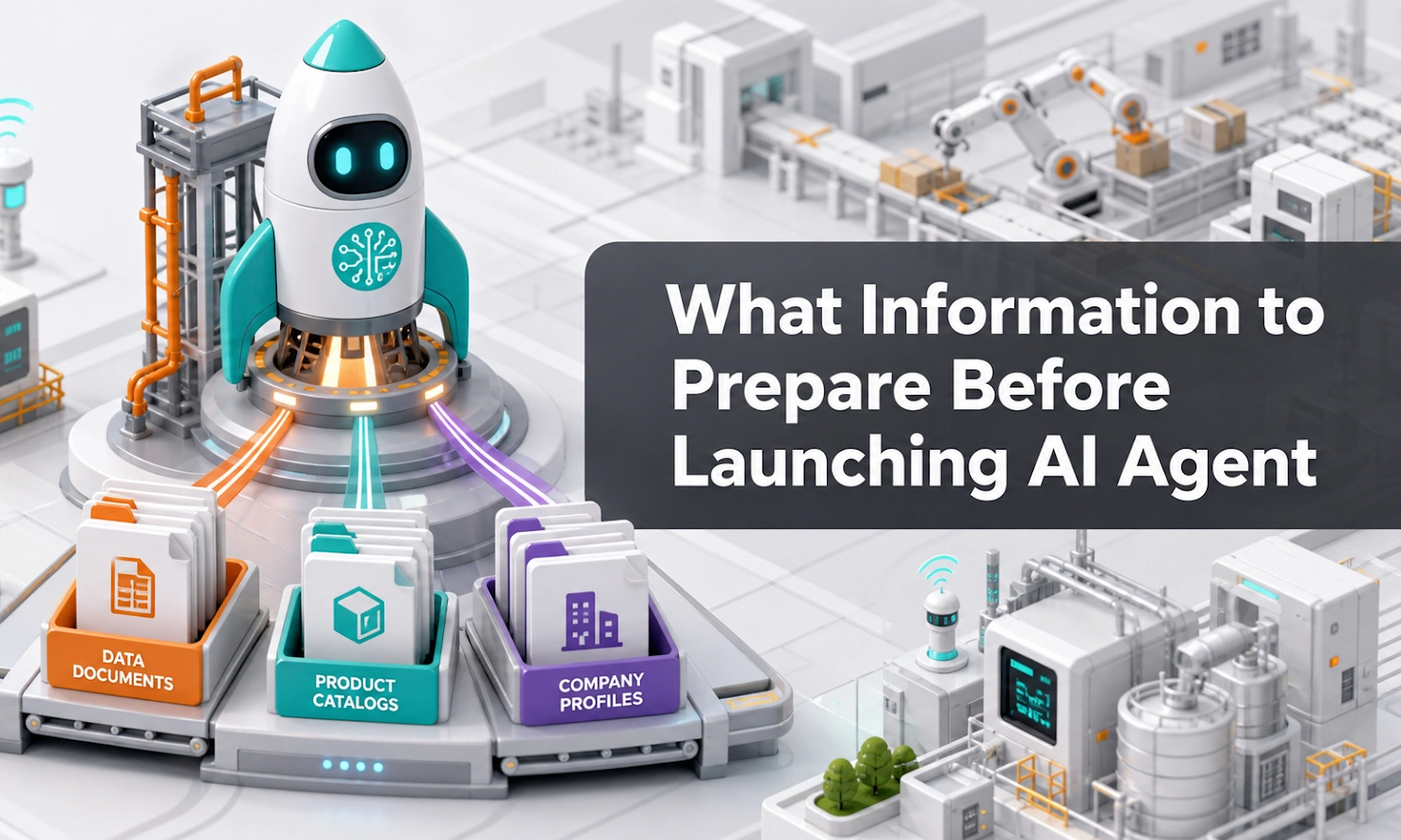
Before launching Antbuildz AI Agent, subscribers should prepare the key business information that allows the AI Agent to represent the company properly. This includes company information, product data, rental and sales coverage, FAQs, agreement terms, policies, pricing guidance, availability rules, enquiry workflows, lead capture fields, handover rules, and approved response boundaries.
This article is a master preparation checklist. It gives subscribers a clear overview of what should be ready before the AI Agent goes live. Each area does not need to be perfect on day one, but the basic information must be clear enough for the AI Agent to answer customers safely, ask useful follow-up questions, and prepare better enquiries for the sales team.
In simple terms, the AI Agent needs three things before launch: it must know who your company is, what your company offers, and how your company handles customer enquiries.
Introduction
Launching an AI Agent is not only a technical setup. It is also a business preparation process.
Antbuildz AI Agent can support customer enquiries, explain products, guide rental and sales conversations, capture lead details, identify deal intent, and prepare enquiries for your sales team. But to do this well, the AI Agent needs the right business information before it goes live.
Many businesses already have this information somewhere. It may be inside product catalogues, websites, PDFs, spreadsheets, FAQs, agreements, WhatsApp messages, internal SOPs, or sales team experience. The problem is that this information is often scattered, outdated, incomplete, or not written in a way that the AI Agent can use properly.
This guide helps subscribers understand what to prepare before launching Antbuildz AI Agent. Think of it as a pre-launch checklist. The goal is not to make everything perfect immediately. The goal is to provide enough accurate and approved business knowledge so the AI Agent can start helping customers in a safe and useful way.
Why Preparation Matters Before Launch
An AI Agent is only as useful as the business knowledge behind it. If the information is clear, updated, and structured, the AI Agent can answer better, ask better questions, and prepare stronger sales enquiries. If the information is missing, outdated, or unclear, the AI Agent may give answers that are too general, hand over too early, or create wrong customer expectations.
For industrial B2B businesses, this matters even more. Customers may ask about equipment rental, product sales, spare parts, service support, delivery, availability, pricing, warranty, technical specifications, agreement terms, or quotation requirements. These are not simple questions. They require product knowledge, business rules, and proper enquiry workflows.
Before launch, subscribers should prepare the most important information first. Start with the information your customers ask about most often, then improve the rest over time inside Antbuildz AI Console.
1. Company Information
The AI Agent should know who it represents. Company information helps the AI Agent introduce your business correctly, explain what your company does, and guide customers based on your actual business scope.
Prepare your company name, short company profile, business type, industries served, service areas, branches or locations, business hours, main product categories, and customer segments. You should also define what your company does not provide, so the AI Agent does not create wrong expectations.
For example, the AI Agent should know whether your business supports equipment rental, equipment sales, spare parts, service support, maintenance, accessories, or industrial supplies. It should also know whether your business serves Singapore, Malaysia, selected states, selected cities, or only certain project locations.
Company information helps the AI Agent sound less generic and more like it belongs to your business.
2. Product Data
Product data tells the AI Agent what your company offers. This is one of the most important foundations before launch.
At minimum, prepare product names, product categories, brand and model, product photos, short descriptions, key specifications, rental or sales status, common use cases, limitations, location notes, and required enquiry questions.
You do not need to clean every product perfectly before launch. Start with your most important products first, especially products that are high-value, frequently enquired, or commonly promoted in marketing campaigns.
For example, if you offer forklifts, the AI Agent should know the capacity, power type, lifting height, indoor or outdoor suitability, rental or sales availability, and what questions to ask before quotation. If this data is missing, the AI Agent may only give a general answer instead of guiding the customer properly.
High-quality product data helps the AI Agent explain, recommend, qualify, and hand over enquiries more effectively.
3. Rental and Sales Coverage
Many industrial B2B businesses support both rental and sales. The AI Agent must understand the difference because rental and sales require different workflows.
For rental enquiries, the AI Agent should usually collect rental duration, start date, project location, delivery requirement, site condition, usage purpose, required capacity, and contact details. For sales enquiries, it should usually collect product model, quantity, specification, budget range, buying timeline, delivery location, new or used preference, and contact details.
If your company rents some products but only sells others, this must be clearly stated. If some products are rental-only, sales-only, new-only, used-only, or quotation-based, the AI Agent should know.
This prevents the AI Agent from asking the wrong questions or confusing customers during the enquiry.
4. FAQs
FAQs help the AI Agent answer repeated customer questions consistently. They are one of the easiest and fastest ways to improve AI Agent performance before launch.
Prepare FAQs based on real customer questions from WhatsApp, email, website forms, sales calls, and quotation requests. Good FAQ topics include rental duration, delivery areas, payment terms, deposit, warranty, quotation process, spare parts availability, service support, rental extension, cancellation, damage responsibility, and product suitability.
FAQ answers should be written in clear customer language. Avoid vague answers like “subject to company policy.” A better answer explains what the customer should expect and what information should be provided.
For example, instead of saying “Rental extension subject to approval,” write: “Rental extension depends on product availability and agreement terms. Customers should request extension before the current rental period ends and provide the product, location, and requested extension duration for confirmation.”
Good FAQs reduce repetitive work and help the AI Agent answer more safely.
5. Agreement Terms and Policies
FAQ, agreement, and policy are the foundation of business operations. Product data tells the AI Agent what you offer, but agreement terms and policies tell the AI Agent how your business works.
Prepare customer-facing rules such as rental terms, sales terms, payment terms, delivery policy, warranty policy, damage responsibility, cancellation rules, return rules, rental extension rules, quotation validity, complaint handling, and service support rules.
This is important because the AI Agent should not create or change company terms by itself. It should only explain approved information and collect details when confirmation is needed.
For example, if a customer asks about damage responsibility, the AI Agent should answer based on your approved agreement terms. If the case involves a dispute, accident, unclear responsibility, or special condition, the AI Agent should collect the details and hand over for human review.
Agreement and policy information protects your business from wrong promises.
6. Pricing and Commercial Rules
Pricing must be prepared carefully because industrial B2B pricing is often not simple.
Some products may have fixed rental rates or listed sales prices. Others may depend on rental duration, location, delivery, quantity, availability, customer type, project size, or sales approval. Before launch, subscribers should decide what pricing information the AI Agent is allowed to provide.
The AI Agent may be allowed to explain pricing factors, show approved listed prices, or collect details needed for quotation. It should not invent prices, offer unapproved discounts, change payment terms, or confirm final quotation without approval.
A useful pricing rule may say: “Rental pricing depends on product type, rental duration, project location, delivery requirement, required date, and availability. The AI Agent should collect these details and prepare the enquiry for quotation follow-up.”
This keeps the AI Agent useful without creating pricing risk.
7. Availability, Location, and Delivery Rules
Customers often ask whether a product is available, whether delivery is possible, or whether your company can support their location. These questions should be prepared before launch.
Prepare service areas, branch locations, delivery coverage, delivery lead time, urgent delivery rules, stock confirmation rules, and areas that require manual confirmation. If final availability still needs human checking, the AI Agent should not promise stock or delivery too strongly.
A safer response is: “Availability and delivery depend on product type, location, required date, and rental duration. May I know your location and required date so our team can confirm?”
This allows the AI Agent to continue the conversation without overpromising.
8. Enquiry Workflows
An AI Agent should not only answer questions. It should help move the customer toward a complete enquiry.
Before launch, subscribers should define the main enquiry workflows. Common workflows include rental enquiry, sales enquiry, spare parts enquiry, service enquiry, pricing enquiry, delivery enquiry, technical enquiry, complaint enquiry, and general company enquiry.
Each workflow should have required questions. For example, a spare parts enquiry may require brand, model, serial number, part number, photo, quantity, urgency, and delivery location. A service enquiry may require machine type, issue description, error code, location, urgency, photo or video, and contact person.
Clear workflows help the AI Agent collect the right details before handover. This is how the AI Agent reduces repetitive sales work and improves lead quality.
9. Lead Capture Fields
The AI Agent should know what information to collect from customers before passing the enquiry to your team.
Useful lead capture fields may include customer name, company name, contact number, email address, product interest, quantity, location, rental or buying intent, timeline, rental duration, budget range, usage requirement, delivery requirement, urgency, and follow-up preference.
You do not need to ask every question at once. The AI Agent should collect details naturally based on the enquiry type.
A weak lead says: “Customer asked about generator.” A stronger lead says: “Customer needs generator rental for factory backup power in Johor next month. Customer is unsure of the required power capacity and wants quotation follow-up. Contact details collected.”
That is the kind of handover your sales team needs.
10. Handover Rules
Antbuildz AI Agent is designed to handle as much of the repeatable sales process as possible before handing over to humans. Handover should not be the first option. It should happen when human judgement, approval, negotiation, technical confirmation, complaint handling, or closing is needed.
Before launch, define when the AI Agent should continue, when it should ask more questions, and when it should hand over. Human handover may be needed for special pricing, discount requests, final quotation approval, complex technical confirmation, spare parts compatibility, complaints, disputes, high-value opportunities, or customer requests for a human.
The AI Agent should collect useful context before handover whenever possible. This helps the sales team continue the conversation without starting from zero.
AI handles volume. Humans handle value.
11. Agent Behaviour and Response Style
Subscribers should define how the AI Agent should sound and behave.
For industrial B2B sales, the best response style is usually clear, helpful, professional, practical, and not too long. The AI Agent should avoid sounding like a generic chatbot. It should answer directly, explain when needed, ask relevant follow-up questions, and guide the customer toward the next step.
You can define whether the AI Agent should be more formal, more friendly, more concise, or more detailed. You should also define what the AI Agent should avoid, such as guessing, overpromising, using unsupported claims, or handing over too early.
Good agent behaviour makes the customer experience feel more natural and more aligned with your business.
12. Approved Answers and Boundaries
Before launch, prepare approved answers for common and sensitive topics. This helps the AI Agent stay consistent and safe.
Sensitive topics may include pricing, discounts, stock confirmation, delivery promises, warranty, damage responsibility, agreement terms, cancellation, refunds, complaint handling, spare parts compatibility, and technical advice.
The AI Agent should not invent product specifications, guess compatibility, confirm final stock unless data is reliable, promise delivery dates without confirmation, approve discounts, change agreement terms, make legal commitments, or provide unsafe technical diagnosis.
When information is unclear, the AI Agent should ask follow-up questions or hand over for human review.
Clear boundaries make the AI Agent safer and more reliable.
13. Testing Questions Before Launch
Before going live, test the AI Agent with real customer questions. Do not only test perfect questions. Customers often ask short, vague, incomplete, or messy questions.
Test questions such as:
Do you have forklift?
How much rental?
Can deliver to Johor?
Need generator for site.
Which lift can use indoor?
Can I buy instead of rent?
Do you have spare part for this model?
Can I get discount?
Got stock?
Can I speak to sales?
After testing, check whether the AI Agent answered correctly, asked the right follow-up questions, stayed within business rules, collected useful lead details, and knew when to hand over.
Testing should be done before launch and repeated after major knowledge updates.
Pre-Launch Information Checklist
Use this checklist before launching your Antbuildz AI Agent.
| Area | What to Prepare |
|---|---|
| Company Information | Company profile, business scope, service areas, business hours |
| Product Data | Product names, categories, photos, descriptions, specifications |
| Rental / Sales Coverage | Which products are rental, sales, both, new, used, or quotation-based |
| FAQs | Common customer questions and approved answers |
| Agreement Terms | Rental terms, sales terms, payment, damage, extension, cancellation |
| Policies | Delivery, warranty, service, complaint, refund, stock confirmation |
| Pricing Rules | Listed prices, pricing factors, quotation rules, discount boundaries |
| Availability Rules | Service areas, location coverage, stock and delivery confirmation |
| Workflows | Rental, sales, spare parts, service, pricing, technical, complaint |
| Lead Capture | Name, company, contact, product, location, timeline, intent, urgency |
| Handover Rules | When to continue, when to escalate, what details to collect |
| Agent Behaviour | Tone, response style, answer length, boundaries |
| Testing Questions | Real customer questions before launch |
What to Prioritise First
Subscribers do not need to prepare everything perfectly on day one. Start with the information that affects the most customer conversations.
The first priority should be company information, top product categories, frequently enquired products, rental and sales coverage, common FAQs, basic agreement terms, delivery rules, pricing boundaries, lead capture fields, and handover rules.
After that, improve deeper areas such as product limitations, compatibility data, detailed pricing logic, availability data, service workflows, warranty scenarios, complaint handling, and advanced technical questions.
The goal is to launch with enough approved business knowledge, then improve from real customer conversations.
How AI Console Helps
Antbuildz AI Console helps subscribers manage and improve the AI Agent over time. Subscribers can update knowledge base content, FAQs, agent behaviour, enquiry workflows, required questions, lead capture rules, deal intent capture, handover instructions, and weak answers.
When customers ask new questions, add them into the knowledge base. When the AI Agent gives a weak answer, improve the source information. When leads are incomplete, refine the workflow. When business rules change, update the relevant FAQ, policy, or agreement information.
A good AI Agent is not a one-time setup. It improves when the business improves the knowledge behind it.
Common Mistakes to Avoid
One common mistake is launching the AI Agent with only product data and no business rules. Product data helps the AI Agent understand what you offer, but business rules tell it how your company operates.
Another mistake is uploading too many messy documents without cleaning conflicts. If one document says one thing and another document says something different, the AI Agent may struggle to know which rule to follow.
A third mistake is not separating rental and sales workflows. Rental and sales require different information, so the AI Agent must know which path to follow.
Another mistake is allowing the AI Agent to answer sensitive topics too freely. Pricing, stock confirmation, delivery promises, discounts, warranty disputes, and agreement terms need clear boundaries.
The final mistake is not testing before launch. Testing is how you find missing information before real customers do.
FAQ
1. Do I need to prepare everything before launching the AI Agent?
No. You do not need everything perfect on day one, but you should prepare the core business information first. Start with company information, main product data, common FAQs, rental and sales rules, delivery policy, pricing boundaries, lead capture fields, and handover rules.
2. What is the most important information to prepare first?
The most important information is the information customers ask about most often. This usually includes product data, rental and sales coverage, pricing guidance, delivery areas, FAQs, agreement terms, and quotation requirements.
3. Is product data enough?
No. Product data is important, but the AI Agent also needs company information, FAQs, policies, agreement terms, workflows, lead capture rules, and handover rules to represent your business properly.
4. Should I prepare both rental and sales workflows?
Yes, if your business supports both. Rental and sales require different questions and follow-up processes. The AI Agent must know whether the customer wants to rent, buy, compare, or request quotation.
5. Should I include pricing information?
Yes, if the pricing is approved and clear. If final pricing depends on duration, location, delivery, quantity, availability, or sales approval, the AI Agent should collect details and prepare the enquiry for quotation follow-up.
6. Should I include agreement and policy documents?
Yes. Agreement and policy documents help the AI Agent understand your business rules, such as payment, delivery, warranty, damage responsibility, cancellation, extension, and customer obligations.
7. Who should prepare this information?
Sales, operations, service, finance, marketing, and management should work together. Sales knows customer questions, operations knows fulfilment rules, service knows support issues, finance knows payment rules, marketing knows brand tone, and management should approve sensitive rules.
8. What should I do after launch?
Review real customer conversations, identify weak answers, update the knowledge base, improve FAQs, refine workflows, and test again. The AI Agent becomes better as your business knowledge becomes clearer.
Conclusion
This article is the master preparation checklist before launching Antbuildz AI Agent.
Before launch, subscribers should prepare company information, product data, rental and sales coverage, FAQs, agreement terms, policies, pricing guidance, availability rules, enquiry workflows, lead capture fields, handover rules, agent behaviour, and approved response boundaries.
The AI Agent does not only need to know what your business offers. It also needs to know how your business operates.
Product data helps the AI Agent understand your offering. Company information helps it represent your brand. FAQs, agreements, and policies help it follow your business rules. Workflows help it ask the right questions. Lead capture and handover rules help your sales team receive better enquiries.
Start with the most important information first. Launch with enough approved knowledge. Then improve continuously inside Antbuildz AI Console based on real customer conversations.
The better prepared your business information is, the better your Antbuildz AI Agent can answer, guide, qualify, and support your sales team.