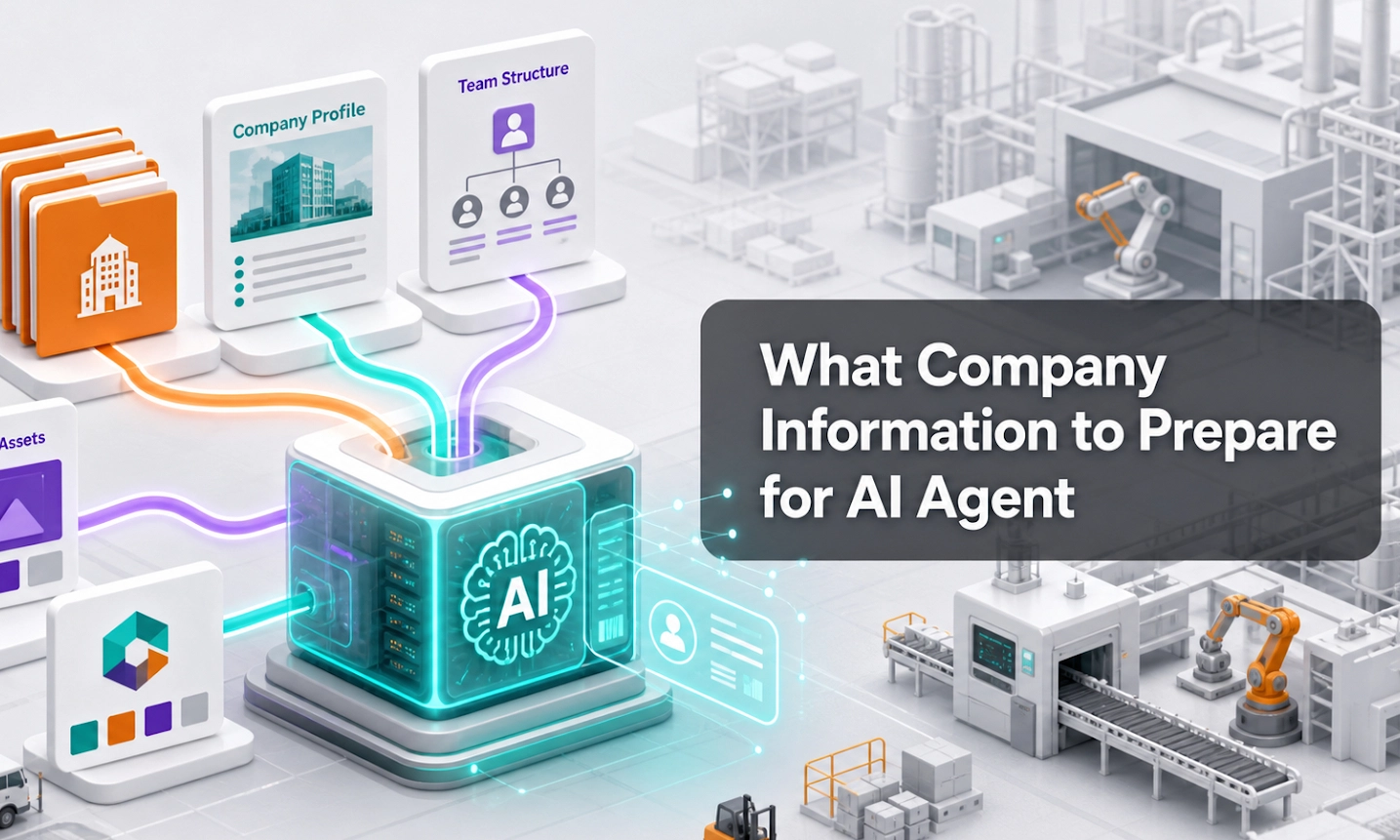
Before launching Antbuildz AI Agent, subscribers should prepare clear company information so the AI Agent knows who it represents, what the business does, where the business operates, what customers it serves, what products or services it supports, and when enquiries should be routed to the right team.
This should include your company profile, business scope, industries served, service areas, product and service categories, rental and sales coverage, branch or location information, team responsibilities, business hours, handover contacts, brand tone, and important operating boundaries.
Product data tells the AI Agent what you offer. Company information tells the AI Agent who your business is, how it should introduce your company, and how it should guide customers correctly.
Without clear company information, the AI Agent may sound generic, describe your business wrongly, route enquiries poorly, or fail to represent your brand properly.
Introduction
When setting up an AI Agent, many businesses focus mainly on product data. They prepare product catalogues, specifications, photos, pricing notes, PDFs, and Webstore listings. These are important, but they are not the full picture.
Before the AI Agent can answer customers properly, it also needs to understand the company behind the products.
A customer may ask, “Who are you?”, “What does your company do?”, “Do you serve my area?”, “Do you only rent or also sell?”, “Do you support spare parts?”, “Can your team help with service?”, “Which branch should I contact?”, or “Who will follow up on my enquiry?”
These questions are not product questions. They are company context questions.
For Antbuildz AI Agent, company information works like onboarding material for a new digital sales assistant. Just like a new salesperson needs to understand your company before speaking to customers, the AI Agent also needs the right company context before it can represent your business confidently.
Why Company Information Matters
A general AI model does not automatically know your company. It may understand language, but it does not know your business identity, market position, operating areas, service coverage, customer segments, team structure, or preferred way of handling enquiries unless you provide that information clearly.
If this company context is missing, the AI Agent may give answers that sound too generic. It may introduce your company in a vague way. It may not know whether your business supports rental, sales, spare parts, service, or all of them. It may not know which regions you serve, which industries you focus on, or when an enquiry should be handed over to the correct team.
For industrial B2B businesses, this matters because customers often need confidence before they enquire. They want to know whether your business is relevant, credible, local enough, experienced enough, and capable of handling their requirement.
Clear company information helps the AI Agent build that confidence.
1. Company Profile
Start with a simple and accurate company profile. This should explain who your company is, what your company does, and what type of customers you serve.
This does not need to be long. The AI Agent does not need a corporate history essay. It needs a clear introduction it can use when customers ask about your business.
A good company profile should include your company name, business type, main products or services, industry focus, years of experience if relevant, location, and key strengths. If your company has certifications, authorised distributorships, brand partnerships, safety standards, or major capabilities, include them clearly.
Example:
“ABC Machinery is an industrial equipment supplier serving construction, warehouse, logistics, manufacturing, and facility management customers in Malaysia. The company supports equipment rental, equipment sales, spare parts, and service enquiries, with a focus on forklifts, access equipment, generators, and material handling solutions.”
This kind of profile gives the AI Agent a clear foundation.
2. Business Scope
Business scope tells the AI Agent what your company can and cannot support. This is important because customers may ask about products or services outside your actual offering.
Your business scope should define whether you support rental, sales, spare parts, service, repair, maintenance, accessories, consumables, technical support, or project-based supply. It should also explain which product categories are included and which are not.
For example, a business may support forklift rental and sales, but not crane rental. Another business may sell spare parts but not provide on-site service. Another may handle equipment sales only, not rental.
If these boundaries are not clear, the AI Agent may over-answer or create wrong expectations.
A clear business scope helps the AI Agent guide customers properly and avoid suggesting services your company does not provide.
3. Product and Service Categories
Your AI Agent should know the main product and service categories your business covers. This is different from listing every single product. The category structure helps the AI Agent understand how to organise conversations.
For an industrial B2B business, categories may include equipment rental, equipment sales, machinery sales, tools, spare parts, accessories, industrial supplies, safety products, maintenance service, repair support, or technical consultation.
You should also separate product categories clearly. For example:
Forklifts
Scissor lifts
Boom lifts
Generators
Air compressors
Excavators
Cleaning machines
Batteries
Tyres
Spare parts
Attachments
Tools and accessories
When categories are clear, the AI Agent can better understand customer intent and ask the right follow-up questions.
For example, a forklift enquiry may require capacity, lifting height, site condition, rental duration, and location. A spare parts enquiry may require brand, model, serial number, part number, photo, and urgency. The AI Agent needs category context to choose the right workflow.
4. Rental, Sales, Spare Parts, and Service Coverage
Many Antbuildz subscribers support more than one business model. Some rent equipment. Some sell equipment. Some do both. Some also provide spare parts, servicing, repair, or accessories.
This must be clearly defined.
The AI Agent should know whether each category is available for rental, sales, spare parts, service, or support. The same product may require different enquiry flows depending on what the customer wants.
For rental enquiries, the AI Agent may need to ask about rental duration, start date, project location, delivery requirement, usage purpose, and site condition. For sales enquiries, it may need to ask about quantity, model preference, budget range, buying timeline, and delivery location. For spare parts, it may need brand, model, serial number, part number, photo, and urgency.
If your company supports rental and sales for some products but only sales for others, this should be stated clearly. Otherwise, the AI Agent may ask the wrong questions or create confusion for customers.
5. Industries and Customer Segments Served
Your AI Agent should understand the industries and customer types your business serves. This helps it answer in a more relevant way.
For industrial B2B businesses, customer segments may include construction companies, factories, warehouses, logistics providers, facility management companies, shipyards, contractors, event companies, government projects, maintenance teams, or procurement departments.
This context helps the AI Agent connect customer problems to suitable product or service categories.
For example, a warehouse customer asking about material handling may need forklifts, pallet jacks, reach trucks, batteries, or tyres. A construction customer asking about working at height may need scissor lifts, boom lifts, scaffolding, or access equipment. A factory customer asking about backup power may need generators or maintenance support.
When the AI Agent understands your customer segments, it can guide conversations more naturally.
6. Service Areas and Geographic Coverage
Service area is one of the most important pieces of company information.
Customers often ask whether your company can serve their location. If the AI Agent does not know your service areas, it may give vague answers or overpromise.
Prepare clear information on countries, states, cities, regions, branches, warehouses, and delivery coverage. You should also define areas that require manual confirmation.
For example:
“Our company serves customers in Kuala Lumpur, Selangor, Johor, Penang, and selected areas in Malaysia. Delivery to remote areas, island locations, or cross-border projects requires confirmation by the sales team.”
This allows the AI Agent to respond safely. It can say that your business supports certain areas, while still collecting the customer’s location for final confirmation where needed.
If service areas change, update this information inside AI Console immediately.
7. Branches, Locations, and Business Hours
If your company has multiple branches, warehouses, showrooms, or service teams, the AI Agent should know the basic structure.
This helps with routing and customer expectation.
Prepare information such as branch locations, operating hours, service hours, showroom availability, emergency support rules, and after-hours enquiry handling.
For example, if your sales team operates Monday to Friday but the AI Agent answers 24/7, the AI Agent should not pretend that humans are always available. Instead, it should collect the enquiry details and explain that the team will follow up during business hours.
A good after-hours response may be:
“Our team is currently offline, but I can help collect the details first so they can follow up faster. May I know your product requirement, location, timeline, and contact number?”
This helps avoid missed enquiries without creating false expectations.
8. Team Responsibilities and Handover Contacts
The AI Agent should know which team handles which type of enquiry.
This does not mean you need to expose internal staff names to customers. But inside the setup, the handover structure should be clear.
For example:
Rental enquiries go to the rental sales team
Sales enquiries go to the product sales team
Spare parts enquiries go to the parts team
Service enquiries go to the service team
Warranty issues go to support or operations
Payment questions go to finance
Complaints go to customer support or management
High-value opportunities go to a senior salesperson
This improves handover quality.
Instead of sending every enquiry to one general inbox, the AI Agent can help route enquiries more accurately based on customer intent. If the AI Agent cannot route automatically yet, it can still prepare a clear summary so your team knows who should handle it.
9. Brand Tone and Response Style
Company information is not only about facts. It also includes how your business wants to sound.
Some companies prefer a formal and corporate tone. Some prefer a friendly and practical tone. Some want the AI Agent to sound like a helpful sales assistant. Some want short and direct replies. Some want the AI Agent to explain more for technical products.
Subscribers should define the preferred response style.
For industrial B2B sales, the best tone is usually clear, helpful, professional, and practical. Customers want useful answers, not fancy language.
A good AI Agent should avoid being too robotic, too casual, too long-winded, or too vague. It should answer clearly, ask relevant follow-up questions, and guide the customer toward the next step.
10. Company Strengths and Trust Signals
Your AI Agent should be able to explain why customers should enquire with your company.
This does not mean exaggerating or making unsupported claims. It means providing clear trust signals that are true and useful.
Trust signals may include years of experience, product range, authorised brands, service capability, local coverage, fast response, technical support, rental and sales availability, spare parts support, certifications, safety standards, past industry experience, or verified supplier status.
For example:
“Our company supports both equipment rental and sales, with spare parts and service support available for selected product categories. We serve construction, warehouse, and industrial customers across selected regions.”
This helps the AI Agent introduce the company more confidently and credibly.
11. What Is Outside Scope
Subscribers should also define what the company does not do.
This is just as important as defining what the company does.
If your business does not provide certain services, the AI Agent should not create wrong expectations. For example, you may not provide same-day delivery, overseas delivery, on-site repair for certain machines, rental for certain product categories, used equipment sales, custom fabrication, or technical certification.
Clear exclusions help the AI Agent avoid overpromising.
A useful rule may say:
“We do not confirm final delivery date before checking product availability, location, and logistics schedule. The AI Agent should collect the details and prepare the enquiry for sales confirmation.”
This keeps the conversation useful and safe.
12. Information Needed for Each Enquiry Type
The AI Agent should know what information must be collected for each enquiry type.
For rental enquiries, prepare required fields such as product type, rental duration, start date, location, delivery requirement, usage purpose, and contact details.
For sales enquiries, prepare product model, quantity, specification, budget range, buying timeline, delivery location, and contact details.
For spare parts enquiries, prepare brand, model, serial number, part number, photo, quantity, urgency, and delivery location.
For service enquiries, prepare machine type, issue description, error code if any, location, urgency, photo or video if available, and contact person.
This helps the AI Agent qualify enquiries before handover. The goal is not only to answer customers. The goal is to prepare a useful sales opportunity for your team.
Simple Company Information Checklist
Subscribers can start with this checklist:
| Information Area | What to Prepare |
|---|---|
| Company Profile | Company name, business type, introduction, key strengths |
| Business Scope | What the company supports and does not support |
| Product Categories | Main product and service categories |
| Rental / Sales / Service | Which categories support rental, sales, spare parts, or service |
| Industries Served | Construction, warehouse, logistics, manufacturing, etc. |
| Service Areas | Countries, states, cities, branches, coverage limits |
| Business Hours | Sales hours, service hours, after-hours handling |
| Team Ownership | Which team handles rental, sales, parts, service, finance, complaints |
| Brand Tone | Formal, friendly, direct, technical, short, detailed |
| Trust Signals | Certifications, experience, authorised brands, local support |
| Out-of-Scope Items | What the company does not provide or cannot promise |
| Required Enquiry Details | What the AI Agent should collect before handover |
How AI Console Helps
Antbuildz AI Console helps subscribers manage and improve company information over time. When your business updates service areas, adds a new branch, changes handover contacts, expands into new product categories, changes business hours, or updates brand messaging, the AI Agent should be updated too.
AI Console also helps refine agent behaviour, enquiry workflows, lead capture rules, deal intent capture, handover instructions, and knowledge base content. This gives the business control over how the AI Agent represents the company.
A good AI Agent should not sound like a random chatbot. It should sound like it belongs to your company.
Common Mistakes to Avoid
One common mistake is giving the AI Agent only product data without company context. This may allow the AI Agent to explain products, but it may still fail to introduce the company, explain service areas, or route enquiries properly.
Another mistake is using vague company descriptions such as “we provide quality service and many products.” This does not help the AI Agent much. Be specific about what you offer, who you serve, where you operate, and what your team can support.
A third mistake is not defining what is outside scope. If your company does not provide certain services, does not serve certain locations, or cannot confirm certain information without human review, the AI Agent should know this clearly.
Finally, do not forget to update company information when your business changes. Old service areas, old contacts, old business hours, or outdated product scope can lead to wrong customer expectations.
FAQ
1. Is a company profile enough for Antbuildz AI Agent?
No. A company profile is a good starting point, but the AI Agent also needs business scope, service areas, product categories, rental and sales coverage, team ownership, handover contacts, business hours, tone of voice, and operating rules.
2. Should I include internal team names?
Only include internal team names if they help with routing or handover. You do not need to show every internal detail to customers, but the AI Agent should know which department handles which enquiry type.
3. Should I include service areas?
Yes. Service area information is very important because customers often ask whether your business can support their location. If service areas change, update the AI Agent immediately.
4. Should I include tone of voice?
Yes. Tone of voice helps the AI Agent answer in a way that matches your brand. For industrial B2B, the best tone is usually clear, helpful, professional, and practical.
5. Should I include what my company does not provide?
Yes. This helps the AI Agent avoid wrong promises. Out-of-scope information is useful for preventing confusion and protecting your business.
6. Should the AI Agent know business hours?
Yes. If human teams are not available 24/7, the AI Agent should collect enquiry details after hours and explain when the team can follow up.
7. How often should company information be updated?
Update it whenever your business changes. This includes changes to service areas, product scope, branches, contacts, business hours, team responsibilities, or company positioning.
8. Who should prepare company information?
Sales, operations, service, marketing, and management should work together. Sales knows customer questions, operations knows service coverage, service teams know support scope, marketing knows brand tone, and management should approve final company positioning.
Conclusion
Company information is one of the first things subscribers should prepare before launching Antbuildz AI Agent.
Product data tells the AI Agent what you offer. Company information tells the AI Agent who your business is, where you operate, what customers you serve, what your team supports, how enquiries should be routed, and how your brand should sound.
For industrial B2B businesses, this context matters because customers often need more than product answers. They need confidence that your company can support their rental, sales, spare parts, service, delivery, and quotation requirements.
The clearer your company information is, the better your AI Agent can represent your business.
Start with a simple company profile, define your business scope, list your service areas, clarify your rental and sales coverage, prepare handover contacts, and set your preferred response style inside Antbuildz AI Console.