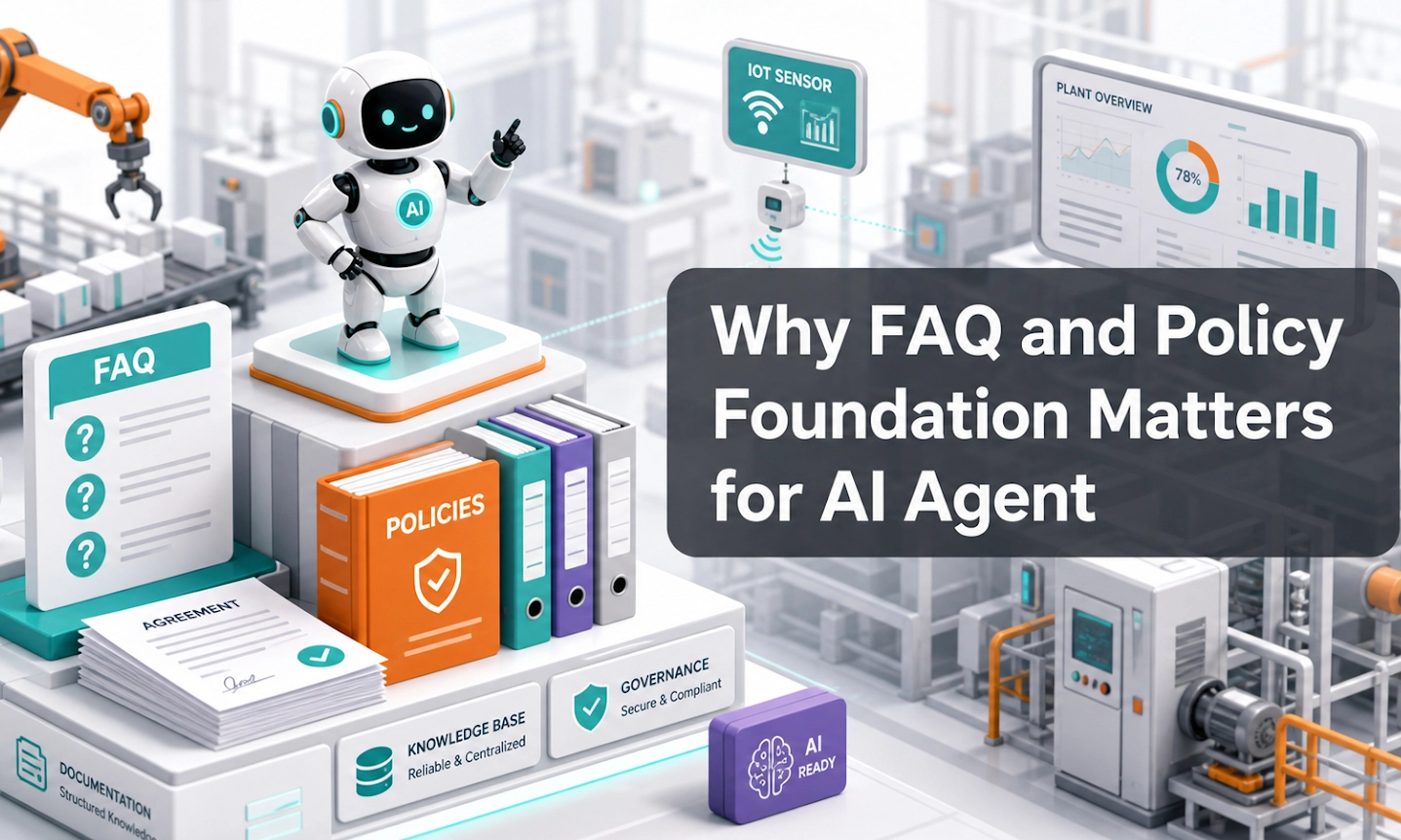
FAQ, agreement, and policy are the foundation of your AI Agent because they define how your business operates. Product data tells the AI Agent what your business offers, but FAQ, agreement, and policy tell the AI Agent how your business should answer customers, what rules must be followed, what can be promised, what should be avoided, and when human approval is required.
For industrial B2B businesses, this is extremely important. Customers do not only ask about products. They also ask about rental terms, sales terms, payment, delivery, warranty, damage responsibility, cancellation, extension, quotation process, discount approval, availability, spare parts, service support, and agreement conditions.
Without these business documents, the AI Agent may understand your product catalogue but still fail to represent your business properly. With clear FAQ, agreement, and policy, Antbuildz AI Agent can answer more accurately, stay within your company rules, qualify enquiries better, and know when to hand over to your team.
Introduction
Many businesses think an AI Agent only needs product information to work well. That is only half correct.
Product information helps the AI Agent understand what your business sells, rents, or supports. It tells the AI Agent about your equipment, machinery, tools, spare parts, accessories, industrial supplies, brands, models, specifications, product pages, and Webstore catalogue. This is important, but it is not enough for real customer-facing conversations.
Customers do not only ask product questions. They ask business operation questions. They may ask whether they can rent for one day, whether delivery is available to their area, whether deposit is required, what happens if equipment is damaged, whether rental can be extended, whether discount is available, whether warranty is provided, or what information is needed for quotation.
These questions cannot be answered properly by product data alone. They need FAQ, agreement, and policy.
For Antbuildz AI Agent, these documents become part of the business brain. They help the AI Agent understand not only what your company offers, but also how your company works. This is what allows the AI Agent to answer safely, ask the right follow-up questions, avoid wrong promises, and support your actual rental, sales, spare parts, service, pricing, and quotation workflows.
FAQ, Agreement, and Policy Are Not Just Documents
FAQ, agreement, and policy are often treated as support documents, but in reality, they are the operating foundation of the business. They define how your company communicates with customers, what your team can promise, what customers must follow, what situations require approval, and how common issues should be handled.
Your FAQ explains what customers usually ask and how your company wants to answer. Your agreement defines the commercial terms, responsibilities, obligations, and conditions between your business and the customer. Your policy explains what your company allows, what it does not allow, and what process should be followed in different situations.
When these documents are clear, the AI Agent can represent your business more consistently. When they are missing, outdated, or unclear, the AI Agent may answer too generally, avoid useful answers, or give information your company cannot support later.
This is why FAQ, agreement, and policy should be prepared properly before expecting the AI Agent to perform well.
Why This Matters for Industrial B2B Businesses
Industrial B2B enquiries are more complex than normal online shopping. A customer buying a simple consumer product may only care about price, size, delivery, and payment. But an industrial B2B customer may need rental terms, sales quotation, product suitability, technical specifications, delivery coverage, site conditions, warranty, service support, spare parts compatibility, agreement terms, and payment rules.
For example, a forklift rental enquiry is not complete just because the customer asks for a forklift. Your team may still need to know the rental duration, project location, required capacity, lifting height, delivery requirement, start date, site condition, and customer contact details. Your agreement may also define minimum rental period, extension rules, return process, damage responsibility, payment terms, and other conditions.
The AI Agent cannot guess these rules. It must follow the information your business provides. That is why FAQ, agreement, and policy are not optional. They are necessary if you want the AI Agent to answer customers properly and protect your business at the same time.
What FAQ Helps the AI Agent Do
FAQ helps the AI Agent answer repeated customer questions faster and more consistently. These are the questions your sales, operations, finance, and service teams answer every week. If they are not documented, your AI Agent may either answer too generally or hand over to humans too early.
A strong FAQ library should cover questions such as what information is needed for quotation, whether your business supports rental and sales, what the minimum rental period is, whether delivery is provided, which areas are covered, whether customers can extend rental, whether deposit is required, whether warranty is provided, whether spare parts are available, and what happens if the product is damaged.
Good FAQ answers should be written in clear customer language. Avoid vague answers like “subject to company policy” or “refer to agreement.” These answers may be technically correct, but they are not useful enough for customers or AI Agent responses.
A better FAQ answer would be: “Rental extension depends on product availability and agreement terms. Customers should request extension before the current rental period ends and provide the product, location, and requested extension duration for confirmation.”
This type of answer gives the AI Agent a clear and safe response to use.
What Agreement Helps the AI Agent Do
Agreement terms help the AI Agent understand the commercial boundaries of your business. This is especially important for rental, sales, service, and high-value industrial B2B transactions where responsibilities and terms must be clear.
For rental businesses, agreement terms may cover rental period, payment, delivery, damage responsibility, extension, return, cancellation, replacement, insurance, and customer responsibilities. For sales businesses, agreement terms may cover payment, warranty, delivery, acceptance, cancellation, quotation validity, after-sales support, and product condition.
The AI Agent should not freely create, change, or interpret agreement terms beyond what your business has approved. It should explain approved terms in simple language, collect relevant details when needed, and hand over to your team when the case is unclear, sensitive, or requires approval.
For example, if a customer asks who is responsible if equipment is damaged, the AI Agent should answer based on your approved agreement terms. If the situation involves a dispute, accident, unclear responsibility, or special case, the AI Agent should collect the necessary details and hand over to the right team for review.
This protects both your customer and your business.
What Policy Helps the AI Agent Do
Policies tell the AI Agent what your company allows and what it should avoid. A policy is not only a written rule. It is a decision guide that helps the AI Agent know how to respond in different situations.
Important policies may include delivery policy, payment policy, warranty policy, cancellation policy, refund policy, rental extension policy, damage policy, service support policy, stock confirmation policy, discount approval policy, complaint handling policy, and escalation policy.
These policies help prevent the AI Agent from overpromising. For example, if final delivery depends on product availability, location, schedule, and logistics confirmation, the AI Agent should not promise delivery immediately. Instead, it should collect the required details and prepare the enquiry for confirmation.
A safe and useful answer would be: “Delivery depends on product type, location, required date, and availability. May I know your project location and required date so our team can confirm the delivery arrangement?”
This kind of answer is helpful without creating business risk.
Business Rules Tell the AI Agent What to Do Next
FAQ, agreement, and policy explain the business. Business rules tell the AI Agent what action to take during the conversation.
For example, if a customer asks for rental price, the AI Agent should collect product type, rental duration, location, delivery requirement, and start date before quotation follow-up. If a customer asks for discount, the AI Agent should not approve it directly. It should collect the details and hand over to sales. If a customer asks about spare part compatibility, the AI Agent should ask for brand, model, serial number, part number, photo, quantity, and urgency.
This is where the AI Agent becomes more than a question-answering tool. It becomes a business assistant that knows how to guide the customer through the right workflow.
For Antbuildz subscribers, this is especially important because rental, sales, spare parts, service, pricing, and technical enquiries all need different information. If the AI Agent follows the wrong workflow, your sales team will still need to restart the conversation from zero.
What Subscribers Should Prepare
To make Antbuildz AI Agent more accurate and useful, subscribers should prepare the most important customer-facing business rules first. You do not need to prepare everything perfectly on day one, but you should start with the areas that customers ask about most often.
Prepare these core items:
Common FAQs
Rental terms
Sales terms
Payment terms
Delivery policy
Warranty policy
Damage responsibility
Cancellation and return rules
Rental extension rules
Quotation process
Pricing and discount boundaries
Spare parts enquiry rules
Service support rules
Complaint escalation rules
Human handover rules
The best starting point is your real customer questions. Look at WhatsApp messages, emails, sales conversations, quotation requests, and repeated customer objections. These are the questions your AI Agent should be trained to handle first.
How to Write Better FAQ, Agreement, and Policy Content for AI
Good AI-ready content should be clear, specific, and practical. Avoid writing only for internal staff. The AI Agent needs information that can be used to answer customers directly and safely.
A weak rule says: “Handle according to company policy.”
A stronger rule says: “If a customer asks for rental extension, ask for the current rental item, current rental end date, requested extension period, project location, and contact details. Explain that extension is subject to availability and agreement terms, then prepare the enquiry for confirmation.”
A good business rule should explain the customer situation, what the AI Agent can say, what the AI Agent should ask, what it must avoid, when to hand over, and what details to collect before handover.
The clearer the rule, the easier it is for the AI Agent to behave correctly.
How AI Console Helps
Antbuildz AI Console helps subscribers manage and improve the business knowledge behind the AI Agent. When customers ask new questions, subscribers can add new FAQs. When the AI Agent gives a weak answer, the knowledge base can be improved. When rental terms, sales terms, delivery policies, warranty rules, or agreement conditions change, subscribers can update the relevant information.
AI Console also helps businesses refine agent behaviour, enquiry workflows, lead capture rules, deal intent capture, and handover instructions. This gives subscribers more control over how the AI Agent represents the business.
The AI Agent should not be treated as a one-time setup. It should improve as your business improves its knowledge, policies, and rules.
What the AI Agent Should Not Do
A good AI Agent should be helpful, but it must also know its limits. Antbuildz AI Agent should not invent product specifications, guess spare part compatibility, confirm final stock unless data is reliable, promise delivery dates without confirmation, approve discounts, change agreement terms, make legal commitments, or handle serious complaints without escalation.
If the information is unclear, the AI Agent should ask follow-up questions or hand over for human review. This does not make the AI Agent weaker. It makes the AI Agent safer and more reliable.
The goal is controlled automation, not uncontrolled answering.
Common Mistakes to Avoid
One common mistake is uploading long agreement or policy documents without simplifying the key points into clear FAQ answers and business rules. Long documents may be useful as reference, but customers need clear answers.
Another mistake is having conflicting information. If one document says one thing and another document says something different, the AI Agent may struggle to know which rule to follow. Old terms, outdated policies, and duplicated documents should be cleaned up.
A third mistake is allowing the AI Agent to answer sensitive topics too freely. Pricing, discounts, stock confirmation, delivery promises, warranty disputes, complaints, and agreement changes need clear boundaries.
Finally, do not let the AI Agent hand over too early or too late. It should collect useful details first, but it should also know when human judgement, approval, negotiation, or complaint handling is required.
FAQ
1. Why do FAQs matter for Antbuildz AI Agent?
FAQs help the AI Agent answer repeated customer questions consistently. They reduce repetitive sales work and help customers get faster answers based on approved information.
2. Why do agreement terms matter?
Agreement terms define the commercial rules, responsibilities, and conditions between your business and the customer. The AI Agent should follow these approved terms instead of guessing or creating its own answer.
3. Why do policies matter?
Policies tell the AI Agent what your company allows, what it does not allow, and what process should be followed. This helps prevent wrong promises around delivery, payment, warranty, cancellation, discounts, and service support.
4. What should I prepare first?
Start with the most common customer questions, rental terms, sales terms, delivery policy, payment terms, warranty policy, quotation process, pricing boundaries, and handover rules.
5. Can the AI Agent answer pricing questions?
Yes, if pricing rules are clearly defined. The AI Agent can explain pricing factors or approved listed prices. For final quotation, discount, special pricing, or negotiation, it should follow your configured rules and hand over when needed.
6. Can the AI Agent explain agreement terms?
Yes, it can explain approved agreement terms in simple language. However, it should not change terms, give legal interpretation beyond approved content, or handle disputes without human review.
7. How often should these documents be updated?
Update them whenever your business rules change. This includes changes to rental terms, sales terms, pricing, delivery, warranty, service coverage, agreement terms, payment policy, or customer enquiry process.
8. Who should prepare these documents?
Sales, operations, service, finance, and management should work together. Sales knows customer questions, operations knows fulfilment rules, service knows support issues, finance knows payment rules, and management should approve sensitive business rules.
Conclusion
FAQ, agreement, and policy are not optional extras. They are the foundation that allows Antbuildz AI Agent to represent your business properly.
Product data helps the AI Agent understand what you offer. FAQ helps it answer repeated customer questions. Agreement terms help it respect commercial boundaries. Policies help it follow your company rules. Business rules help it know what to ask, what to avoid, and when to hand over.
For industrial B2B businesses, this matters because customer enquiries often involve rental, sales, pricing, delivery, availability, warranty, spare parts, service support, technical suitability, and agreement terms.
The clearer these documents are, the more accurate, useful, and safe your Antbuildz AI Agent becomes.
Start by preparing your common FAQs, approved agreement terms, rental and sales policies, pricing boundaries, delivery rules, service rules, complaint escalation process, and handover instructions inside Antbuildz AI Console.