Many industrial B2B businesses already have a product catalogue.
It may be a PDF brochure, Excel file, printed booklet, website page, WhatsApp album, or internal product list.
That is a good starting point.
But it is not enough.
A catalogue can show your products, but it usually cannot guide the customer. It cannot explain specifications in simple language. It cannot ask follow-up questions. It cannot understand whether the customer wants rental, sales, spare parts, service, or technical advice. It cannot capture deal intent. It cannot turn online browsing into a structured sales enquiry by itself.
This is the gap.
Industrial B2B customers are not always looking for a simple product name. They may be trying to solve a job. They may need help choosing the right product, comparing options, understanding specifications, checking suitability, confirming delivery area, asking about rental, or preparing information for quotation.
A static catalogue cannot handle that conversation.
Antbuildz AI Webstore is designed to solve this problem.
It combines structured product pages, Webstore data, business rules, enquiry workflows, Knowledge Base, AI Agent, and AI Console control so your product information becomes more than a list.
It becomes a digital sales channel.
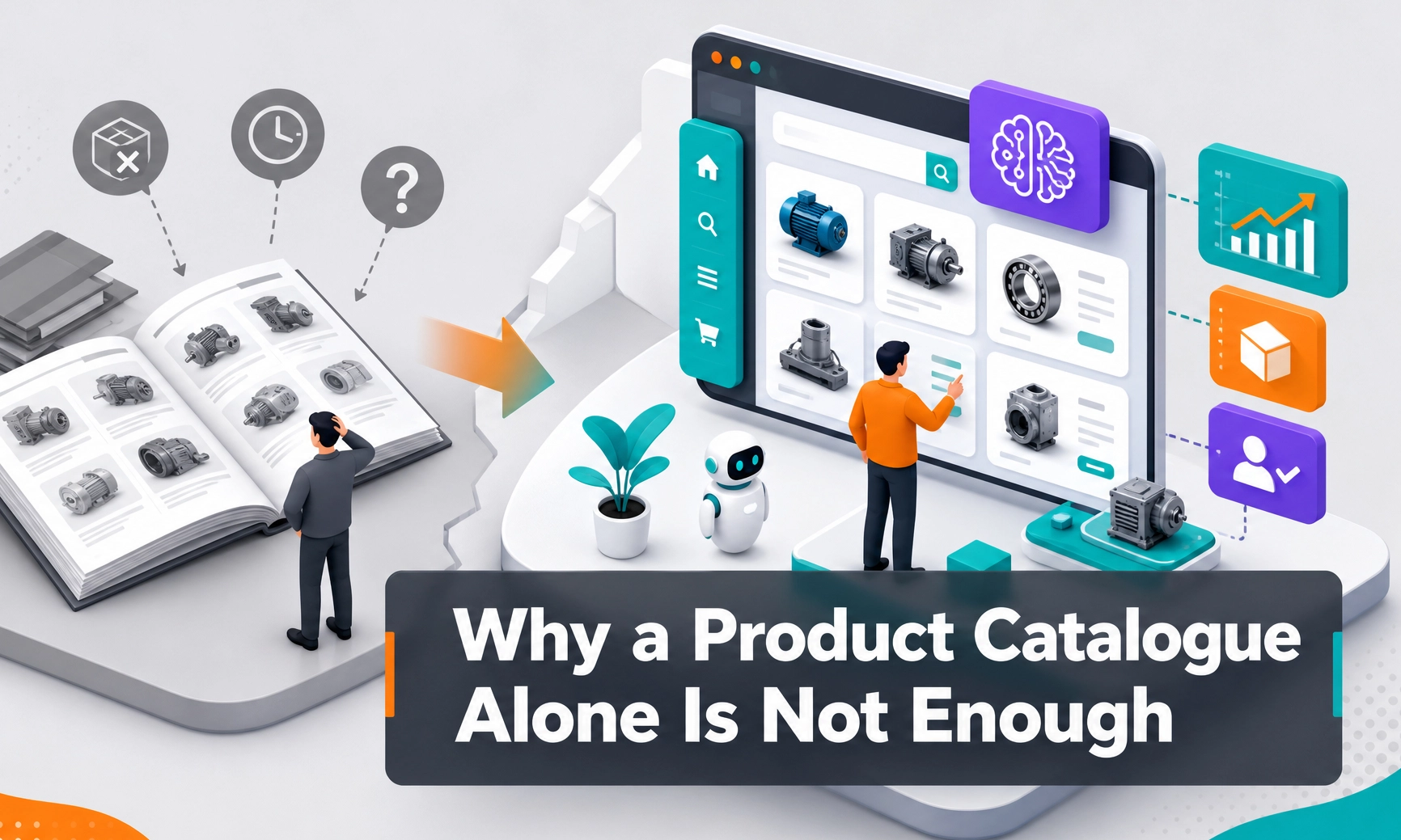
Catalogue Shows Products. AI Webstore Guides Customers.
The main difference is simple:
A product catalogue displays information.
An AI Webstore supports the customer journey.
A catalogue says:
“Here are our products.”
An AI Webstore helps answer:
“Which product is suitable for my requirement?”
“What do these specifications mean?”
“Should I rent or buy?”
“What details do I need to provide?”
“Can this product fit my job site?”
“What is the next step?”
“Can I submit an enquiry with the right information?”
This is a big difference.
For industrial B2B businesses, product discovery is not enough. Customers need guidance.
That is why a catalogue alone cannot fully support modern digital sales.
Why Product Catalogues Alone Fail in Industrial B2B
Product catalogues are useful, but they have serious limitations.
1. Catalogues Are Often Too Technical
Industrial product catalogues are usually written for people who already understand the product.
They may include model numbers, capacity, working height, engine type, voltage, dimensions, compatibility details, fuel type, attachment type, and other technical terms.
This information is important, but not every buyer knows how to interpret it correctly.
In many companies, the person browsing the catalogue may not be the final technical expert. They may be a purchaser, procurement executive, admin staff, project coordinator, site representative, or first-time buyer trying to source the right product for the team.
Even experienced buyers may not understand every product across every category.
For example, a purchaser may understand forklifts but not scissor lifts. A project coordinator may know the site requirement but not the exact machine model. A procurement team may be comparing options from different suppliers but may not know which specification matters most.
This is why a catalogue alone is not enough.
Customers do not only need product information. They need help understanding what the information means.
2. Different Brands Present Specifications Differently
Another problem is that every brand may present specifications in a different way.
One brand may highlight working height.
Another may highlight platform height.
Another may use different capacity wording.
Another may describe power, size, compatibility, or application differently.
Even when two products look similar, the way their specifications are presented may make comparison difficult.
This creates confusion for buyers.
They may ask:
Are these two models actually comparable?
Which specification should I focus on?
Is this suitable for indoor or outdoor use?
Is this enough for my load requirement?
Is this model better for short-term or long-term rental?
Is this product suitable for my site condition?
A catalogue may show the data, but it may not explain the difference clearly.
Antbuildz AI Webstore helps by structuring product information more clearly and allowing Antbuildz AI Agent to explain, compare, and guide customers based on their requirements.
3. Many Buyers Are First-Touch Purchasers
In industrial B2B sales, the person making the first enquiry may not be a product expert.
They may be assigned to source a product for a project, department, warehouse, factory, or site team.
They may not know every product name, model, capacity, size, or specification.
They may simply know the job they need to solve.
For example:
“We need something to reach the ceiling for maintenance.”
“We need to move heavy pallets in a warehouse.”
“We need backup power for a factory.”
“We need a spare part for this machine, but we are not sure what it is called.”
A catalogue may not help enough because the customer does not know what to search for.
Antbuildz AI Webstore, supported by AI Agent, can guide the customer by asking follow-up questions and mapping the requirement to a more suitable product, rental, sales, spare parts, or service enquiry.
4. Knowing How to Read Specs Does Not Mean Knowing the Best Fit
Even if a customer can read the specifications, they may still not know whether the product is the best option for the job.
This is an important point.
A product may look suitable on paper, but the real decision depends on the customer’s use case.
For example:
A machine may have enough height but may not be suitable for the floor condition.
A forklift may have enough lifting capacity but may not be ideal for a narrow warehouse.
A generator may have enough power output but may not match the actual load profile.
A spare part may look similar but may not fit the exact model.
A tool may work for one application but not another.
A rental option may be better than purchase for short-term use.
This is why product fit matters more than product information alone.
A catalogue can show what the product is.
An AI Webstore helps customers understand whether it may be suitable for their job.
5. Catalogues Are Passive
A catalogue waits for the customer to read.
But many customers do not know exactly what to look for.
They may not know the correct product name, model, capacity, height, size, attachment, spare part, or technical specification.
For example, a customer may not search for:
“Electric scissor lift 10m working height.”
They may simply ask:
“I need something for indoor ceiling maintenance.”
A catalogue may not guide them from that problem to the right product.
Antbuildz AI Webstore helps by allowing the AI Agent to ask follow-up questions and guide the customer toward a suitable option.
6. Catalogues Do Not Understand Customer Intent
The same product enquiry can mean different things.
A customer asking about “forklift” may want to:
Rent a forklift
Buy a forklift
Compare forklift models
Ask for spare parts
Arrange service
Check pricing
Confirm delivery area
Ask for availability
A catalogue cannot identify intent.
It only shows product information.
Antbuildz AI Agent can help understand what the customer is trying to do and follow the right enquiry workflow.
This matters because rental, sales, spare parts, service, pricing, and technical enquiries all require different questions.
7. Catalogues Do Not Ask Follow-Up Questions
Industrial B2B enquiries are often incomplete.
A customer may ask:
“How much is this?”
But your sales team still needs to know:
Which product?
Rental or purchase?
Quantity?
Location?
Delivery required?
Rental duration?
Start date?
Usage requirement?
Technical specification?
Budget?
Contact details?
A static catalogue cannot collect this information.
Antbuildz AI Webstore, supported by AI Agent, can help ask the right questions before the enquiry reaches your sales team.
This turns vague interest into a more complete sales opportunity.
8. Catalogues Do Not Explain Business Rules
Product facts are only one part of the sales process.
Industrial B2B customers also need to understand business rules such as:
Rental duration
Minimum rental period
Delivery rules
Service area
Warranty
Agreement terms
Payment terms
Availability process
Quotation requirements
Approval rules
Return or extension rules
A catalogue may not explain these clearly.
Even if the information exists somewhere, it may be separated from the product data.
Antbuildz AI Webstore can connect product information with Knowledge Base, FAQs, agreement terms, and workflow rules so the AI Agent can give more useful and business-specific guidance.
9. Catalogues Do Not Capture Leads Properly
A PDF catalogue may generate interest, but it does not capture a structured enquiry.
The customer may forward a screenshot, send a vague WhatsApp message, or call without complete information.
This creates more manual work for sales.
Antbuildz AI Webstore can help capture useful lead information such as:
Customer name
Company name
Contact number
Email address
Product interest
Quantity
Location
Rental or buying intent
Rental duration
Timeline
Budget range
Delivery requirement
Follow-up preference
This gives your sales team a better starting point.
Instead of receiving:
“Customer asked about generator.”
Your team can receive:
“Customer is looking for generator rental for factory backup power, located in Johor, required next month, needs advice on suitable size, and wants quotation follow-up.”
That is a much stronger enquiry.
10. Catalogues Do Not Complete the Sales Journey
A catalogue can show the product, but it usually stops there.
It does not guide the customer from browsing to enquiry.
It does not support rental flow.
It does not support sales flow.
It does not capture intent.
It does not help the customer understand what to do next.
Antbuildz AI Webstore is different because it is designed as a digital sales channel, not just a product display.
It can support:
Product browsing
Category navigation
Product pages
AI Agent conversation
Rental enquiry
Sales enquiry
Spare parts enquiry
Service enquiry
Quotation request
Lead capture
Deal intent capture
Sales team follow-up
This is the shift from catalogue to digital sales channel.
What an AI Webstore Adds Beyond a Catalogue
A strong AI Webstore adds structure, intelligence, and workflow.
1. Structured Product Pages
Each product can have its own page with product name, category, model, photos, description, specifications, rental or sales status, and enquiry action.
This gives customers a clearer experience.
It also gives the AI Agent better product context.
2. Product URLs That Can Be Shared
Every Webstore product page can have a URL.
This is powerful because the AI Agent can guide customers to a relevant product page instead of only replying with text.
Customers can see the product photo, read specifications, compare details, share the link internally, and submit an enquiry from the right page.
For industrial products, visual context matters.
Customers often want to see what they are enquiring about.
3. Rental and Sales Workflow
Rental and sales are not the same.
Rental usually requires duration, start date, location, delivery, usage, and return or extension terms.
Sales usually requires quantity, model, specification, budget, delivery location, and buying timeline.
Antbuildz AI Webstore can support both rental and sales workflows.
This makes it more useful than a normal catalogue or basic website.
4. Knowledge Base and Business Rules
A product catalogue gives product facts.
Knowledge Base gives business rules.
This may include FAQs, agreement terms, pricing rules, rental policy, delivery coverage, warranty information, service rules, and internal sales instructions.
When combined with AI Agent, this helps customers get more relevant answers.
The AI Agent does not only know what the product is. It can understand how the business handles the enquiry.
5. AI Agent for Guided Conversations
The AI Agent helps turn browsing into conversation.
It can explain products, ask follow-up questions, reason through requirements, compare options, and capture lead details.
For example, if a customer asks:
“Which forklift is suitable for indoor warehouse use?”
The AI Agent can ask about load capacity, lifting height, aisle width, rental duration, location, and diesel, electric, or lithium preference.
This is much better than leaving the customer to guess from a catalogue.
6. AI Console for Control and Improvement
A good AI Webstore should not be static.
Your products, policies, pricing rules, FAQs, and customer questions change over time.
Antbuildz AI Console helps subscribers improve their AI Agent by managing knowledge base content, agent behaviour, FAQs, enquiry workflows, conversation review, and lead capture rules.
This gives businesses control.
The AI Agent becomes better as the business updates information and reviews real customer conversations.
Product Catalogue vs Antbuildz AI Webstore
| Area | Product Catalogue | Antbuildz AI Webstore |
|---|---|---|
| Product display | Shows product list | Creates structured product pages |
| Technical explanation | Customer reads alone | AI Agent explains in simpler language |
| Product comparison | Manual and often difficult | AI Agent can guide comparison |
| Customer intent | Not captured | AI Agent identifies enquiry intent |
| Follow-up questions | Not available | AI Agent asks based on workflow |
| Product fit | Customer must decide alone | AI Agent helps clarify suitability |
| Rental workflow | Usually manual | Can support rental enquiry flow |
| Sales workflow | Usually manual | Can support sales enquiry flow |
| Business rules | Often separate | Can connect with Knowledge Base and workflows |
| Lead capture | Often vague | Captures structured enquiry details |
| Product URL | Often unavailable or hard to share | Product pages can be shared and referenced |
| Sales team support | Sales starts from zero | Sales receives better context |
| Continuous improvement | Static | AI Console supports ongoing improvement |
This is why a product catalogue alone is not enough.
The catalogue is only the starting point.
The Webstore turns that product information into a working sales channel.
Example: Forklift Catalogue vs AI Webstore
Imagine your catalogue lists several forklift models.
A customer sees the list but still does not know which one to choose.
They may ask:
“Which forklift is suitable for indoor warehouse use?”
With a normal catalogue, the customer has to read, compare, and guess.
They may contact sales with incomplete information.
With Antbuildz AI Webstore, the customer can browse forklift product pages and ask the AI Agent.
The AI Agent can then ask:
Are you looking to rent or buy?
What lifting capacity do you need?
What lifting height do you need?
Is it indoor or outdoor use?
What is the aisle width?
What is your location?
How long do you need it?
Do you prefer diesel, electric, or lithium forklift?
After collecting the information, the AI Agent can guide the customer toward a more suitable product page or prepare a better enquiry for the sales team.
This is the difference.
The catalogue shows the forklift.
The AI Webstore helps the customer understand, choose, and enquire.
What Your Catalogue Needs Before It Becomes Useful for AI
If you want your catalogue to support AI Agent properly, do not only upload product names and photos.
You should also prepare:
Product categories
Product descriptions
Product specifications
Photos
Use cases
Unsuitable use cases
Rental or sales status
Pricing rules, if applicable
Availability or inventory rules, if applicable
Location and delivery coverage
FAQs
Agreement terms
Warranty or service rules
Comparison notes
Required enquiry questions
Lead capture fields
Handover rules
The better this information is structured, the better the AI Agent can guide customers.
What Antbuildz AI Agent Should Not Do
A good AI Agent should help customers, but it should also stay within business rules.
Antbuildz AI Agent should not invent product specifications, pricing, stock availability, delivery promises, agreement terms, or spare part compatibility if the information is not available in the approved business data.
If the information is unclear, the AI Agent should ask follow-up questions, provide careful guidance, or prepare the enquiry for sales or technical confirmation.
This protects customer trust and keeps the business in control.
Why This Matters for Scaling
Many industrial B2B businesses want to grow, but growth creates more enquiries.
More enquiries usually mean more salespeople, more admin work, more repetitive questions, and more follow-up pressure.
An AI Webstore helps scale the front part of the sales process.
It can help customers browse, understand, compare, ask, and enquire without depending entirely on manual sales response.
This is useful for businesses that want to:
Improve online conversion
Reduce missed enquiries
Support more product categories
Handle repeated questions
Scale rental and sales enquiries
Support multilingual customers
Test overseas markets
Grow without immediately hiring more people
A catalogue alone cannot do this.
An AI Webstore can.
FAQ
1. Is a product catalogue still useful?
Yes. A product catalogue is still useful, but it is only the starting point.
To support digital sales and AI Agent conversations, catalogue data should be cleaned, structured, and connected to business rules, workflows, FAQs, and enquiry paths.
2. Why is a PDF catalogue not enough?
A PDF catalogue is usually static.
It may show product information, but it does not guide customers, ask follow-up questions, capture lead details, support rental or sales workflows, or help customers move toward quotation.
3. Why do buyers struggle with technical catalogues?
Industrial catalogues often use technical terms, model numbers, specifications, and brand-specific formats.
Many buyers may be purchasers, procurement staff, coordinators, or first-time users who need help understanding what the information means and whether the product is suitable for the job.
4. What should be added beyond catalogue data?
You should add business rules, pricing logic, rental or sales terms, FAQs, delivery areas, agreement policies, product use cases, comparison notes, and enquiry workflows.
This helps the AI Agent answer better and capture better enquiries.
5. How does Antbuildz AI Webstore help?
Antbuildz AI Webstore turns product data into structured product pages, enquiry paths, AI Agent conversations, lead capture, rental or sales workflows, and customer-facing product guidance.
It helps customers move from browsing to enquiry.
6. Can the AI Agent use product specifications?
Yes, if the specifications are accurate and clearly structured.
The AI Agent can help explain specifications in customer-friendly language and ask follow-up questions based on the customer’s use case.
7. Can Antbuildz AI Webstore support rental and sales?
Yes. Antbuildz AI Webstore can support rental, sales, or both, depending on the business model.
This is important for industrial B2B businesses because rental and sales enquiries require different information and workflows.
8. Does this help the sales team?
Yes. When customers are guided properly and enquiries are captured with more complete details, the sales team can follow up faster and with better context.
This reduces repetitive clarification work and helps the team focus on serious opportunities.
Conclusion
A product catalogue is useful, but it is not enough.
It shows what your business offers, but it does not always help customers understand technical specifications, compare brands, choose the best option for the job, qualify their own requirements, or submit a complete enquiry.
Antbuildz AI Webstore helps solve this.
It turns product information into structured product pages, AI-guided conversations, rental and sales workflows, lead capture, and better customer enquiry journeys.
For industrial B2B businesses, this is the real shift:
From static catalogue to digital sales channel.
From technical product list to guided customer understanding.
From online browsing to qualified enquiry.
Ready to turn your product catalogue into an AI-powered sales channel? Build your Antbuildz Webstore and connect it with Antbuildz AI Agent to help customers browse, understand, ask, and enquire faster.