A customer sends a short message:
“Do you have forklift?”
At first glance, it looks simple. But for an industrial B2B business, this one question can mean many different things.
The customer may want to rent a forklift for one week.
They may want to buy a used forklift.
They may need spare parts.
They may be asking for servicing.
They may want to compare diesel, electric, and lithium models.
They may only be checking price, availability, or delivery area.
Each intent requires a different response.
A rental enquiry needs location, rental duration, start date, and delivery details.
A sales enquiry needs quantity, specification, budget, and buying timeline.
A spare parts enquiry needs brand, model, serial number, part number, or photo.
A service enquiry needs machine details, issue description, urgency, and location.
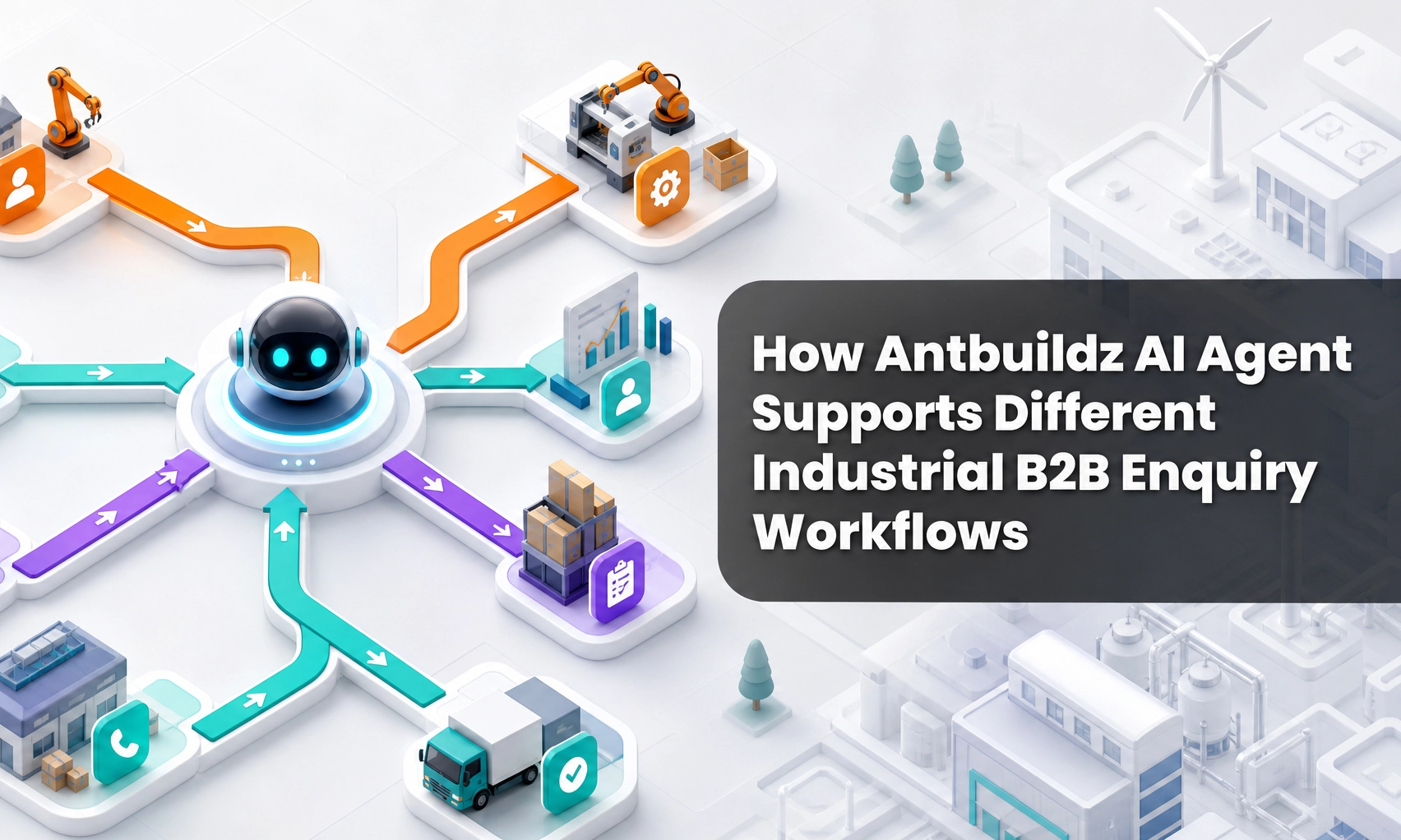
This is why Antbuildz AI Agent is built around workflow intelligence.
It does not treat every customer message the same way. It first understands what the customer is trying to do, then follows the right enquiry flow based on the business model, product type, and customer intent.
For industrial B2B businesses, this means the AI Agent can support rental, sales, spare parts, service, technical, pricing, delivery, and product recommendation enquiries in a more structured and useful way.
Why Workflow Intelligence Matters
Most businesses do not lose opportunities because they have no products.
They lose opportunities because enquiries are slow, incomplete, scattered, or handled with the wrong flow.
In industrial B2B sales, the right follow-up question depends on the type of enquiry.
If the customer wants rental, you should ask about duration, start date, location, delivery, and usage.
If the customer wants sales, you should ask about quantity, specification, budget, model preference, and buying timeline.
If the customer wants spare parts, you should ask about brand, model, serial number, part number, photo, and urgency.
If the customer wants service, you should ask about issue description, machine model, error code, location, and urgency.
A generic chatbot may only answer the surface-level question.
Antbuildz AI Agent is designed to understand the workflow behind the question.
That is the difference.
The Problem With Generic AI Chatbots
Generic AI chatbots usually work well for simple FAQs.
They can answer questions like:
What are your opening hours?
Where is your office?
How can I contact your team?
Do you provide delivery?
But industrial B2B enquiries are not always that simple.
A customer may describe a job instead of naming a product.
For example:
“I need something to lift materials in a narrow indoor area.”
A basic chatbot may not know whether the customer needs a forklift, pallet jack, material hoist, mini crane, spider crane, or another lifting solution.
It may give a generic reply.
Antbuildz AI Agent is designed to reason through this type of enquiry.
It can ask:
What is the load weight?
What is the lifting height?
Is it indoor or outdoor?
How narrow is the working area?
What is the project location?
How long do you need it?
Are you looking to rent or buy?
This helps move the customer from an unclear request to a more structured sales enquiry.
Business Brain + Workflow Engine + Webstore Structure
Antbuildz AI Agent is built with more than general AI knowledge.
It combines three important layers:
Industrial B2B business logic
Configurable workflow engine
Structured Webstore data
Together, these layers help the AI Agent understand what the customer wants, what information is missing, and what should happen next.
1. Industrial B2B Business Logic
Industrial B2B sales is different from normal e-commerce.
Customers often need guidance before they decide. They may not know the exact product, model, capacity, size, or specification they need.
Antbuildz AI Agent is built with industrial B2B enquiry logic, so it can better understand common enquiry patterns such as:
Rental enquiry
Sales enquiry
Spare parts enquiry
Service enquiry
Technical enquiry
Pricing enquiry
Delivery enquiry
Product recommendation enquiry
Quotation follow-up
Lead capture and deal intent
This allows the AI Agent to behave more like an industrial sales assistant instead of a basic FAQ bot.
2. Configurable Workflow Engine
Every company has its own process.
A rental company may need to collect rental duration, project location, delivery requirement, and start date.
A sales company may need to collect quantity, budget, technical specification, and buying timeline.
A spare parts company may need brand, model, serial number, part number, and photo.
A service company may need issue description, error code, location, urgency, and contact person.
This is why Antbuildz AI Agent includes configurable workflow capability.
Subscribers can configure how the AI Agent should handle different enquiry types, what questions it should ask, what information it should collect, and when the enquiry should move to sales, service, or support follow-up.
This makes the AI Agent more practical.
It is not only chatting with customers. It is helping your business follow a proper enquiry process.
3. Structured Webstore Data
The Webstore gives the AI Agent a structured product and sales environment.
Instead of depending only on uploaded documents, Antbuildz AI Agent can work with Webstore information such as:
Product categories
Product pages
Product names
Brands and models
Photos
Specifications
Product descriptions
Rental or sales options
Product URLs
Location data
Inventory-related information
Enquiry actions
FAQs
Agreement or policy pages
This gives the AI Agent better context.
If a customer is viewing a forklift product page and asks:
“Is this suitable for indoor warehouse use?”
The AI Agent can understand the product context and ask better questions about lifting capacity, lifting height, aisle width, fuel type, rental duration, and location.
This is much stronger than a standalone AI chatbot that only depends on uploaded documents.
A Simple Look at the Technology Behind the Workflow
Antbuildz AI Agent is not just a chat box.
At a high level, it combines:
Large Language Model capability
Intent understanding
Business knowledge
Webstore data
Reasoning logic
Enquiry workflow
Lead capture
Deal intent identification
The flow is simple.
First, the AI Agent understands the customer’s message.
Second, it identifies the likely intent.
Is the customer trying to rent, buy, repair, compare, find parts, ask for specifications, check availability, or request pricing?
Third, the AI Agent retrieves relevant business information.
This may include Webstore product data, knowledge base content, FAQs, agreement terms, pricing rules, location data, inventory-related information, service policies, and enquiry workflows.
Fourth, the AI Agent applies the right business logic.
It asks the right questions, avoids unsupported claims, captures useful details, and guides the customer toward the next step.
In simple terms, Antbuildz AI Agent does not only answer questions. It helps route the customer into the right industrial B2B workflow.
1. Product and Technical Enquiries
Many customers start by asking product-related questions.
They may ask about:
Product suitability
Product specifications
Model differences
Load capacity
Working height
Power output
Compatibility
Application
Indoor or outdoor use
Safety requirement
Product alternatives
For example:
“Is this generator suitable for factory backup power?”
Or:
“Which scissor lift should I use for indoor maintenance?”
Or:
“Can this product handle heavy-duty site work?”
Antbuildz AI Agent can help explain product information in simpler language, ask for missing details, and guide the customer toward a more suitable option based on approved business data.
For complex or safety-sensitive cases, the AI Agent should not guess. It should collect the right information and guide the customer toward technical confirmation.
The goal is to reduce confusion and help customers understand the product better before they enquire.
2. Rental Enquiries
Rental enquiries are usually time-sensitive.
Customers may ask:
“Do you have forklift rental for one month?”
Or:
“Can I rent a scissor lift next week?”
Or:
“Do you provide generator rental for my site?”
For rental enquiries, Antbuildz AI Agent can collect key information such as:
Product or equipment type
Rental duration
Start date
Project location
Delivery requirement
Usage purpose
Site condition
Required capacity, height, size, or specification
Contact details
Rental enquiries require different questions from sales enquiries.
A rental customer usually cares about timing, availability, location, delivery, duration, and usage requirement.
Antbuildz AI Agent can help collect these details before the sales team follows up.
This makes the enquiry more complete and easier to act on.
3. Sales and Purchase Enquiries
Sales enquiries usually require more product comparison and buying qualification.
A customer may ask:
“Do you sell this model?”
Or:
“Can you recommend a suitable forklift for warehouse use?”
Or:
“What options do you have for new or used machines?”
For sales enquiries, Antbuildz AI Agent can ask about:
Product category
Preferred model or brand
Quantity
Budget range
Technical specification
Delivery location
Buying timeline
New or used preference
Application or use case
Buying intent
This helps the AI Agent understand whether the customer is casually browsing, comparing options, or ready for sales follow-up.
For industrial B2B sales, this is important because buying decisions often involve budget approval, management review, project timeline, and technical suitability.
Antbuildz AI Agent helps prepare the conversation before the salesperson steps in.
4. Spare Parts, Tools, and Accessories Enquiries
Spare parts and accessories enquiries can be difficult because customers may not know the exact part name or part number.
They may ask:
“Do you have tyres for this model?”
Or:
“I need a replacement battery.”
Or:
“Can you help me find a hydraulic filter for this machine?”
For spare parts enquiries, Antbuildz AI Agent can collect details such as:
Brand
Model
Serial number
Part number, if available
Machine type
Photo or description
Quantity
Urgency
Delivery location
Replacement or alternative requirement
This is where the AI Agent must be careful.
Spare part compatibility can be sensitive. The AI Agent should not guess if the information is unclear.
Instead, it should collect the right details, check against the available knowledge base or Webstore data, and prepare the enquiry for follow-up.
This helps reduce wrong enquiries and saves time for both customer and sales team.
5. Service and Support Enquiries
Some businesses provide service, repair, maintenance, inspection, or after-sales support.
Customers may ask:
“My machine is not working. Can you help?”
Or:
“Do you provide maintenance service?”
Or:
“Can I arrange repair support?”
For service enquiries, Antbuildz AI Agent can collect useful information such as:
Product or machine type
Brand and model
Issue description
Error code, if any
Location
Urgency
Photo or supporting details
Warranty or agreement status
Contact person
Preferred follow-up time
For simple support questions, the AI Agent can provide approved guidance from the knowledge base.
For technical issues that require inspection, repair, safety judgement, or on-site work, the AI Agent should not pretend to solve everything.
It should collect the required information and guide the customer to the right next step.
This helps the service or support team understand the issue faster before responding.
6. Pricing, Quotation, and Commercial Enquiries
Customers often ask about pricing early.
They may ask:
“How much is the monthly rental?”
Or:
“Can you quote me for two units?”
Or:
“What is the price if I buy in bulk?”
For pricing or quotation enquiries, Antbuildz AI Agent can help collect the information needed before pricing can be confirmed.
This may include:
Product interest
Quantity
Rental duration
Start date
Delivery location
Usage requirement
Buying or rental intent
Required specification
Contact details
Depending on the business setup, the AI Agent can explain general pricing structure or prepare the enquiry for quotation follow-up.
However, special pricing, discounts, custom terms, and high-value negotiation should follow the company’s configured business rules.
This keeps the sales conversation moving while protecting pricing control.
7. Location, Delivery, and Availability Enquiries
Industrial B2B enquiries often depend on location.
A customer may ask:
“Can you deliver to Johor?”
Or:
“Is this available in Singapore?”
Or:
“How fast can you deliver?”
Location, delivery, and availability may affect whether the business can fulfil the enquiry.
Antbuildz AI Agent can help collect:
Customer location
Project location
Delivery requirement
Preferred date
Rental duration
Quantity
Product interest
Service area
Urgency
If the Webstore or knowledge base includes location, inventory, or availability-related data, the AI Agent can use that context to guide the conversation.
If final stock or availability is not confirmed, the AI Agent should not invent the answer. It should collect the requirement and prepare it for sales team confirmation.
This is the right balance between speed and business control.
8. Lead Capture and Deal Intent Enquiries
One of the most important roles of Antbuildz AI Agent is capturing sales-ready information.
A customer may ask one simple question, but that question can become a real opportunity if the AI Agent captures the right details.
Antbuildz AI Agent can collect:
Customer name
Company name
Contact number
Email address
Product interest
Quantity
Location
Rental or buying intent
Timeline
Budget range
Urgency
Delivery requirement
Project details
Follow-up preference
It can also help identify deal intent.
For example, is the customer:
Casually browsing?
Comparing suppliers?
Asking for budgetary pricing?
Looking for urgent rental?
Ready for quotation follow-up?
Waiting for project confirmation?
Asking for technical advice?
This helps the sales team prioritise better.
The AI Agent does not only capture leads. It helps capture the context behind the lead.
Summary Table: Different Workflows Need Different Information
| Enquiry Workflow | What the AI Agent Should Understand | What the AI Agent Should Collect |
|---|---|---|
| Product / Technical | Product suitability, specification, use case | Application, capacity, size, compatibility, site condition, technical requirement |
| Rental | Rental intent, timing, location | Product type, rental duration, start date, location, delivery, usage |
| Sales / Purchase | Buying intent, product fit | Quantity, budget, model, specification, delivery location, timeline |
| Spare Parts / Accessories | Compatibility and part requirement | Brand, model, serial number, part number, photo, quantity, urgency |
| Service / Support | Issue type and urgency | Machine details, problem description, error code, location, photo, contact |
| Pricing / Quotation | Commercial intent | Product, quantity, rental duration, location, specification, contact details |
| Location / Availability | Service area and fulfilment context | Location, delivery date, product interest, quantity, urgency |
| Lead / Deal Intent | Sales readiness | Name, company, contact, timeline, budget, intent, follow-up preference |
This table shows why workflow intelligence matters.
Different enquiry types need different questions.
How Webstore Supports These Workflows
Antbuildz Webstore gives the AI Agent structured business data.
This may include:
Product categories
Product pages
Product photos
Product descriptions
Specifications
Rental or sales options
Product URLs
Location data
Inventory-related data
Enquiry actions
FAQs
Agreement or policy pages
This helps the AI Agent understand what products exist, how they are organised, and what customer journey should happen next.
For example, if a visitor is viewing a rental product, the AI Agent can ask rental-related questions. If the visitor is viewing spare parts, it can ask for model, serial number, part number, or photo.
This is the advantage of connecting the AI Agent with Webstore data.
The AI Agent is not operating blindly. It has product and workflow context.
How Knowledge Base Supports These Workflows
The Webstore gives product structure.
The knowledge base gives business rules.
The knowledge base may include:
FAQs
Pricing rules
Rental terms
Sales terms
Agreement terms
Service rules
Warranty information
Delivery policies
Handover rules
Common customer questions
Internal sales instructions
This helps the AI Agent answer more consistently and stay within approved business rules.
Without a strong knowledge base, the AI Agent may give answers that are too generic or incomplete.
With a strong knowledge base, it can support each enquiry workflow more accurately.
How AI Console Helps Businesses Configure Workflows
Every business handles enquiries differently.
One company may focus on rental.
Another may focus on sales.
Another may focus on spare parts.
Another may provide service and support.
Another may handle all of them together.
This is why Antbuildz AI Console is important.
Through AI Console, subscribers can improve how their AI Agent works by managing:
Knowledge base content
Agent behaviour
FAQs
Enquiry workflow
Required questions
Lead capture rules
Deal intent capture
Handover instructions
Conversation review
Continuous improvement
This gives businesses control over how the AI Agent handles different workflows.
The AI Agent should not be a fixed chatbot. It should be configurable based on the business model.
Example: One Customer, Multiple Possible Intents
A customer types:
“Do you have forklift?”
This looks simple, but it could mean many things.
The customer may want to:
Rent a forklift
Buy a forklift
Compare forklift models
Ask for forklift pricing
Find forklift spare parts
Request forklift service
Check delivery area
Ask for urgent availability
A weak chatbot may answer too quickly.
A stronger AI Agent should clarify the intent.
It may ask:
“Are you looking to rent, buy, request spare parts, or arrange service for a forklift?”
From there, the AI Agent can follow the right workflow.
If the customer says rental, it asks for rental duration, location, start date, and usage.
If the customer says purchase, it asks for quantity, model preference, specification, and buying timeline.
If the customer says spare parts, it asks for brand, model, serial number, and part details.
If the customer says service, it asks for issue description, machine model, location, and urgency.
This is how Antbuildz AI Agent turns a vague enquiry into a structured conversation.
What Antbuildz AI Agent Should Not Do
A good AI Agent should be useful, but it should also stay within business rules.
Antbuildz AI Agent should not:
Treat every enquiry as the same workflow
Guess spare part compatibility when data is unclear
Invent product specifications
Confirm final stock unless inventory data is reliable
Decide special pricing without approved rules
Promise delivery timelines without business confirmation
Provide unsafe technical diagnosis for complex service cases
Make legal or contractual commitments outside approved terms
If information is unclear, the AI Agent should ask follow-up questions or guide the customer to the next best step.
This protects customer trust and keeps the business in control.
Why Businesses Should Choose Antbuildz AI Agent
Industrial B2B businesses should not choose an AI solution only because it can chat.
They should choose a system that understands different enquiry workflows and can support the way their business actually operates.
Antbuildz AI Agent is built for this.
It combines:
Industrial B2B business logic
Configurable workflows
Webstore data
Knowledge base
Product pages and URLs
Rental and sales structure
Lead capture
Deal intent capture
AI Console control
This is what makes Antbuildz AI Agent different from standalone AI chat tools.
It is not just a chatbot. It is an AI sales system designed for industrial B2B enquiries.
FAQ
1. Can Antbuildz AI Agent support businesses beyond equipment rental?
Yes. Antbuildz AI Agent is designed to support a wide range of industrial B2B businesses, not only equipment rental.
It can support businesses dealing with machinery, tools, spare parts, accessories, industrial supplies, safety products, materials, technical products, rental, sales, service, or support workflows.
2. How does the AI Agent know which workflow to follow?
The AI Agent first understands the customer’s intent.
It identifies whether the customer is asking about rental, sales, spare parts, service, technical specifications, pricing, delivery, availability, or quotation follow-up.
It then follows the relevant enquiry workflow based on the business setup and available knowledge.
3. Can the AI Agent handle rental and sales in the same conversation?
Yes. Some customers may start with rental and later consider buying. Others may ask about purchase first but later decide rental is better.
Antbuildz AI Agent can support multi-turn conversations and guide the customer based on changing intent.
4. Can the AI Agent handle spare parts enquiries?
Yes, if the business provides the right product and spare parts information.
For spare parts, the AI Agent should collect important details such as brand, model, serial number, part number, photo, quantity, and urgency.
It should not guess compatibility if the information is unclear.
5. Can the AI Agent support service enquiries?
Yes. The AI Agent can collect service-related details such as machine type, issue description, error code, location, urgency, photo, and contact person.
For complex repair, inspection, or safety-critical cases, the AI Agent should guide the enquiry to human review.
6. How does Webstore improve the workflow?
Webstore gives the AI Agent structured product data, product pages, specifications, rental or sales options, product URLs, location information, and enquiry actions.
This helps the AI Agent understand the customer’s browsing context and ask more relevant questions.
7. How does AI Console help?
AI Console helps subscribers manage and improve the AI Agent.
Businesses can update knowledge base content, refine FAQs, adjust agent behaviour, configure enquiry workflows, review conversations, and improve how the AI Agent captures lead details and deal intent.
8. Will the AI Agent replace my sales or service team?
No. The AI Agent is designed to handle common early-stage enquiries and repetitive front-line work.
Your human team is still important for technical confirmation, negotiation, special pricing, complex service cases, key accounts, and closing.
Conclusion
Industrial B2B enquiries are not all the same.
A customer asking about one product may be looking to rent, buy, repair, compare, find spare parts, check pricing, confirm delivery, or request technical support.
Antbuildz AI Agent supports these different workflows by understanding customer intent, asking the right follow-up questions, using Webstore and knowledge base data, capturing lead details, and guiding the customer toward the next best step.
This is what makes it more useful than a generic chatbot.
It does not only answer messages.
It identifies the workflow, captures the right information, and prepares a better enquiry for the business.
For industrial B2B businesses, this means faster response, better qualification, fewer missed opportunities, and a sales or service team that can focus on higher-value work.
Ready to see how Antbuildz AI Agent can support your industrial B2B enquiry workflows? Book a demo and test it with your own product catalogue, Webstore data, workflows, and real customer questions.