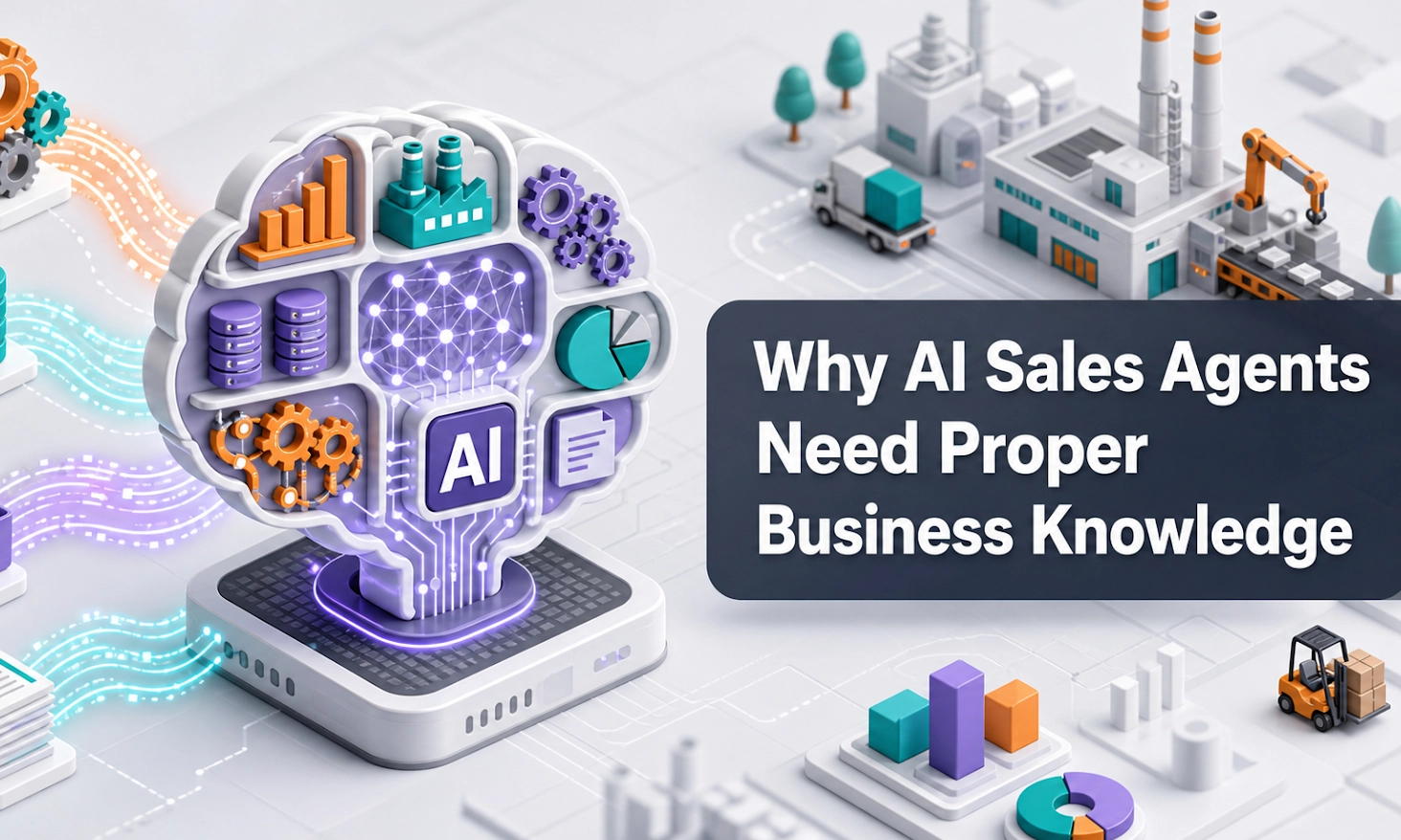
A general LLM can answer many things, but it does not automatically know your business.
This is one of the biggest misunderstandings about AI. Tools like ChatGPT, Gemini, and Claude are powerful because they can understand language, reason through questions, and generate useful responses. But unless they are connected to your business knowledge, they do not know your actual product catalogue, pricing rules, agreement terms, service areas, rental or sales process, or customer enquiry workflow.
For industrial B2B businesses, this difference matters.
Customers do not only ask simple questions. They may ask about product suitability, technical specifications, rental duration, delivery location, pricing, spare parts, alternatives, availability, service terms, and commercial requirements.
To answer properly, the AI Sales Agent needs access to your approved business knowledge — not just general AI knowledge.
That is why Antbuildz AI Agent is built around knowledge base, reasoning, business rules, and enquiry workflow. It turns general AI capability into a business-ready sales agent.
Why Business Knowledge Is the Foundation of a Good AI Sales Agent
An AI Sales Agent is only as strong as the business knowledge behind it.
If the knowledge base is incomplete, outdated, or unclear, the AI Agent may give answers that are too generic, incomplete, or wrong.
For example, a customer may ask:
“Do you have a forklift suitable for warehouse use?”
A weak AI Agent may simply give a broad answer.
A properly trained AI Sales Agent should ask better follow-up questions:
Are you looking to rent or buy?
What lifting capacity do you need?
What is the lifting height?
Is it indoor or outdoor use?
What is the location?
How long do you need it?
Do you prefer diesel, electric, or lithium?
The difference is not only the AI model. The difference is whether the AI Agent has the right business knowledge, product data, and enquiry workflow to reason through the customer’s requirement.
For industrial B2B businesses, proper business knowledge helps the AI Agent respond faster, recommend better options, capture lead details, identify deal intent, and support the sales team with more useful enquiries.
General LLM vs Business-Ready AI Sales Agent
A general LLM is powerful, but it is not automatically ready to sell for your business.
It may understand language, but it does not know your company-specific rules unless you provide them.
It does not automatically know:
Your product catalogue
Your rental or sales terms
Your pricing rules
Your agreement terms
Your delivery areas
Your preferred enquiry flow
Your lead qualification criteria
Your stock or availability rules
Your sales team handover process
Your business tone and response style
Antbuildz AI Agent is different because it is designed to work with your business knowledge.
It can use your approved product information, FAQs, agreement terms, service areas, pricing rules, and enquiry workflow to guide customer conversations in a more relevant and controlled way.
This is what turns AI from a general chat tool into a practical sales agent.
The Business Knowledge Your AI Sales Agent Needs
For industrial B2B businesses, knowledge base preparation should not be limited to uploading a few documents.
A good AI Sales Agent needs different types of business knowledge to perform properly.
1. Product Catalogue and Specifications
This is the foundation.
Your AI Sales Agent needs to understand what your business sells, rents, supplies, or supports.
This may include:
Equipment
Machinery
Tools
Spare parts
Accessories
Safety products
Industrial supplies
Materials
Technical products
Rental items
New or used products
For each product, the knowledge base should include useful information such as model, category, brand, specifications, capacity, size, power, application, use case, compatibility, and key differences between options.
Without clear product data, the AI Agent cannot guide customers properly.
For example, if a customer asks for a generator, the AI Agent should not immediately guess the answer. It should understand that more details may be needed, such as load requirement, usage duration, site condition, backup power need, and location.
2. Use Case and Recommendation Knowledge
Product data alone is not enough.
Many customers do not know what product they need. They may only describe their job, site condition, problem, or requirement.
For example:
“I need something to lift materials in a narrow indoor area.”
This is where reasoning becomes powerful.
Antbuildz AI Agent can reason through the requirement, identify missing details, ask the right follow-up questions, and guide the customer toward more suitable options based on your approved business data.
To support this, your knowledge base should include use case guidance such as:
Which product is suitable for which application
Which equipment works best for indoor or outdoor use
Which product is suitable for tight spaces
Which machine is better for heavy-duty use
Which spare part or accessory fits which model
Which rental option is better for short-term or long-term use
What alternatives can be offered when the first option is not suitable
This is one of the strongest differences between a basic chatbot and an AI Sales Agent.
A chatbot answers questions.
An AI Sales Agent helps customers find the right solution.
3. FAQs and Common Customer Questions
Your sales and support teams probably answer the same questions every day.
Customers may ask:
Do you sell or rent this product?
What is the rental duration?
What is the delivery area?
What is the minimum order?
What is the payment term?
Do you provide warranty?
Can you recommend an alternative?
What information do you need for a quote?
Is this product suitable for my project?
Do you support overseas enquiries?
These questions should be documented clearly.
A strong FAQ library helps the AI Agent answer common questions faster and more consistently. It also reduces repetitive work for your sales team.
This is often one of the fastest ways to improve AI Agent performance because FAQs are usually easy to prepare and have direct impact on customer conversations.
4. Pricing Rules and Commercial Information
Pricing is important, but it must be controlled carefully.
Your AI Sales Agent may need to understand:
General pricing structure
Rental rate logic
Sales pricing rules
Minimum rental period
Delivery fee rules
Deposit rules
Volume pricing
Discount approval rules
Quotation requirements
Special pricing restrictions
The AI Agent should not freely decide pricing by itself.
Instead, it should follow your approved pricing rules. If final pricing, special discounts, or custom commercial terms require human approval, the AI Agent should collect the required details and guide the customer to the next step.
This protects your margin while still keeping the sales conversation moving.
5. Business Policies and Agreement Terms
Business policies are important because they define how your company operates.
Your AI Sales Agent should understand approved information such as:
Rental terms
Sales terms
Payment terms
Deposit requirements
Delivery rules
Return or exchange policy
Warranty terms
Service terms
Cancellation rules
Agreement conditions
Customer responsibilities
If this information is missing, the AI Agent may either avoid answering or give an incomplete response.
Worse, if the knowledge base is unclear, it may give an answer that does not match your real business policy.
For industrial B2B businesses, this can create serious problems because agreement terms, pricing, delivery, and liability matters are commercially sensitive.
6. Service Areas, Delivery Rules, and Market Coverage
Customers often ask whether your business can serve their location.
This is especially important for equipment rental, machinery sales, spare parts supply, tools, industrial products, and overseas enquiries.
Your AI Sales Agent should understand:
Local service areas
Delivery coverage
Branch or warehouse locations
Countries or regions served
Delivery conditions
Lead time rules
Overseas enquiry handling
Areas that require manual confirmation
This is also important if your business wants to scale beyond the local market.
With proper business knowledge, Antbuildz AI Agent can support 24/7 enquiries and multilingual conversations, helping your business handle local and overseas customer interest without immediately hiring a larger sales team in every market.
7. Inventory and Availability Information
Inventory and availability can be useful, but this area must be handled carefully.
If your business has reliable inventory data connected, the AI Agent may be able to support availability-related answers based on that setup.
If live inventory is not connected, the AI Agent should not make final stock confirmation. Instead, it should collect the customer’s requirement, product interest, location, rental duration, quantity, and timeline so your sales team can confirm accurately.
This is the safer approach.
The AI Agent should not invent availability. It should only use approved data or guide the customer to the next step.
8. Agent Behaviour and Response Rules
Business knowledge is not only product information.
You also need to define how the AI Agent should behave.
This includes:
How formal or friendly the agent should sound
What language style it should use
What it should ask first
What it should avoid saying
When it should ask follow-up questions
When it should stop and collect contact details
When it should guide to sales follow-up
What topics are outside its scope
How it should handle uncertain information
This is important because every business has its own sales style.
A supplier selling high-value machinery may need a different tone from a company selling tools or spare parts. A rental business may need different enquiry questions from a sales-only business.
Agent behaviour setup helps the AI Agent sound more like your business, not a generic chatbot.
9. Sales Workflow and Lead Qualification Rules
The AI Agent should not only answer questions.
It should help move the sales conversation forward.
That means your knowledge base should include your sales workflow.
For example:
What information should be collected for rental enquiries?
What information should be collected for sales enquiries?
What information is needed before quotation?
When should the AI ask for company name and contact?
How should buying intent be captured?
How should urgent enquiries be handled?
What makes a lead qualified?
When should the sales team follow up?
This is how Antbuildz AI Agent turns conversations into useful sales opportunities.
Without workflow rules, the AI may chat well but fail to create business value.
How RAG Helps AI Agents Use Business Knowledge
Modern AI Agents often use a method called RAG, which stands for Retrieval-Augmented Generation.
In simple terms, the AI Agent does not only rely on general AI knowledge. It retrieves relevant information from your business knowledge base before generating a response.
The process usually works like this:
Your product information, FAQs, policies, and business rules are stored in a searchable knowledge base.
A customer asks a question.
The AI Agent searches the knowledge base for relevant information.
The AI Agent uses that information to generate a more business-specific answer.
If the answer is unclear or missing, the AI Agent can ask follow-up questions or guide the customer to the next step.
This is why knowledge base quality matters.
If the source information is strong, the AI Agent can give stronger answers.
If the source information is weak, the AI Agent will struggle.
What Happens When Business Knowledge Is Poor
Poor business knowledge creates poor AI performance.
Here are common problems.
1. Outdated Product Information
If your product catalogue is outdated, the AI Agent may mention products you no longer sell or rent.
It may also provide old specifications, old models, or wrong product details.
This creates confusion and damages trust.
2. Inconsistent Pricing
If your website shows one price, your spreadsheet shows another, and your sales team uses a different number, the AI Agent may not know which source to follow.
This can lead to wrong expectations, margin issues, or customer complaints.
The fix is not only better AI. The fix is clearer pricing rules and approved sources.
3. Missing Policies
If your rental terms, delivery rules, warranty conditions, or payment terms are not documented, the AI Agent cannot answer confidently.
It may need to avoid answering, ask for more details, or guide the customer to sales follow-up.
This slows down the conversation.
4. No Clear Recommendation Logic
If your knowledge base only lists products but does not explain which product fits which use case, the AI Agent may struggle to recommend properly.
For industrial B2B businesses, this is a major issue because customers often need guidance, not just information.
A strong knowledge base should include use cases, product comparisons, suitability notes, and common recommendation logic.
5. Unclear Lead Qualification Flow
If the AI Agent does not know what information to collect, it may end the conversation too early.
For example, it may answer a product question but fail to collect customer name, company, location, quantity, budget, timeline, rental duration, or buying intent.
This means the sales team still needs to restart the conversation manually.
A good AI Agent should help convert conversations into sales-ready enquiries.
How to Prepare Business Knowledge for Antbuildz AI Agent
Preparing your business knowledge does not need to be complicated.
Start with what you already have.
Step 1: Gather Existing Materials
Collect your available business information, such as:
Product catalogues
Price lists
Rental rate sheets
Product specifications
Brochures
FAQs
Agreement terms
Policy documents
Service area details
Sales scripts
Common WhatsApp replies
Customer enquiry examples
Even if the information is currently in PDFs, Excel files, Word documents, website pages, or internal notes, it can be a useful starting point.
Step 2: Clean and Remove Outdated Information
Before uploading knowledge, remove outdated or conflicting information.
Check whether:
Product models are still available
Specifications are correct
Pricing rules are current
Agreement terms are updated
Service areas are accurate
Old policies should be removed
Duplicate answers conflict with each other
This cleanup improves both the AI Agent and your internal sales process.
Step 3: Turn Repeated Questions into FAQs
Ask your sales team:
What questions do customers ask every day?
These repeated questions should become FAQs.
Common examples include pricing, delivery, rental duration, warranty, payment terms, product suitability, alternatives, and quotation requirements.
The more clearly these are documented, the more useful the AI Agent becomes.
Step 4: Define Your Enquiry Workflow
Do not only upload product information.
Define how the AI Agent should handle enquiries.
For example:
For rental enquiries, collect product type, location, rental duration, start date, usage requirement, delivery need, and customer contact.
For sales enquiries, collect product interest, quantity, specification, budget range, location, timeline, and buying intent.
For spare parts enquiries, collect brand, model, part number, serial number, photo, quantity, and urgency.
This makes the AI Agent more useful as a sales tool.
Step 5: Set Agent Behaviour Rules
Define how your AI Agent should speak and behave.
For example:
Be helpful and professional
Ask follow-up questions when information is missing
Do not invent product data
Do not confirm final stock unless approved
Do not offer special discounts unless rules are configured
Capture lead details when customer intent is clear
Guide complex technical cases to human review
Stay within the approved knowledge base
This helps control the AI Agent and protects customer trust.
Step 6: Review Real Conversations and Improve
After launch, your AI Agent should improve through review.
Your team should check:
Which questions were answered well
Which answers were weak
Which customer questions were missing from the knowledge base
Which leads were captured properly
Which workflows need adjustment
Which product content needs improvement
The AI Agent should not be treated as a one-time setup.
It should become a continuous sales improvement system.
The Bigger Benefit: Better Knowledge Helps the Whole Business
Preparing business knowledge is not only for AI.
It also improves your sales team, customer experience, product pages, webstore, marketing content, and internal training.
Many industrial B2B businesses have knowledge scattered across people, spreadsheets, WhatsApp chats, PDFs, and old websites.
The process of preparing knowledge for Antbuildz AI Agent forces the business to organise what it already knows.
This creates long-term value.
Your sales team answers more consistently.
Your customers get clearer information.
Your website and webstore become more useful.
Your AI Agent performs better.
Your business becomes easier to scale.
Frequently Asked Questions
1. Do I need perfect data before using Antbuildz AI Agent?
No. You do not need perfect data to start.
But the clearer your product information, FAQs, business rules, and enquiry workflow are, the better the AI Agent will perform.
You can start with the information you already have, then improve the knowledge base over time.
2. What type of knowledge should I prepare first?
Start with the information customers ask about most often.
This usually includes product catalogue, specifications, FAQs, pricing rules, rental or sales terms, delivery areas, agreement terms, and common enquiry questions.
After that, improve your recommendation logic, lead qualification flow, and agent behaviour rules.
3. Can Antbuildz AI Agent work if my product information is in PDFs or Excel files?
Yes. Existing documents such as PDFs, Excel files, brochures, price lists, FAQs, and product catalogues can be used as a starting point.
However, the information should be cleaned, updated, and structured where possible so the AI Agent can use it more effectively.
4. Can the AI Agent learn from customer conversations?
The AI Agent can help reveal knowledge gaps by showing what customers ask and where answers are weak or missing.
However, it should not invent missing answers by itself.
Your team should review conversations, update the knowledge base, add new FAQs, refine workflows, and improve agent behaviour based on real customer questions.
5. Why is business knowledge so important for industrial B2B sales?
Industrial B2B enquiries are often complex.
Customers may ask about product suitability, specifications, rental duration, pricing, delivery, spare parts, alternatives, or technical requirements.
Without proper business knowledge, the AI Agent may give generic answers. With proper business knowledge, it can reason through requirements and guide customers toward more suitable product, rental, or sales solutions.
6. Does better knowledge help the sales team too?
Yes. A well-structured knowledge base does not only help the AI Agent.
It also helps your human sales team answer more consistently, train faster, reduce repeated internal questions, and follow a clearer enquiry process.
This is why knowledge preparation should be seen as a business improvement project, not only an AI setup task.
Conclusion
A general LLM can understand language, but it does not automatically understand your business.
For Antbuildz AI Agent to work well, it needs proper business knowledge: product data, specifications, pricing rules, FAQs, agreement terms, service areas, agent behaviour, and enquiry workflow.
The stronger your knowledge base, the better the AI Agent can reason through customer requirements, ask the right follow-up questions, recommend suitable options, capture lead details, and identify deal intent.
AI alone is not the advantage.
The advantage comes when AI is connected to your approved business knowledge and used as a practical sales agent for industrial B2B enquiries.
Ready to build an AI Sales Agent that understands your business? Start by preparing your product knowledge, FAQs, and enquiry workflow with Antbuildz.