What is an AI technical support agent for industrial products?
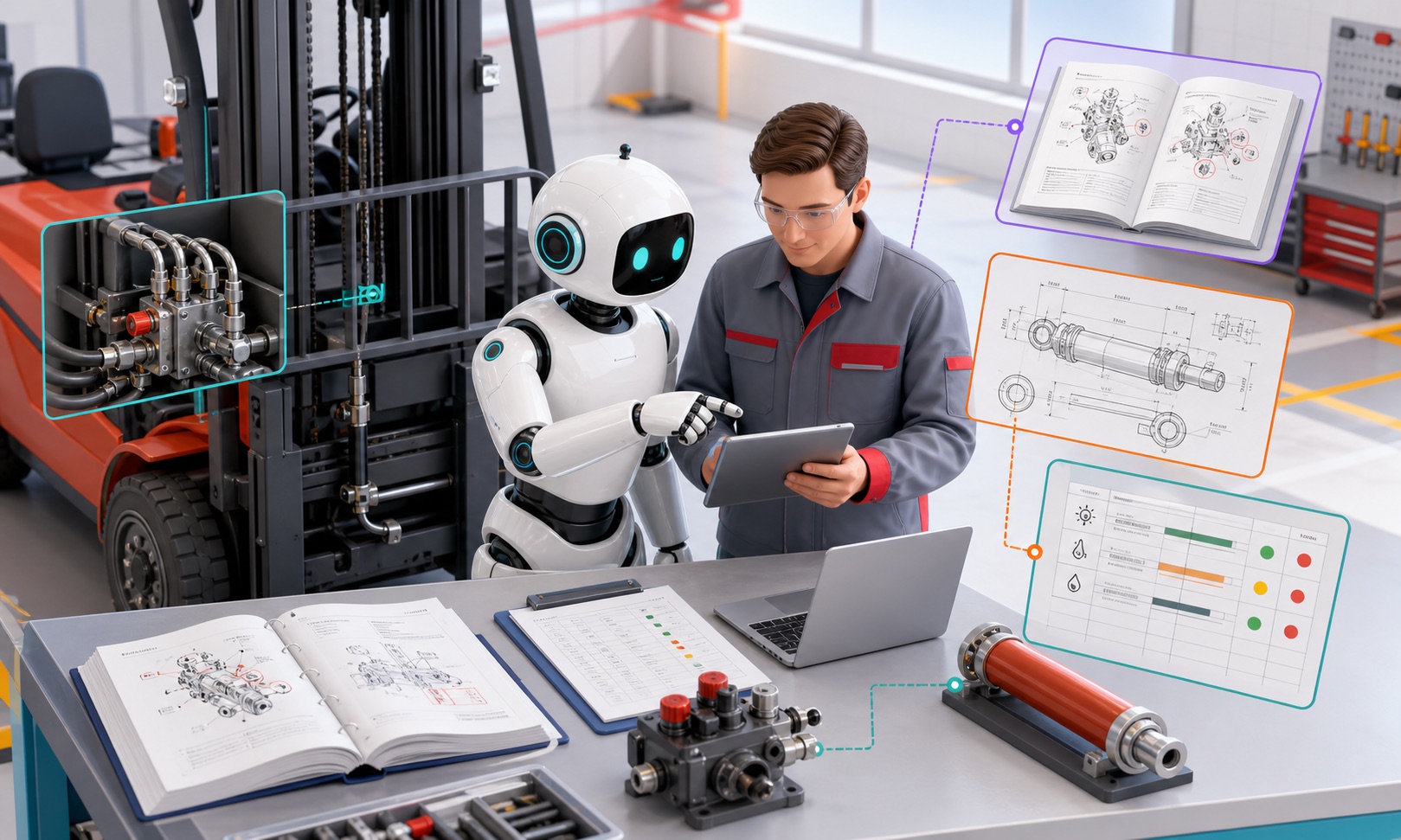
An AI technical support agent helps customers and internal teams retrieve, interpret, and compare complex product information. It can work across specifications, manuals, engineering tables, charts, diagrams, operating limits, compatibility data, troubleshooting guidance, and application requirements supplied by the business.
Industrial technical support cannot be based on fluent wording alone. A generic language model may know that a crane has a nominal maximum capacity, but that does not answer whether a load can be lifted at a specific radius, boom length, configuration, and ground condition. The correct response must come from the applicable manufacturer documentation and the right configuration-specific data.
Antbuildz is designed for industrial information where the evidence behind an answer matters. Its role is to help retrieve and reason over approved sources, explain the relevant factors, and make uncertainty visible rather than fabricate technical confidence.
What does the technical support role do?
The agent turns a technical question into a structured set of conditions, finds the documentation that applies, and uses the retrieved information to formulate a grounded answer or a clear escalation.
It can help someone locate the correct manual, identify which specification governs a decision, compare model configurations, or collect the details a product specialist needs. It is particularly useful when the answer is distributed across a catalogue, table, diagram, service note, and compatibility record.
Technical enquiries it can handle
The technical support role is suited to evidence-based questions that can be grounded in approved product and engineering information.
Retrieve product specifications, approved manuals, datasheets, and the correct document revision.
Interpret engineering tables, product charts, performance curves, reach diagrams, and configuration notes.
Compare technical configurations against a defined application requirement.
Check documented operating limits, compatibility rules, and product relationships.
Guide troubleshooting using approved diagnostic or service information.
Ask for missing conditions such as model, serial range, duty point, radius, boom length, load centre, environment, or connection standard.
Explain when available evidence is insufficient and escalate to a qualified technical professional.
A realistic crane load-chart enquiry
User: Can this crane lift a 7-tonne load at a 16-metre radius with a 34-metre boom?
Antbuildz AI agent: The crane's nominal maximum capacity cannot answer that safely. Please confirm the exact crane model, counterweight and outrigger configuration, working area, boom configuration, and whether the quoted radius is the operating radius shown in the manufacturer's chart.
User: Model GR-600EX, full outriggers, specified counterweight, over the side. The operating radius is 16 metres.
Antbuildz AI agent: I need to retrieve the approved load chart for that exact configuration and verify the 34-metre boom row at the 16-metre radius, including all chart notes and deductions. I will not infer a capacity from the crane's 60-tonne class. The lift must ultimately follow the current manufacturer chart, site conditions, lift plan, and verification by the qualified operator or appointed professional.
The process is analyse intent → extract configuration and operating conditions → retrieve the applicable chart → check the correct cell and notes → produce a cited, conditional answer or escalate. This is why generic LLM knowledge alone is not sufficient for industrial technical support.
How Antbuildz works with industrial technical information
Antbuildz can use approved technical catalogues, specification sheets, operating and service manuals, engineering tables, charts and diagrams, product relationships, configuration data, compatibility records, and internal technical guidance.
The reasoning step connects the user's conditions to the right evidence. For a pump, that may mean finding the performance curve that covers the requested flow and head, then checking fluid, temperature, material, efficiency, and motor conditions. For a forklift, it may mean checking residual capacity at the required lift height and load centre. For a replacement component, it may mean resolving the exact model and serial range before checking fitment.
Document quality and version control still matter. Antbuildz does not guarantee perfect accuracy, and it should clearly identify when source data is missing, contradictory, outdated, or requires professional confirmation.
How the technical support flow works
The technical workflow keeps the user's operating conditions connected to the source evidence used in the answer.
Ingest
Understand approved manuals, catalogues, technical specifications, tables, diagrams, service information, and company knowledge.
Reason
Interpret the application, configuration, operating conditions, technical constraints, and the evidence needed to answer.
Retrieve
Find the applicable document, table, chart, model record, compatibility rule, or troubleshooting instruction.
Act
Explain the evidence, compare supported options, retrieve the right document, ask for missing information, or escalate a safety-critical or unresolved decision.
How to configure the technical support role in Antbuildz
Technical support should begin with a narrow, well-documented product scope. The goal is not to let AI answer every engineering question; it is to make approved evidence easier to retrieve and to recognise when a qualified person must decide.
Choose a controlled technical domain
Select one product family and a defined question set, such as forklift capacity comparisons, pump selection inputs, equipment manual retrieval, component compatibility, or standard fault-code guidance. Name the decisions the agent must never make independently.
Prepare revision-controlled sources
Add current manuals, datasheets, engineering tables, charts, diagrams, service bulletins, compatibility records, and approved internal guidance to Knowledge Base. Include manufacturer, model, variant, region, document number, revision, and effective date wherever possible.
Define required technical inputs
In Agent Setup and Scenarios, state the conditions needed before the agent can answer. A pump workflow may require flow, head, fluid, temperature, materials, and power. A lifting workflow may require exact model, configuration, radius, height, load centre, attachments, and site conditions.
Configure evidence and escalation behaviour
Require the agent to distinguish quoted facts, calculated or interpreted conclusions, assumptions, and missing information. Route safety-critical, contradictory, out-of-scope, or site-specific questions to the responsible engineer, product manager, or service professional.
Test against known technical cases
Create a test set with correct answers reviewed by your technical team. Include similar model names, superseded documents, values near operating limits, wrong units, missing conditions, and questions where escalation is the only acceptable outcome.
What is technically possible in the technical support role?
The role can combine document retrieval with structured reasoning, but only within the quality and format of the approved sources.
Technical document retrieval: locate the relevant manual, table, chart, diagram, service note, or specification by product and revision metadata.
Condition extraction: identify model, serial range, operating point, configuration, environment, unit, and other variables stated in the question.
Table and relationship lookup: find a documented value, compatibility relationship, model difference, or limit when the source has been prepared in a usable format.
Evidence-based comparison: compare approved configurations and explain which conditions cause the result to differ.
Source-aware answers: state which document or approved record supports the response and flag when the source is missing or contradictory.
Technical case handover: send the question, conditions, documents checked, uncertainty, and conversation history to a qualified specialist.
Some PDFs, scanned diagrams, or complex charts may need document preparation before reliable retrieval is possible. Formula-based calculations, safety decisions, and manufacturer-specific engineering judgments should be validated separately and kept behind the appropriate approval boundary.
Technical support scenario playbook
The same technical role can support different product families by changing the required inputs, source set, and escalation rules.
Material handling: residual-capacity check
A warehouse planner asks whether a forklift can lift a load to a specific height. The agent collects load weight, load centre, lift height, mast, attachment, and exact model, then retrieves the applicable capacity information. It explains that nominal capacity is not the answer and routes any unresolved configuration or safety decision to the authorised specialist.
Pumps: operating-point selection
A plant engineer provides the required flow and head but omits fluid and temperature. The agent asks for the missing conditions, retrieves the approved performance curves and material limits, and explains which pump family covers the duty point. Final system design, NPSH review, motor sizing, and site verification remain with the engineering team.
Manufacturer support: error-code guidance
A customer reports an error code on a specific model. The agent verifies the model, serial context, controller version, symptoms, and operating state, then retrieves the approved troubleshooting steps. It can guide safe observation or reset steps documented for the customer, while lockout, electrical work, disassembly, or unresolved faults are escalated.
Building products: compatibility and installation evidence
A contractor asks whether a fixing system is suitable for a substrate and load condition. The agent retrieves the approved product data, substrate scope, environmental limits, certification, and installation document. It can identify missing inputs and relevant sources, but the engineer or authorised specifier confirms the final design and compliance decision.
Where technical support AI fits
The role can assist a public product or support page, an AI-powered webstore, a technical sales workflow, or an internal portal where approved information is available. It can support technical sales, product management, engineering support, service desks, dealer networks, and customer self-service.
The use cases are strong for manufacturers and OEMs, dealers and distributors, industrial and MRO suppliers, rental businesses, building product suppliers, and parts and aftermarket operations.
Technical content can also power an AI product specialist, helping employees find the same approved evidence used in customer support. When the technical question forms part of product selection, it can return to the AI sales workflow with the requirement and supporting evidence intact.
Relationship with technical professionals
The agent can independently retrieve documents, surface specifications, compare documented configurations, and handle repeatable information-heavy questions. Qualified professionals remain responsible for final engineering decisions, safety-critical applications, site-specific risk, approvals, exceptional configurations, and verification against current manufacturer documentation.
This division is commercially useful: technical teams spend less time locating routine evidence and more time on questions that genuinely require expertise and accountability.
Why generic AI is not enough for industrial technical support
Generic AI can explain common concepts, but industrial product support often depends on information that is specific to a manufacturer, model, serial range, configuration, document revision, and operating condition.
Headline specifications can be misleading
A crane's nominal capacity, a forklift's rated load, or a pump's maximum flow is not the same as confirmed performance at the customer's operating point. The agent must retrieve the chart, table, curve, or configuration that applies.
The correct document matters
Two similar model names may have different manuals, parts, limits, or regional specifications. Technical support should identify the exact product and retrieve the approved revision rather than combine information from similar equipment.
Technical answers need boundaries
A useful answer explains the evidence, assumptions, missing conditions, and required verification. When a question is safety-critical or the source is incomplete, escalation is a feature—not a failure.
How to prepare an AI technical support agent
Select a controlled technical scope
Start with a product family, document set, or repeatable support workflow. A clear scope makes it easier to test retrieval, terminology, configurations, and escalation behaviour.
Organise technical sources by product and revision
Prepare catalogues, manuals, datasheets, charts, tables, diagrams, service notes, compatibility records, and document dates. Use consistent model names and identify superseded information.
Define the conditions every answer needs
For each technical workflow, document the inputs that govern the answer. A crane enquiry may need radius and configuration; a pump enquiry may need flow, head, fluid, and temperature; a parts enquiry may need model and serial range.
Test the difficult cases
Test missing values, conflicting documents, incorrect model references, boundary conditions, safety-sensitive questions, and requests where the right response is to stop and involve a qualified professional.
FAQ
- 1
Can AI read technical manuals, tables, charts, and diagrams?
Antbuildz is designed to work with approved industrial information including manuals, specifications, tables, charts, diagrams, and product relationships. Performance depends on the quality, structure, and clarity of the supplied source material.
- 1
Can an AI technical support agent make engineering decisions?
It can retrieve evidence, explain documented conditions, compare supported configurations, and help structure the question. Final safety-critical, site-specific, or professional engineering decisions must follow current manufacturer documentation and qualified verification.
- 1
What happens when technical information is missing?
The agent should state what cannot be verified, ask for the missing model or operating condition, retrieve another approved source where available, or escalate to the responsible technical team.
- 1
Can the same technical knowledge support employees and customers?
Yes, with the appropriate permissions and presentation. Customer-facing support can answer approved product questions, while a product specialist can give employees access to deeper procedures, training, and internal guidance.
Conclusion
AI technical support is valuable when it makes complex industrial evidence easier to find and use—not when it hides uncertainty behind a confident answer. Antbuildz connects the user's operating conditions to approved technical sources and keeps qualified human verification in the workflow where it matters.
Make technical product knowledge easier to use
Explore the Antbuildz AI Sales Agent and industrial intelligence layer, or book a demo to discuss a technical support use case using your approved documentation.