What is an AI product specialist for industrial businesses?
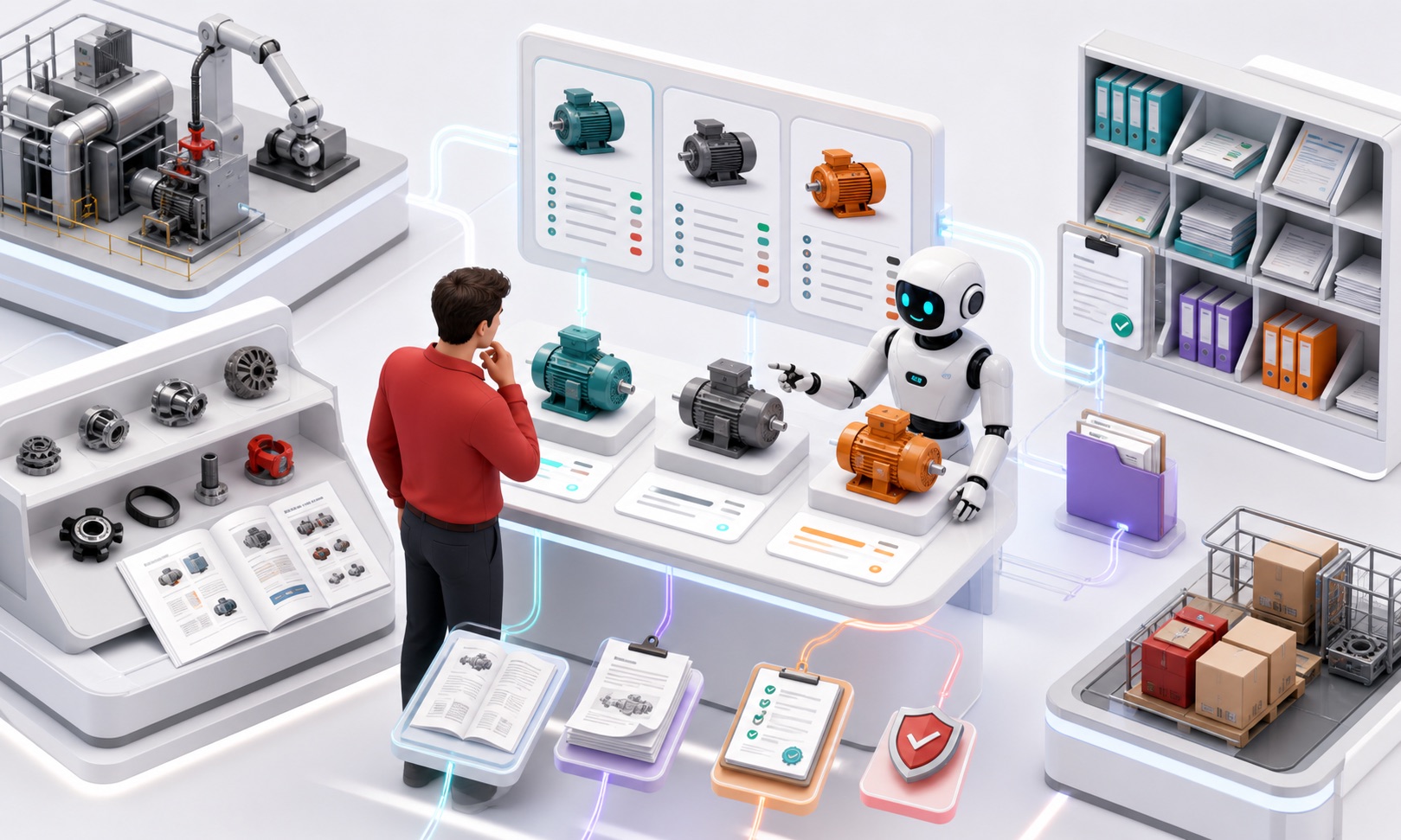
An AI product specialist helps buyers and employees understand an industrial product range through natural conversation. It can guide product discovery, compare models, explain approved specifications, locate documents, answer application questions, and retrieve company knowledge without forcing the user to search across hundreds of product pages, PDFs, catalogues, shared folders, manuals, and policy documents.
Industrial product knowledge is often deep but fragmented. A buyer may not know which model fits an application. A new salesperson may need to compare three similar products, a service coordinator may need the correct SOP, and a branch employee may need a policy that changed months ago. The problem is not always that information is missing; it is that finding, interpreting, and applying the right source takes too long.
Antbuildz provides an industrial intelligence layer designed for product catalogues, technical documentation, business rules, and company knowledge. One product-specialist role can be deployed publicly for approved buyer guidance or internally for deeper employee enablement. The two deployments should use different permissions, sources, and answer boundaries.
What does an AI product specialist do?
The agent interprets the user's question, asks for missing application details, retrieves relevant product or company information, and presents a clear explanation with the conditions and uncertainty that matter. It can help a buyer narrow a product range or help an employee learn products, locate a procedure, compare approved models, and prepare for a customer conversation.
It is not a replacement for document ownership or training governance. Its value is making established knowledge easier to access and exposing gaps when the business has contradictory, outdated, or undocumented information.
Product-specialist workflows it can support
The role can make approved information easier to use in customer-facing and employee-facing workflows.
Guided product discovery based on application, capacity, environment, compatibility, or performance needs.
Product comparison that explains meaningful differences instead of listing specifications without context.
Retrieval of product pages, catalogues, datasheets, manuals, certificates, and application guidance.
Employee onboarding across products, departments, policies, and routine processes.
Product training and comparisons for sales, service, branch, or distributor teams.
Sales enablement using approved positioning, specifications, application guidance, and objection-handling material.
Retrieval of SOPs, internal policies, warranty processes, and escalation rules.
Technical reference across manuals, datasheets, troubleshooting guides, tables, and diagrams.
Locating the right source document instead of relying on memory or an old file copy.
Identifying missing or conflicting information for a knowledge owner to review.
A realistic new-salesperson conversation
Employee: What is the difference between these three forklift models, and which applications is each normally suitable for?
Antbuildz AI agent: I can compare them using the approved catalogue and internal application guidance. What load range, lift height, environment, aisle width, and duty pattern are relevant to the customer you are supporting?
Employee: Indoor warehouse, loads up to 2.5 tonnes, 5.5-metre lift, narrow aisles, two shifts per day.
Antbuildz AI agent: Based on the approved records, I will compare the three models by capacity at the required height, mast options, turning and aisle requirements, battery configuration, and duty guidance. I will explain which applications each model is normally positioned for and link the source documents. Final selection still needs the complete load-centre and site information.
This process analyses the employee's intent, extracts the application context, searches approved internal and product knowledge, retrieves the relevant comparisons, and generates an explainable answer. It avoids presenting a memorised headline specification as a complete recommendation.
How Antbuildz organises industrial knowledge
The agent can work with product catalogues, technical specifications, manuals, engineering tables, charts, diagrams, compatibility records, training material, SOPs, company policies, approved sales guidance, and other internal documents supplied by the business.
For large portfolios, product relationships are as important as individual facts. Employees may need to know which accessory fits a model, which replacement supersedes an older item, which document revision applies, or how two configurations differ. A well-maintained knowledge layer can make those connections easier to retrieve.
Access controls, document ownership, review dates, and source quality remain important. Where the approved knowledge does not support an answer, the agent should identify the gap or route the question to the appropriate owner.
How the product specialist workflow works
The product specialist workflow turns a question into a source-grounded answer or a clear route to the responsible knowledge owner.
Ingest
Understand approved product information, internal policies, SOPs, training content, technical references, and company knowledge.
Reason
Interpret whether the user is a buyer or employee, the question, application context, permissions, and level of detail needed.
Retrieve
Find the relevant document, model data, process, policy, comparison, or source reference from the permitted knowledge base.
Act
Answer, compare, recommend a supported shortlist, explain, link the source, support onboarding, or escalate an unresolved question to the product or knowledge owner.
How to configure the product specialist role in Antbuildz
Decide first whether the role is public, internal, or deployed as separate agents for both audiences. Do not expose internal commercial guidance, SOPs, or restricted documents through a public product assistant.
Choose the audience and product scope
For a webstore product specialist, define the categories, buyer questions, recommendation boundaries, and enquiry handover. For an internal specialist, define the teams, permitted document groups, training goals, and processes it should explain.
Structure product knowledge
Use Inventory or structured product data for models, categories, specifications, variants, compatibility, accessories, availability signals, and product relationships. Use Knowledge Base for catalogues, manuals, application guides, certificates, FAQs, SOPs, policies, and training material.
Teach the specialist how to ask application questions
Create Scenarios that mirror how customers and employees describe needs. A buyer may say “I need a pump for wastewater,†while the useful selection fields are flow, head, solids size, fluid, temperature, materials, power, and installation. The agent should collect those fields before narrowing the catalogue.
Set permissions and answer depth
Public users should receive approved customer-facing facts and documents. Employees may receive deeper training, procedures, and commercial guidance based on their access. Configure handover when the question reaches engineering, policy approval, pricing, or information outside the permitted source set.
Use conversation gaps to improve product content
Review questions that produce weak answers, poor shortlists, or unnecessary escalation. They often reveal missing comparison fields, inconsistent product names, outdated documents, or application knowledge that exists only in an employee's memory.
What is technically possible in the product specialist role?
The role combines conversational search with structured product reasoning and source retrieval.
Natural-language catalogue search: translate an application description into product attributes and filters.
Requirement clarification: ask follow-up questions based on the category and information still missing.
Model comparison: retrieve comparable specifications and explain differences that affect the stated application.
Relationship lookup: find compatible accessories, approved alternatives, replacements, supersessions, and related documents.
Permission-aware knowledge retrieval: use separate public and internal source sets so answers match the user's access.
Document discovery and explanation: locate the current product page, manual, SOP, certificate, policy, or training source and summarise the relevant part.
Knowledge-gap detection: recognise when sources conflict or do not answer the question and route the gap to its owner.
This role can guide a selection, but it should not turn missing application data into a confident recommendation. Final engineering suitability, commercial approval, safety, compliance, and site-specific decisions stay with the qualified owner.
Product specialist scenario playbook
These cases show how product expertise can be delivered to both external buyers and internal teams.
Webstore buyer: narrow a large catalogue
A buyer needs an indoor access platform but does not know the product category. The specialist asks about working height, platform capacity, doorway and aisle limits, floor conditions, power preference, and duration. It filters the approved catalogue, explains why two models fit, links their product pages, and sends the selected requirement to sales for availability and quotation.
Distributor sales team: prepare for a customer meeting
A salesperson asks for the difference between three similar compressor models. The specialist retrieves the current specifications and internal application guidance, compares flow, pressure, power, duty, noise, dimensions, and option packages, then provides questions the salesperson should confirm with the customer. Restricted pricing or discount guidance remains available only to authorised users.
Manufacturer dealer network: retrieve the correct product evidence
A dealer needs the current certificate and installation document for a regional product variant. The specialist identifies model, market, revision, and application, then returns the approved files and highlights important conditions. If regional documents conflict, it stops and routes the issue to product management.
New employee: learn products through real tasks
A new branch employee asks which attachment works with a particular machine. The specialist requests the model and serial context, retrieves the compatibility record, explains the selection logic, and links the source. The conversation teaches the employee how to verify the answer instead of giving an isolated part number to memorise.
Where an AI product specialist fits
The role can operate on a public AI Webstore, product page, customer portal, internal portal, or another supported interface. Public experiences can guide product discovery and comparison, while internal experiences can support sales, customer service, technical support, service operations, product management, training, and branch teams.
It is especially useful for manufacturers and OEMs, dealers and distributors, industrial and MRO businesses, rental companies, building product suppliers, and parts and aftermarket teams with broad or technical product ranges.
The same approved technical sources can support the AI technical support role, while product and commercial guidance can help the AI sales specialist handle buyer enquiries more consistently.
Relationship with human knowledge owners
The agent can independently answer routine questions, locate documents, explain standard comparisons, guide a supported shortlist, and support learning. Humans remain responsible for creating and approving policies, resolving conflicting sources, updating product information, making exceptional decisions, and providing professional judgement where a document is not enough.
This approach preserves accountability while reducing the time skilled employees spend repeating established answers or hunting through folders.
Why industrial knowledge becomes difficult to manage
Industrial companies build knowledge over many years. Product facts sit in catalogues, technical teams keep application guidance, operations teams maintain SOPs, and experienced employees remember exceptions that may never have been documented clearly.
New employees need context, not just files
Giving a new salesperson access to a folder does not teach them how products differ or which questions to ask. A knowledge agent can explain approved information in the context of the employee's task and point back to the relevant source.
Product ranges change over time
Models are introduced, revised, replaced, or discontinued. Accessories and parts may have compatibility rules or supersessions. The knowledge layer needs owners, review dates, and a clear approach to outdated information.
Different teams need different answers
Sales may need an application comparison, service may need a troubleshooting procedure, and management may need the policy behind an approval. The underlying source can be shared while access and response detail remain appropriate to each role.
How to prepare an AI product specialist
Identify the questions employees repeatedly ask
Collect onboarding questions, product comparisons, policy requests, SOP searches, technical references, and common escalation points. Prioritise questions that currently depend on one experienced employee.
Assign owners to every knowledge area
Product, technical, operations, HR, finance, and commercial knowledge should have responsible owners. The agent can improve access, but people still need to approve and maintain the source information.
Separate approved knowledge from working notes
Remove duplicates, mark drafts, archive outdated files, and distinguish public product facts from restricted internal guidance. This reduces conflicting answers and supports appropriate access.
Test with employees from different roles
Ask new and experienced employees to test the same knowledge base. Their questions will reveal missing terminology, unclear documents, access issues, and explanations that require more context.
FAQ
- 1
What can an AI product specialist answer?
It can answer supported questions about products, specifications, applications, comparisons, SOPs, policies, training material, manuals, troubleshooting references, and company knowledge that the user is permitted to access.
- 1
Can customers use the AI product specialist?
Yes. A customer-facing version can guide product discovery, comparison, and document retrieval from approved public information. Internal knowledge, pricing rules, and restricted procedures should remain in a separately permissioned experience.
- 1
Does it replace an intranet or document system?
It can provide a conversational route into approved knowledge, but source documents, ownership, permissions, and update processes still matter. The agent makes knowledge easier to retrieve; it does not remove the need to manage it.
- 1
How does it help employee onboarding?
New employees can ask product and process questions in natural language, compare approved models, locate the relevant SOP, and learn which details require escalation instead of depending on repeated one-to-one explanations.
- 1
What should happen when two documents conflict?
The agent should not choose silently. It should identify the conflict, avoid presenting an uncertain rule as fact, and route the issue to the responsible knowledge owner for review.
Conclusion
An AI product specialist gives buyers and employees a faster route to the product information they need while keeping approved sources and human ownership at the centre. For businesses with complex catalogues and large document estates, it can turn scattered knowledge into practical product guidance at the point of need.
Make your industrial knowledge accessible
See how the Antbuildz industrial AI platform can work with approved product and company knowledge, or book a demo to discuss an AI product specialist use case.